
Symposium Introduction
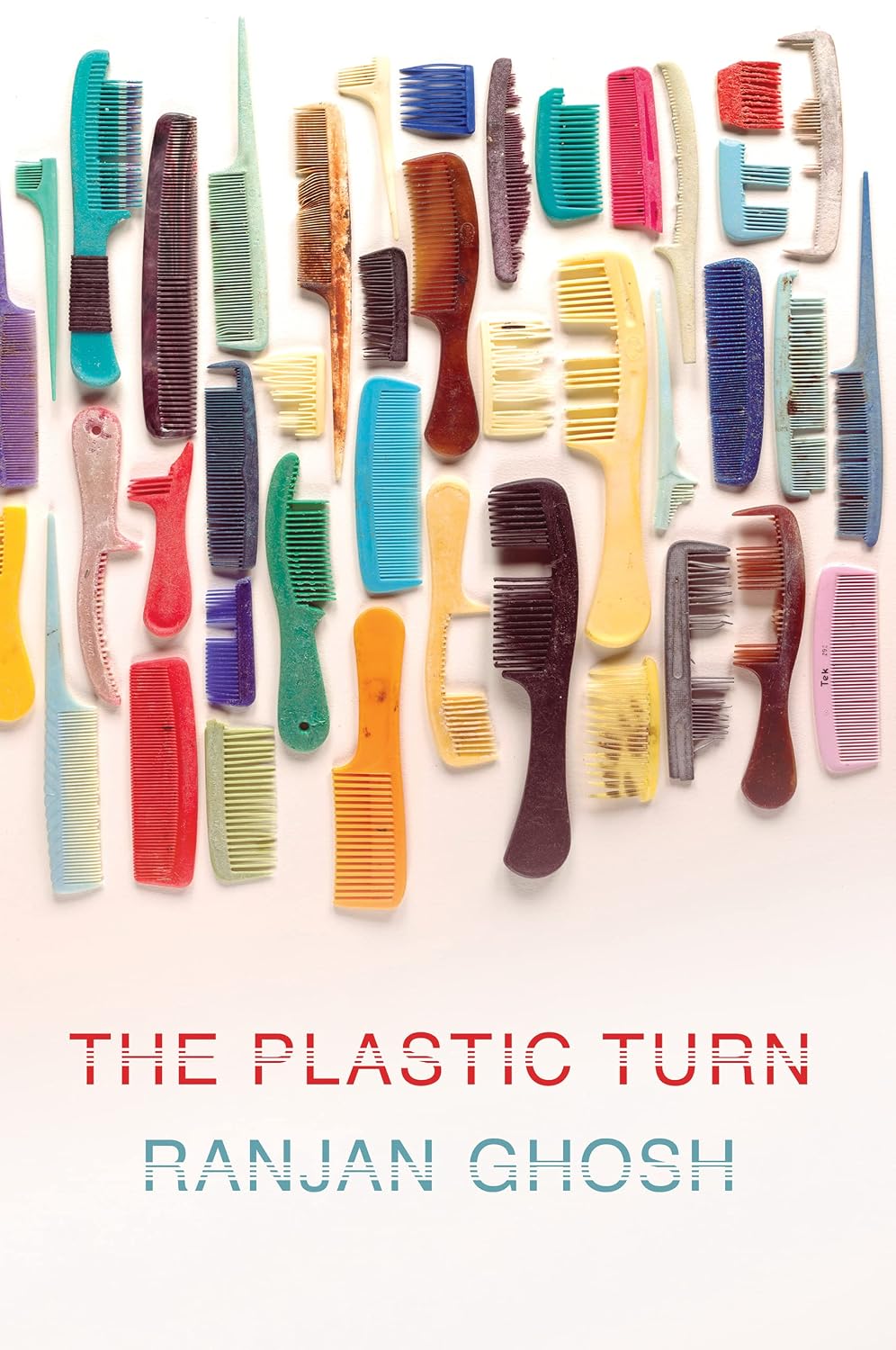
What does it mean to claim, as Ranjan Ghosh does, that “plastic nature exceeds our world-making” (170)? That “plastic speaks, has its own respiration” (193)? In Ghosh’s The Plastic Turn (2022, Cornell University Press), synthetic polymers are more than docile, malleable materials populating our households in the guise of a myriad of domestic items. Much more radically, they are the “subjective object” expressing the “life of the inhuman,” the “substance-ability of the material” (193). Thinking with plastics and through plastics, Ghosh presents us with a complex “plastiscape” (91): a multifaceted scenario of thought in which plastics act and are acted upon, often in unexpected ways.
Mirroring, or perhaps redoubling, the exuberant and excessive materiality of plastics, this book is itself exuberant and excessive, staging all sorts of strange encounters. Throughout its pages, literature meets polymerization processes (“how interesting is it to call Eliot’s The Waste Land a PVC?,” 69), artists hang out with plastic waste (it is “the convulsive interplay” between “the plasticity of plastic and the plasticity of an artistic mind,” 84–85), while “animal bodies and plastic materials” become entangled in marine ecosystems that launch our imagination toward an unimaginable future (118). All these encounters, and many more, are made by Ghosh into extremely productive couplings—into chemical assemblages, even, capable of bringing forth unlikely reactions.
Two are, in my view, the truly exceptional operations that The Plastic Turn performs. Firstly, the book turns to the popular concept of plasticity to inaugurate a brand-new way of conceiving it. Whereas the state of the art in “plasticity studies” tends to look at plasticity as a biological concept that invariably has to do with human subjectivity (so that it is the human subject—its living body and its ever-transforming brain in particular—that is regarded as properly “plastic”), Ghosh goes in a different direction, choosing plastics as a new, unsettling, nonhuman “plastic subject.” Not only is the plastic subject “displaced” and transfigured, it is also the methodology at work that diverges from more standard approaches in the humanities. “Plasticity, [. . .] for this book, is not a pre-materialistic phenomenon but a material-figural event that comes after the discovery of plastic” (7). The concept (plasticity) does not precede the object (be it plastics or neurons and synapses): in The Plastic Turn, conceptuality stems from sheer materiality. In tackling plasticity, then, Ghosh goes off the beaten path and dares to explore the concept from a different perspective and through a different methodology. The result is a fertile rethinking of one of the most meaningful notions in contemporary debates.
If it is true that the book makes plasticity turn to plastics, or even stem from them, it is also true—and this is the second remarkable operation—that plastics are tackled in a way that reveals their less familiar faces. Contributions in “plastic studies” are often informed by a critical perspective that emphasizes the toxic and problematic aspects of these materials: their adherence to petrocapitalist logics, for instance, or to waste colonialism, to exploitative and extractivist practices, and so on. Ghosh acknowledges the environmental and political issues that cannot be parted from plastics but focuses on something else: their very materiality. The materiality of plastics is observed and worked out on two different levels, which correspond to two different spaces. First, there is the space inside the laboratory, where plastics are synthesized and their molecular structure becomes the dimension that prompts material-aesthetic investigation. Second, there is the space outside the laboratory, where plastics manifest behaviors that unfold on the molar level. Both levels—molar and molecular—activate, for Ghosh, the functioning of plastics as a theory machine. “How can a thing [. . .] become an [. . .] axis for critical reflection and for thinking across disciplines and subjects not strictly related to the thing itself? [. . .] Mundane objects, under appropriate circumstances, can help generate complex theoretical structures” (1). Such is the role of plastics in this book: inside and outside the laboratory, they become the powerful material thing that sets theory in motion, shedding new light on disciplines and objects (such as literary texts) that would appear far removed from the materiality of synthetic polymers. This is an approach that differs from more common strands in “plastic studies,” as it does not indulge in (necessary, but by now rather ordinary) cultural analyses or ecocritical ventures.
What does it mean to convene a symposium around such a book? To offer an interpretative lens through which to read this forum, I would like to summon, again, the materiality of plastics and their chemical peculiarities. Plastics are synthetic polymers: artificial substances made of macromolecules resulting from the repetition and assemblage of simpler units, the monomers. And yet, the polymer is only the beginning, especially in the case of plastics like polyvinyl chloride (PVC): there is another figure that plays a relevant role in making these materials what they are. Additives (plasticizers, pigments, stabilizers, fillers, flame retardants) occupy a strange position—often treated as ancillary, they produce some of the characteristics that make plastics so special: flexibility, color, transparency, texture, durability, smell, and more. A plastic like PVC is not meant to be used on its own, in its “pure” state: it requires the intervention of additives to function and enact its aesthetic, political, and socio-cultural performances. In much the same way, I would like to suggest that The Plastic Turn, like a plastic, is transfigured and transformed when it encounters the perspectives represented by the panelists of this symposium, which act upon the book much as additives do. Nicola Zengiaro offers a perspective from ecosemiotics and works out the idea of an “opaque semiosis” that accounts for plastics’ ability to displace meaning. Meaning and meaning-making are also at the core of Gregorio Tenti’s response, but in the guise of “non-assertiveness.” From the perspective of literary theory, Tenti allows us to better grasp the stylistic gesture performed by Ghosh, claiming that theory may need poetry more than veridiction to fruitfully interact with an object like plastics. James Martell, through a series of ungrounding gestures, mobilizes some political aspects that make The Plastic Turn speak in the present tense. Anda Pleniceanu critically digs into The Plastic Turn to find negativity already at work, more or less tacitly, across Ghosh’s pages. Finally, Andrija Filipović makes plastics react with Deleuze and Guattari’s notion of intensity to obtain yet another concept of plasticity—a plasticity capable of describing the fact that, perhaps, “plastics do not add anything [. . .]; rather, they intensify.”
The Plastic Turn is a timely book in that it sheds light on a transformation or an event—a turn, precisely—that is already taking place and that calls for our attention. A turn that happens “on two counts” (9): the first ontological (the invention of plastics), the second epistemological (the emergence of “a new sensibility [. . .], a fresh perspective of reality,” 11). The book records these transformations but also amplifies and expands them in creative ways. The panelists of this symposium, in turn, interact with the book and react to it—their perspectives functioning as additives that plasticize The Plastic Turn, that stabilize or pigment it, bringing about new colors, new qualities of the text.

9.30.26
An Essay in Poetic Materialism
An Essay in Poetic Materialism
I’ve been immediately impressed by the elegance and intelligence of The Plastic Turn. Due to my background in philosophy, the introduction—where Ghosh discusses the problem of analogy with grace and wit in order to ground the book’s theoretical operation—was definitely for my palate. The peculiar worlding of plastic materials, he argues, spreads beyond what we always thought were the limits of their existence: in fact, the ontology of plastics is so pervasive and historically relevant that it dictates new ways of thinking and making symbolically mediated experience. The problem is immediately indicated in the possible relation between this autonomous ontological domain, plastics, and human experience, given that the former does not depend on the latter. The encounter between the two occurs as a reciprocal conditioning within one and the same process of expression, a conditioning that Ghosh describes as “analogical” and also “metaphorical.”
I was surprised by the choice to maintain both terms—although I can imagine that in the field of literary theory, metaphor is simply too important to be let go. As a reader of Deleuze (and perhaps also of Simondon), Ghosh is surely aware of the poststructuralist distinction between analogy and metaphor. He chooses to rely on another distinction, via authors such as James F. Ross and Esa Itkonen, one that defines analogy per se as a symmetrical relation (denominative or proportional) and metaphor as an asymmetric analogy (3). It makes sense: analogy produces a third term from what the previous terms have in common; metaphor is a particular kind of analogy based on a figural friction, from which derives a poetical increment. Analogy is employed in science and critical thinking, while metaphor is an aesthetic tool for co-thinking with the world. It may be relevant to recall that for Simondon and Deleuze analogy was not less, but more than metaphor (“These are not metaphors!” Deleuze used to repeat during his course at Vincennes. I refer to Deleuze on art, on which see, e.g., Bastidas-Bolaños 2025; in A Thousand Plateaus, Deleuze clarifies that metaphor and analogy are both to be discarded).
By grounding his ontoepistemology on metaphoricity, Ghosh is going in the opposite direction than Simondon and Deleuze, as he tries to rehabilitate language as a means of true ontological expression. This is an admirable and extremely relevant effort. It is consistent with some of the statements we find in the book, like the one regarding the need to go beyond “the mere simplistic post-Goethean understanding of plasticity as generative, transformative, and creative” (5). But this fundamental intent is many times at odds with the book’s philosophical syncretism. In chapter 4, for example, the references to Heidegger and Nancy are perfectly in line with the overall effort toward rehabilitating the ontoepistemological role of language, but they cannot harmonize with an endorsement of anti-correlationism (147)—which is then promptly corrected through a reference to Dufrenne opening up to the chapter on affectivity. Maybe I’m overlapping Ghosh’s beautiful spirals with pedantic dichotomies (phenomenology or anti-correlationism, analogy or metaphor . . .). Maybe this is plastics’ omnipotence of transit, or even better, its metaphorical nature. My philosophical background compels me to wonder whether this power is merely a metaphorical one, and whether it finds its ultimate reason in the writer’s subjectivity and in the effects on the reader. And yet, as I’ll explain in a moment, I profoundly sympathize with this posture.
Other odd encounters take place along the flow of Ghosh’s writing: in chapter 4 again, the tension between locality and planetarity is never resolved, only metaphorically conjoined. The author clearly refers to an ongoing debate that is among the most relevant for our times; a debate that is still torn between the non-scalability of existence and forms of life and their scalability in a planetary sense. Ghosh seems to lean toward the idea of a planetary totality intended (through plastics) as an “unimaginable heterogeneity” (136), a planetary “plastic net” (143), not far from positions such as that of Dipesh Chakrabarty and along the lines of Nancy’s speculations on “mundialization.” But this raises more questions than it answers. If not developed, such perspective falls back on an updated Heideggerianism, basing on a relation of expression between World—that today are many worlds or worldings—and Earth—that today presents itself as a postnatural planet endowed with toxic agency. Such expressive process is described through a notion of affectivity much indebted to Deleuze (plastics’ incommensurability is interpreted in the framework of an intensive and virtual ontology, which founds the possibility of experiencing it “through quanta of unrealized reality,” 186). Only that for Deleuze, affection is a descent backwards along the stream of expression, which implies a whole ethics and aesthetics of deterritorialization that is not present here—or maybe only in passing in the beautiful pages devoted to the figure of the mariner.
I believe that the book succeeds magnificently in its intent of showing us a way to make a plastic symbolic experience. It does so not through philosophical inventiveness, but through a performative effort of poetic materialism, that is, an effort of conceptualizing a poetic materialism while enacting it. I didn’t read The Plastic Turn as a poetry book, of course, but neither as a theoretical book in a traditional sense. I think that subtly, Ghosh performatively displays a feature of plasticity that is not thematized as such, but is everywhere present: non-assertiveness. Let me dare to continue the author’s gesture here, looking forward to reading what he thinks.
Non-assertiveness is a category that has been introduced in the Italian literary debate during the 2010s to rephrase and repurpose the traditional divide between “lyrical” and “experimental” poetry. Non-assertive are all those texts that undermine the function of communication. In poetry, this entails an act of pragmatic distancing of the author from the text which has nothing to do with difficulty or obscurity, but with the hijacking of the pathos related to the lyrical I (Picconi 2020). To produce non-assertive theoretical texts, instead, could mean to abandon veridiction and embrace the concretization of thought. If traditional theoretical writing is declarative and aims at the exercise of truth as its only real content, non-assertive theoretical writing decouples the text’s enunciatory function and the empirical author’s voice to affirm many different truths that can overlap (redundancy), entertain non-logic relations (non sequitur), contrast each other (contradiction), and so on. This does not descend from a schizoid subjectivity behind the text, but from the encounter between the texts and a concrete (and as such manifold) object. The text becomes an opaque machine à penser. What is said in the text does not depend orphically on what is not said, on the contrary: everything is said, all is present, and yet nothing is necessary and much more could be said in its place. What the text enunciates is neither true nor untrue, but exceeds this alternative, like reality itself (here would be the analogical operation). Like reality, the text is absolutely dogmatic by virtue of its own presence, which is always both complete and insufficient. Yet it is not a text that relies on form to perform this operation.
The principle of non-assertiveness is, at least to a certain extent, already at work in every theoretical text insofar as it is an object and not a disembodied message of truth. But in itself, it is a question of posture, one that is very rare in philosophy. Incidentally, non-assertiveness has nothing to do with postmodernist irony; if anything, it pertains to categories and problems that run across all modernity. Ghosh’s book does not give us any indication of such a posture (there is no visible metatextual act in this sense, like a final sentence that says “all this could have been said otherwise, and it can also be not true”). But I got the impression that, much like a poet, Ghosh does not derive the justification of his book from a rational argumentation with a clear and coherent structure, but from the concrete encounter with its subject (plastics), of which the book results as a testimony. Plastics themselves, I would say, are inherently non-assertive: their culturally established use is to pack up and contain goods, to be invisible and ontologically thin; but this meta-objectual is a layer of opacity that diffracts and distorts rather than conveying a content transparently. Its presence on the planet is equivocal in all senses; its meaning is undigestible because it carries no message and edifies no subjectivity. Plastics confront us with our own materiality, as Ghosh rightly notices. As such, we need poetry, not veridiction, to absorb its meaning—also when we are doing theory.
References
Bastidas-Bolaños, David. 2025. “Crystalline, Organic, Energetic: Analogy, Modulation, and Art History in Deleuze’s Lectures on Painting (1981).” Dialogue: 1–25.
Picconi, Gian Luca. 2020. La cornice e il testo: Pragmatica della non-assertività. Tic Edizioni.
9.30.26
A Response to Gregorio Tenti
A Response to Gregorio Tenti
Throwing plastic turn, plasticity and plastic with poetry, poet, poetic and performance into a contemplative play, Gregorio Tenti builds an engaging discourse around veridiction as against contradiction, logicality as against excess, apodictic reality relayed with multiplicity of truth. The convergence here is on the “non-assertiveness” which, for me, builds plasticity through the quotient of remainder: and the plastic turn invests in the principle and philosophy of non-assertiveness to construct a poetics of failing. Tenti notes strikingly that plastics are “inherently non-assertive”; they are “ontologically thin”; thus, Tenti observes, they are “meta-objectual” and invisible and the consequent layer of opacity generates more diffraction and distortion than transparency. The philosophy of plastic is a philosophy of failure: a failure that philosophy as a discipline and a mode of thinking has always encountered from Socrates to Kant to Deleuze. There has always been a story of philosophic thought as fragile, the act of thinking as getting undone, and epistemology answering questions that it thought had already been conclusively answered. The history of plastic, from its production to microplastic ingestion through food, is about historical moments that are not immovable dots of truths always; rather, as fragile moments, they speak for non-assertiveness. Plastic is prose in its historical truth-generation; plastic is poetry in its material-philosophical-aesthetic fragility and failing.
Non-assertiveness encourages the “fragile principle” and variation of intensity in expressions about plastic, about plasticity in expressions; this brings us before the event of remainder. And remainder becomes the constituent in the ontogenesis of the actual; it provokes the singularity, the transversality, and possible forms of entanglement. If Deleuze sees intensity as becoming the vehicle of difference, I see remainder as a form of intensity that contributes to the non-assertiveness of the material and the text in question. It is remainder as difference that expresses the world in fragile and revisionary configurations. Sensations and ideas formed out of these configurations are never complete solutions to the differential field of existence and representation. Incompletion in understanding and expression are results of indeterminate intensities.
It is here that Derrida’s argument on desistance—as contrasted with resistance, and heavily inflected by insistence, consistence and existence—speaks of a way of being, activism and movement. Sergio Villalobos-Ruminott sees this as an allusion to a “secondary or non-principal movement, a declination or abdication” (2021, 233). He writes that “in a more general sense, desistance is somehow a powerless form of resistance, a form of renunciation, and even an act of abdication, yet one without positive or affirmative associations, finality, or telos, in addition to being a potentiality without realization, a forceless disagreement with the economy of force, a powerless will to power” (233). “Désister” for Derrida does not announce anything negative but has the non-resisting power to dislodge meaning, building a truth that withdraws, “masks itself,” promotes rupture, an absence that never ceases (Derrida 2008, 196). The non-assertive plasticity is the unthought as desistance; it is an “irreducible dispersion” that hides an irresponsibility of the object or the text leading to “desertion.” This desertion is the repossession of the text—a desertion that deconstitutionalizes the edifice of meaning-expression into further forms and styles of thought. I see in desistance impotentiality, a slow and fragile movement that has both intention and nonintentionality, exhaustion and possibility, a withering away that again does not make a movement bereft of all force and energy; it is a continuity in interruption. Plastic is incomplete; it is non-assertive for being fragile. Non-assertiveness is a kind of desistance.
Plasticity loves to hide. Mereologically speaking, plasticity seems to leave a “part” behind always: a portion that does not find its salience immediately but builds its own pertinence with time and changing contexts. Plasticity is at once assertive and non-assertive. And the non-assertive is the remainder in intensity and the intensity that by not revealing itself immediately builds its own conative force-field. Non-assertiveness is a new idiom of relationality; it is the force that can result in reflexivity, transitivity and asymmetry. A thought allowed to manifest cannot just be symptomatic of plasticity; thoughts live in underlap and overlap and these create the power of the remainder and generate what I call “failing as plasticity.” The non-assertive then is the supplement. It is also a state of decomposition where the remainder is playfully active. This remainder as the non-assertive is often indeterminate and ambiguous. The question arises as to what stays as remainder to energize the non-assertive quotient of expression; is the remainder a part of a concrete reality that got half expressed? Or is it something that is both a constituent part of the processes of expression and revealment and also something that forms on its own, an event that the whole assertive game wasn’t prepared for? The whole idea of part-whole is not fulfilling here: the constitutive and the ontogenetic, the form and the forming, the part as remainder and the supplementary formation, self-actuating, indecisively generated can also be a part of this non-assertive phenomenon. Can there be both an assertive and non-assertive plasticity? And, this consequently, makes the intensity of the remainder function both as the differentiation and ontogenesis.
Is this non-assertiveness as plasticity also a way to announce a halt in how we see plasticity as relentless lubricity and caducity of an object or a thought or an event? How often does the ego of an object need a check to reduce its transformation to a halt that does not allow either a one-time manifestation or an unabated malleability? Non-assertiveness for me is the check that mediates between expression and surplus, between what we say and what awaits saying. It is a kind of hidden principle—invisible and indivisible—that negotiates between the assertive and the non-assertive. The check is the remainder. For Giorgio Agamben this check is the caesura: non-assertiveness is the interruption “in moments that language fails to say when the thought is paused” (2005, 64). This creates the remainder: is the remainder. The caesura, for me, provides the temporal dislocation between the past and present resulting in a territory of “indiscernibility”. And, rightfully, the non-assertive as check, caesura, desistance, remainder, is what expands the ego of the text as much as the performativity of plasticity. By its limit or check, non-assertiveness sets off a drive in the text as more engagements with the text ensues greater overcoming of the resistance to understand. This makes me assert that plasticity cannot be without remainders where contradiction in the system puts a concept always against the other, and what one says and understands with judgment has its opposing pair that calls for a non-assertive quotient. This is the unignorable fate of all critical thinking. The assertiveness of totality is bound to a non-assertive reality, perhaps, qualified as transcendent or an indeterminable and ineliminable remainder or an eros. Plasticity in such patterns and moments of complexity and subtlety, as Tenti and I would agree, is not prose always; it is both poetry and theory at the same time.
References
Agamben, Giorgio. 2005. The Time That Remains: A Commentary on the Letter to the Romans. Translated by Patricia Daly. Stanford University Press.
Derrida, Jacques. 2008. “Désistance.” In Psyche: Inventions of the Other, vol. 2, edited by Peggy Kamuf and Elizabeth Rottenberg. Stanford University Press.
Villalobos-Ruminott, Sergio. 2021. “Desistance: Literature and the Logic of Life.” Discourse 43 (2): 216–38. https://doi.org/10.13110/discourse.43.2.0216.
10.2.26
Plastic Turns or How “Mourning Is Our Present Continuous”
Plastic Turns or How “Mourning Is Our Present Continuous”
The earth surprises, it “ungrounds”; it is never the “solid ground” we thought it has been or was.
—R. Ghosh, The Plastic Turn, 161
This line appears in The Plastic Turn in chapter 5, “Plastic Affect,” in the context of plastiglomerates, those “things” made “naturally” through the residue of man-made plastic and rocks or other debris. The quote encapsulates the stakes, however, not only of The Plastic Turn as a book, but of the complete philosophical, artistic, and experiential turn to plasticity in the last decades. Further, through its references to the earth, the ground and ungrounding, it connects with a vast and complex tradition that, at least in Western philosophy, we can trace from Plato’s khōra, through Schelling’s ground/reason (Grund) as the space of both ultimate origination (Urgrund) and radical undoing (Ungrund), up to Heidegger’s own notion of ground/reason and his Erde (Earth) / Welt (World) distinction. Through its present tense, however, it signals an urgency, one that paradoxically is particularly old, at least as old as modernity. In this connection, the turn designates precisely the crisis identified not only with aesthetic representation, but also with political and cultural logics of representation as they appeared at and as the birth of modernity: regicides and the emergence of democracy, death or abandonment of/by the gods, the explosion of empirical sciences and of industry as the man-made nature that will end up creating the plastic world that surrounds and penetrates us, etc.
In the previous chapter, “Plastic Literature,” Ghosh describes a general theory of cultural (and literary) formation that explains the aforementioned “ungrounding of the earth” in both senses of the genitive. That is to say, this undergrounding is both 1) the ungrounding/unreasoning/unfounding (ungründen) done to the earth (by something that is not it), and 2) the earth’s own act (as the Nature that is free in itself, as Schelling depicts it in his Freiheitsschrift through the Urgrund/Ungrund distinction) of shattering, quaking, and overturning its and (since nothing is firm unless the earth is so also) every foundation. The way Ghosh describes these cultural and literal formations, we sense that in them such ungrounding events go beyond the spatio-temporal since they are five-dimensional series of events straddling both real and unreal time, traversing all of history, geography, topology, and topography. Such ungrounding as trans-plastic events perform their traversals through not only what Hegel called “negation,” but also through the painful figures of history and daily existence; in other words, through aberration, abandonment, (the) uncanny, shock, surprise, return and—if we are lucky, for a little while—: rescue. Here is Ghosh’s ekphrasis of these movements.
The fundamentals of any cultural and literary formation, paradigmatic or conceptual, are maximally vibrated through maximal entanglements. This makes plastic literature entropic within a trans-plasticity that is fundamentally five-dimensional—events that exist as particles in unreal time, as waves across history through real time, the spatiality and temporal relativity of their existence, the hidden variables that inflect and influence them, and the transformative power, the implicate and conative potential, that make certain things happen outside our spatio-temporal understanding. The plastic web of the “literary” is complicit in these actualizations. Being tensional in a post-Romantic way, plastic becomes a statement, a negation, aberration, abandonment, uncanny, shock, surprise, rescue, and return. And doing plastic literature is no different from that as it ensues its existence within such a transvaluational performative as a project in motion, incompletion, and failing. (150; my italics)
I want to linger for a moment on the avatars that Ghosh gives here to these plastic, ungrounding becomings: “a statement, a negation, aberration, abandonment, uncanny, shock, surprise, rescue, and return” (150). If we, in 2025 [when this essay was written, editor’s note], are still in the plastic epoch, or in the time under the plastic paradigm (and even Catherine Malabou has opened the possibility that this time might be soon over, or at least that this epoch is morphing into something different),1 it is too easy to link these descriptors to contemporary affects that we experience when looking at the daily news and at the current development of necroliberalism and the recrudescence of neofascism in the world. In other words, if these days there is indeed a “transvaluational performative [. . .] project in motion” (150), it does not seem to be one of ecstatic and/or artistic creation and liberation, but rather one of violence and annihilation through the ungrounding of institutions, moral codes (written and unwritten), historical understandings, etc., namely, a project called by Naomi Klein and Astra Taylor “end times fascism” (Klein and Taylor 2025).
There is, nevertheless, in our plastic epoch a countermovement or response given through the call from some scholars and activists to take the notion of “transvaluation” literally and up to the limits of bodily materiality and perhaps even of ontology. This transvaluation is thus also five-dimensional and, what is more, it will never stop, since it is the unfinished movement called “trans,” and not even a concrete and finite “transversality.” In this fluid movement, there is no versatility, no versus, in other words, no “turn,” nothing but the trans(ition), the passage, migration, mutation, without destination. Here is this call as the philosopher Paul B. Preciado expressed it in February 2025, two weeks after Trump’s second inauguration to the presidency of the United States:
Let us reject their taxonomies, their hierarchies, their laws, their machines, their names. We are nothing of that, let us be trans. It is urgent and possible to go beyond the logic of political identities and to build a revolutionary transversal reuniting a multitude of subaltern bodies against necroliberalism’s capture, to organize a planetary resistance, to forge a net of antagonisms. The Zapatistas showed us the way: no face, no Facebook, no Instagram, no X, no smartphone, no State, no identity. Let us take the forms that our relations of care and cooperation determine. We are nothing. Let us be trans. We have nothing else but the body and the body does not even belong to us. Let us migrate. Let us mutate. Let us transition. We are nothing. Let us be trans. (Preciado 2025, my translation)
To collate the radicality of Preciado’s call and its trans-gendered and trans-genre promise with The Plastic Turn, let us go back a few pages. Back in chapter 5, “Plastic Affect,” commenting on the effects of microplastics in our biological constitution, and linking them to “the interests of transgenderism and bisexualism” (179), Ghosh speaks of what he calls “slow sexuality, a teleology that has its own modes and temporality of progression—plasticized sexuality” (179). He sees at this non-human/human confluence the possibility of a “queer future,” and he explains: “not the end of a future but a queering of a future disembeds how we think and practice reproductivity, build and sustain progeny, the politics of generation-building, species orientation and extinction” (180). All these descriptions come in a subsection titled “Plastipsychosis.” Close to the end of it, reflecting on our shock and surprise at the aberration—he calls it the “biophobia” (183)—of discovering all the “plastic deaths of other species” (183), Ghosh declares: “The mourning is our present continuous. And this mourning without finitude is a complex system and a changing pattern of nonlinear relationships wherein plastic cuts into Earth and Earth cuts into its inhabitants” (183). We can connect such a mourning with Preciado’s assertion within the call, “We are nothing,” and with its subsequent command: “Let us be trans.” Now, while greed and indifference are implied in Ghosh’s consideration of the proliferation and ubiquity of plastics in the environment and inside our own bodies—the negligence of science, of poor, sick, and dying bodies through pollution and starvation—what distinguishes the plastic turn from Preciado’s trans-plasticity is the latter’s explicit agonistic form vis-à-vis end times fascism’s own negative plasticity or ungrounding. While these two opposing ungrounding movements facing each other, “end times fascism” and trans-becoming, embody both a plastic promise of radical transformation in their pendant yet opposite aims to destroy certain forms and to create others (trans vs. trad bodies, emancipatory becoming vs. imprisonment, nets of care vs. nets of profit), the former one implies a significant historical form and drive lacking in the latter: pleasure in cruelty. Is it not precisely this historical yet recurrent form that we painfully experience these days full of—following the plastic turn’s events—aberration, abandonment, (the) uncanny, shock, surprise, return and, we hope, we really hope: some rescue?
To end, let me suggestively juxtapose and examine two citations, to see where, if at all, this pleasure in cruelty might lie in plasticity. One comes from early on in The Plastic Turn, when Ghosh is describing the plastic imagination as it appeared in eighteenth-century aesthetics, vis-à-vis the plastic turn as the paradigm of our epoch. It is thus a quote about plastic images and the possibility of a move, a turn away from the image. Here it is:
The plastic imagination, as propounded in eighteenth-century aesthetics, is a constructive force with a proto-romantic strength of image-making. With the turn, the plastic imagination is formed in the trans-dialectic—the anxiety, the con, and the contrary—which points to a complexity that is creative. This is not because it produces a new being or form; it is because of a creativity that countertextualizes in the helplessness of submission and the fragility of a surrender, the urge to avoid and the compulsion to engage—the love-problematic enmeshed in seduction and revulsion. The negative dialectics works best through such plastic thinking. Is plastic hard or malleable? Is critical thinking hard or soft? (20)
The other quote comes at the end of Georges Didi-Huberman’s Invention of Hysteria. It describes the time just after Jean-Martin Charcot died (1893), who had, at la Salpêtrière, (re)created the “hysteric” as a series of images in front of—agonistically—the knowledge forming them while trying to penetrate their secret. However, at the death of the “master” of them, Charcot, Didi-Huberman explains, nothing ended, the confrontation between the keeper and creator of knowledge and the resistance of the hysteric image was just starting, ready for the twentieth—and perhaps too for the twenty-first—century. Here is the quote:
Faced with this never-ending distress, there is nothing but an exasperation of knowledge. This exasperation, too, will never end. It will not know anymore what mask to wear. This is the undecided exacerbation of the forms of its power and its efficacy.
This indecision will indeed become, at some propitious moment, a hatred of the image. An effect of deceptions and paradoxes of evidence. It will be the hatred of all that holds, resists, and returns as from the real in hysterical images, poses, attitudes, and deliria. “Curing” [curer] hysteria will amount to offering its thousand imaginary productions, its “specters,” as quarry [curée]. First, feeding on them. Then reproducing and mastering the reproduction. Finally, to conjure and to exorcise, forever. (Didi-Huberman 2003, 278–79; 1982, 271; trans. modified)
As I have stressed in different places before, I do not think one can ever separate plasticity from the plastic or visual arts. In other words, one can never separate plasticity, as a thought, or an event, from images and their visual and haptic history. If these two quotes resonate and complicate each other, it is not only because they belong to the same development of plastic and image-thinking (as it expands from Western to world philosophies), but also because they speak of the same “love-problematic enmeshed in seduction and revulsion” (20). They explain as well how the images of hardness and softness are forever entangled in any type of thought and experience, notwithstanding if conceived as plastic or dialectic. This inextricability between plasticity and images is the same one between plastic, images, our bodies and the bodies of others. I believe that at the end of The Plastic Turn, Ghosh sees this inextricability precisely in the aporia of where is the plastic in relation to this turn:
We are thrown into the plastic turn as a continuity and as an epiphanic instant, “listening” to the life of the inhuman, the subjective object, and the substance-ability of the material. Plastic speaks, has its own respiration, and is our modern-day reverie. The Plastic Turn, intriguingly, is with, without, and outside plastic. (193)
Such life listening is always epiphanic in the etymological sense. It is an appearance (phaínō) upon (epí) some surface, that is to say, upon some body that—seductive, repulsive, or both—is always a quarry to some other body.
References
Didi-Huberman, Georges. 1982. Invention de l’hystérie. Macula.
Didi-Huberman, Georges. 2003. Invention of Hysteria. Translated by Alisa Hartz. MIT Press.
Klein, Naomi, and Astra Taylor. 2025. “The Rise of End Times Fascism.” Guardian, April 13, 2025.
Malabou, Catherine, and Tyler Williams. 2022. “The Example of Plasticity.” In Plasticity: The Promise of Explosion, by Catherine Malabou, edited by Tyler M. Williams. Edinburgh University Press.
Preciado, Paul B. 2025. “Make America Trans Again.” Libération, February 3, 2025.
- In a recent interview, commenting on plasticity’s difference with the Derridean trace or writing as “paradoxically permanent, always acting in the same way,” Malabou told Tyler Williams: “Plasticity, by contrast, is absolutely finite. I know that, very soon, plasticity will no longer be adequate. It functions at a certain moment of our culture; it is obvious that, for example, there are so many references in cellular biology to plasticity (of the genome, of vaccines, etc.). But at some point, another model, another paradigm, will replace it. For me, plasticity always promises more than itself but it is also constantly diminishing, if I may say so. It is witnessing its own obsolescence” (Malabou and Williams 2022, 312). ↩
10.2.26
A Response to James Martell
A Response to James Martell
James Martell’s response to the turn to plastic through the dual paradigms of trans and ungrounding leaves me with the inspiration to share my thoughts on what I call plastic figurality (see Ghosh 2026) and how such a concept has the principle of “transfiguration” as one of its major constituents. The trans-plastic events owe their manifestation and performance to plastic figurality, a force, construction and happening, that put thoughts, subjects and issues under figuration: transfiguralization, to be precise. Transfiguration addresses the “hardness and softness” that Martell sees as staying entangled in any type of thought and experience. Transfigurality questions the hegemony of inscription and writing, and challenges those forms of figural thinking that inveterately affiliate with and model cultural and material reflections and paradigms. Transfigures are evental mutations that manifest a possibility beyond the stability of everyday comprehension (what we might call the DNA of events)—a figure exists in “possibilizing” a figure, a figure “within” a figure, a figure “othering” a figure. The non-DNA dimensions of these transfigures create separate lines and force of mutation allowing for ruptures in situations of understanding. The ungrounding is/constructs the excess in the axiomatic, the given, and the regnant. Certain figural ungrounding come into form in a kind of emergence outside a conscious subjective agency; some actualize through what already exists (figured), the “constituted” (the figure), and some, in the words of Catherine Malabou (2016, 34), as the “germ of an organism that must develop in order to come into existence” (figuring); some lines are formed through self-differentiation, what Malabou, following Kant, calls the epigenetic forming, where “form earns its substantial appearance through the intra-actions and intrications of history, experience, time” (Wormald 2020, 109). Transfigures are figures (say, having the property F) and also figures in process, excess, and unconcealment (having the property beyond F, > F, < F). Aligned with the principle of complementarity, transfigures are both F and not-F, and more and less than F and, hence, sub-F. Ibuanyidanda philosophy sees complementarity in figurations. In such formations we see productive dialecticism, the energy of inequality, and positive contradiction. Innocent Asouzu writes that “complementarity does not entail the idea of self-negation, and compatibility of contradictory opposites” (2007a, 303). So entities “confirm their existence only by entering into a relation” (2007b, 303). Going beyond Asouzu’s idea of complementarity, I would like to qualify this as a plastic relation that does not declare intractability and intransigence among competing paradigms; not doxastic, it is a relation about negotiating disparities, being in a plastic relation among different states and conditions of existence, just like a small bird perched on the back of a grazing ox, bouts of smoke billowing against a resplendent evening sky, scraps of colorful plastic hurrying off in an exquisite waterfall, and scientist Avi Loeb claiming that he collected remains of “extraterrestrial technology” from the bottom of the Pacific Ocean. In a nonabsolutist roundtable of complementarities and differences, plastic figures as transfigures, thus, are mostly about finding the missing and apparently imperceptible relation—the rhythm of to be and not to be as simultaneous reality.
It is plastic figurality that can address the issue of ungrounding of institution and values, as Martell observes, and historical and political understandings. Here I see the performative of the ungrounding with the philosophy of saturation. Our understanding of concepts and situations—be they religion, faith, violence, community, revolt, secularism, environment, waste, institutional hegemony or the nonhuman other in animals and plants—can come with their levels and degrees of saturation. However, figurality as a force of transgression and ungrounding, inspires us to see an excess within the situation; this is saturation as off limits, and an exception to regnant modes of being and discourses. A political or social event, be that an incident of communal conflagration or ethnic rebellion, is a moment of saturation. The French anthropologist Sylvain Lazarus sees saturation as a mode that makes politics question itself within its closures. It is thus a matter of “questioning the work from the point of the expiry of the category and of re-identifying it in this new conjuncture” (1996, 37). Lazarus observes that the method of saturation allows us to constitute the intellectuality of a closed form of politics on the basis of its foundational categories, that is to say, by studying what the thought of the sequence was and by taking its singular historicity into account. It is in this sense that “historical” is to be understood in the expression “historical mode of politics” (2016, 127). An act of racial genocide, for instance, can be the event’s closure within the political sequences of its historicity or mytho-historical unfoldment but not in its thought, which is untotalizable. The immediate closure of such an incident as a cultural-political figure does not allow the mode of thought that led to the event to end; it becomes a fidelity to a thought. But the figurality of saturation sets off the investigation into the thought that closed off the mode and stopped the process of thinking. This is “fidelity to fidelity” (in the words of Alain Badiou): questioning a certain fidelity with a strong fidelity to a mode of questioning, a certain mode of politics and history. Sociopolitical events cannot be understood in a thought that blocks saturation. Lazarus observes that “the method of saturation distinguishes between what is thought in a thinking in the moment where it has taken place and, on the other hand, between what has been thought in thought when the mode is closed” (1996, 42). In an exhaustion of its present, it unblocks a mode of thought with a different fidelity to its happening and the “taking place.” Habits bring with them fatigue. However, fatigue can be a saturation to destabilize a mode of thinking. In that sense, fatigue can recognize the discontinuities of history; it can be repetition with a difference. Fatigue is fidelity; a people’s movement or ethnic displacement or violent migration becomes a fatigue as habit and stay possessed with an unduplicable and unsurpassable ego; but plastic figurality questions the fidelity to a fidelity in fatigue. Habit here becomes a question unto itself. To rephrase further, we can say that fidelity to a political movement that results in a rebellion explores the causes and ramifications of its emergence, but a fidelity to a fidelity (this is where plastic figurality comes into play) questions the reasons of it happening, the mode of thought and history, in a way where thoughts do not end with the understanding of the rebellion but continue to refigure and reinvest its life in the history and politics of the times and beyond. Plastic figurality generates transplastic habits that make a thought return to itself; saturation, I argue, is mostly about returning to an idea through what lies hidden from obvious and direct view. It forces a mode of thought to generate fidelity to itself within a situation and a context where extinguishment of thought or a concept or an event is not about losing it.
And plastic figurality, challenging the sovereignty of expression and meaning, lubricates meaning beyond what Jean-Luc Nancy calls “forbidden representation” (2005, 27–50). Such representation denies the existence of figurality, as all possibilities of plasticity are scrubbed off in the face of a commitment to exhibit a singular truth of understanding. Nancy calls “surreprésentation” a “kind of representation whose object, intention, or ideal is fully completed within what is manifestly present [. . .] total, saturated presence” (39). Plastic figurality builds individuality as an interrogative force (which can be read as saturation) makes the figures “listen” (écouter, in the sense of understanding) to other forms of expression and representations. This listening builds the excess outside forbidden representations and helps us see saturation as excess. The listening then creates new forms of representation. Saturation is representation in the sense of a presencing that brings “confusions, paradoxes and contradictions” (39). (This is how one returns to a thought to change the habit of thinking.) The power of trans and the event of ungrounding build a separate space of listening that defers and displaces the pre-figurative sense (the accepted and normed), its superrepresentation (forbidden), to initiate an access to absence. Plastic figurality considers this absence as a way to understand saturation both as an invitation or seduction and as a limit that provokes interrogation and the imagination.
References
Asouzu, Innocent. 2007a. Ibuanyidanda: New Complementary Ontology; Beyond World Immanentism, Ethnocentric Reduction and Impositions. Transaction Publishers.
Asouzu, Innocent. 2007b. Ibuarụ: The Heavy Burden of Philosophy: Beyond African Philosophy. LIT Verlag Münster.
Ghosh, Ranjan. 2026. Plastic Figures. Cornell University Press.
Lazarus, Sylvain. 1996. Anthropology of the Name. Translated by Gila Walker. Columbia University Press.
Lazarus, Sylvain. 2016. “Can Politics Be Thought in Interiority.” Translated by Tyler Harper. Cosmos and History: The Journal of Natural and Social Philosophy 12 (1): 107–30.
Malabou, Catherine. 2016. Before Tomorrow: Epigenesis and Rationality. Translated by Carolyn Shread. Polity Press.
Nancy, Jean-Luc. 2005. The Ground of the Image. Translated by Sarah Clift. Fordham University Press.
Wormald, Thomas. 2020. “On Plasticity’s Own Conceptual Epigenesis: Malabou on the Origin and History of Plasticity.” Cosmos and History: The Journal of Natural and Social Philosophy 16 (1): 102–24.
10.5.26
Negative Remainders of the Plastic Turn
Negative Remainders of the Plastic Turn
1. Honey, Your Plastic Has a Heart
Ranjan Ghosh’s The Plastic Turn invites plastic inside, into organs and tissues, habits of thought, oceans, and conceptual organs of criticism. He effectively allows plastic to develop a critical heart, which turns the critical wheel. Discourse is molded by means of an interpretive engine using a material, analogical, and para-structural method. Plastic’s figural and chemical conditions allow for a renewed reading of twentieth-century arts and letters. The book operates through circularity, just like plastic does in the world: it surrounds, entraps, and contaminates while refusing to give in to a stable, closed system. Once the reader enters the book’s conceptual entanglement, thinking outside of it becomes a structural impossibility. Plastic, for Ghosh, is the medium that shapes the reading as an analogical poesis, which brings together moulded and composed structures. In my reflection inspired by Ghosh’s speculative practice, I follow his methodological lead and remain within the literary, conceptual, and aesthetic grounds the book establishes, taking seriously its attention to “formation, processing, structure, behaviour, and properties” (4). My intervention here, dialectical in form, is simply meant to pressure certain edges in Ghosh’s account using the force that negativity can apply to plastic’s own method. It includes a first part, in which I reconstruct plastic-contextuality in relation to its internal negativity. Part two pushes back against the moments when Ghosh’s plastic-contextuality folds resistance back into its engine. The third part suggests the plastiglomerate as the point where the engine jams: the moment of strong negativity which, in my opinion, Ghosh intuits but does not take up strongly in this work.
Negativity, as an aesthetic-conceptual pressure internal to form itself, unsettles identity at the moment of its constitution. I distinguish between weak negativity and a more radical inflection. By weak negativity I mean the use of negation as mediation within a subject-centered dialectical circuit, as in certain readings of Hegel, where contradiction ultimately reinforces the self-relation of the subject. By contrast, the radical inflection of negativity designates a kind of theorizing oriented toward an “outside,” meaning an irrecuperable, already-lost dimension of thought that cannot be reabsorbed into circular structures. This outside-oriented negativity draws on Michel Foucault’s account of Sade, Mallarmé, Artaud, Klossowski, and above all, Blanchot in Maurice Blanchot: The Thought from Outside (1987), as well as on late-poststructuralist efforts to think beyond language and an iteration of closed, hierarchical subjectivity. My own use combines this orientation with a Frankfurt School emphasis on materiality and the recalcitrance of the object, above all in Adorno’s account of non-identity.
Ghosh’s plastic correspondences, especially as he theorizes denominative and proportional analogies, stage a tension inherent in negative thought. Reading The Plastic Turn alongside an aesthetics of negativity exposes how plastic’s vaunted pliability is knotted with obstinacy, how its combinatory power is shadowed by resistance to dissolution, and how the very “turn” that plastic inaugurates in modern aesthetics is also a turn toward the nonidentical—a point at which form and matter do not coincide without remainder.
Ghosh’s analogical approach adopts plastic’s material procedures, such as polymerization, cross-linking, plasticizers, and glass transition temperature, in order to reflect on poetry, painting, theory, and discourse in general. His conceptualization of intraschematism denotes a mode of bringing together plastic as material and plastic as aesthetic form so that they are compared within a single frame without being treated as identical. Intraschematism names a mode of analogy in which meaning arises from the contrast and partial overlap between these two schemata. Plastic as substance and plastic as figure make sense in relation to each other because of their asymmetry and misfit, not in spite of it: “It is out of the asymmetry (plastic sea as against world literature or plastic polymerization as against modernist intertextuality, x–y) that meaning–relevance emerges, building on the conceptual and performative predication of each other” (4; emphasis mine). In principle, this keeps their distinctness intact and allows misalignment to become a source of insight. At the same time, by building meaning on a managed and repeated misfit, intraschematism turns non-identity itself into a stable feature of the scheme.
Negativity becomes legible as an internal resource of Ghosh’s method when, although adopting analogy, his thought steers away from harmony and adopts “equivocative substitution” (3), asymmetricities, and misalignments. Negativity names the pressure that keeps x from disappearing into y, holding the gap open so that the passage between materials and artworks remains a passage, an opening, rather than a fusion. In that sense, it would be interesting to stage an encounter between plastic and the nuclear. When Ghosh writes that plastic is “visible, haptic, diagrammatic or geometric, referential, structural, curvilinear, differential, and hence, figural” (5), a reader attuned to negativity understands that this is a catalogue of forms whose figuration emerges from constraint. Thus, the diagram is not the same as the geometric shape it schematizes, and the referential does not exhaust the structural. Plastic moves through commodity chains and tactile use; the nuclear adopts secrecy and geostrategic infrastructures, mobilizing through the particle a non-human temporality. While plastic modulates, the nuclear crosses limits. But in a sense, negativity as the force of misalignment underlines both regimes through the ecologies of harm that they sustain. Plastic’s toxicity is chronic and metabolized by daily use, while nuclear contamination imposes zones of exclusion and non-use.
There is no outside to Ghosh’s entanglement; yet there is also the sense that Ghosh is aware of the risk of weak negativity, by which the problem is solved through its own formal circulation. He describes a sort of plastic-contextuality, which designates the simultaneous pliancy and obstinacy that marks twentieth-century thought. My sense is that, while Ghosh does not explicitly privilege negativity, his analogical engine runs on friction. In the strong sense, friction is the very condition of plastic’s operation, as Ghosh states: plastic is “disruptive and oppositional but not without a sense of continuity” (30), yet it also “evolved out of itself” (30) in a continual effort to test and index its own limits. The figure of plastic, therefore, brings together incompatible operations, such as continuity and rupture, without allowing either pole to cancel the other, and thus plastic-contextuality can become the basis for a material poetics in which tension is formative. Pasts that do not yet have plastic and futures that cannot think outside plastic intersect in the present, and it is the resistance at that crossroads—the obstinate remainder that does not yield to identity—that keeps interpretation from closing in on itself, making Ghosh’s plastic method genuinely generative rather than accommodative.
Ghosh insists that “form does not enter or exit from nameless matter so easily [. . .]. Form has to be forced onto matter, and even more force is required to remove it” (13). This idea of a decisively anti-Romantic, anti-spontaneous emergence confirms the acts of constraint at the core of Ghosh’s writing. In aesthetic terms, Ghosh’s plasticity is a montage, enjambment, erasure, and cross-media grafting operating as resistance that cannot be sanded down. Negativity is the name of plastic residues when they become legible. If form is forced, two corollaries follow. First, de-forming is a violent forcing (through, for example, grinding, shredding, incinerating), while the second, inherent in matter, is its “obstinacy” (15), as Ghosh calls it, and it is not the opposite of plasticity but its very condition. An artwork’s flexibility is bounded by its own metrical, tonal, historical constraints, while below and above certain thresholds, the polymers at the core of its materials persist—at this level, the artwork ceases to be artwork. Aesthetically, in Adornian terms, this is what is called non-identity (the identity of identity and non-identity), which impedes all attempt to resolve form into a total coherence by affirming the negative imprint of the forcing that made it possible.
But the question remains: Does the friction at the center of Ghosh’s engine ever truly risk breaking the incessant turn?
2. This Heart Won’t Break
While plastic-contextuality names the tension between pliancy and obstinacy, Ghosh’s deployment of it, his very style of writing, often tends to neutralize that tension by refusing any genuine “outside.” The field of operation in the book is thoroughly plasticized, as materials, genres, media, artworks all become instances of a single medium’s capacity to connect and analogize. From the standpoint of negativity, this hermeneutic totalization is a problem not because of its ambition but because it is strangely non-catastrophic and triumphant. Ghosh’s account of plastic never quite allows for the event in which the plastic field itself could be interrupted or rendered inoperative. Even where he emphasizes asymmetry, the relation remains structurally bilateral, contained within a proportional schema that presupposes the commensurability of the terms. The misfit is genuine, but it is always already formatted as a misfit—so the fissure is a function, not a wound. The notion of the “outside” is preemptively mediated as context, as yet another dimension of plastic’s “deep intertextuality” (30). Even though the non-identical is accounted for and consistently thematized, it is rarely allowed to interrupt.
Ghosh’s sliding style, a mode of continuous relaying in which examples, media, and concepts glide into one another under the sign of plastic is often exhilarating because it performs, at the level of prose, the dynamics of polymerization and cross-linking that the book tracks conceptually. However, it also tends to smooth over the very frictions that plastic-contextuality was meant to spotlight. “Equivocative substitution” (3), for instance, promises a non-harmonizing relation between x and y, but then in practice it sometimes becomes a rapid substitution of one figure for another, until the resistant specificity of each term is subordinated to the momentum of the chain. The rhetorical continuity undoes the material discontinuity that the project claims to honor. Take, for example, the following passage:
Plastic has shown that form and content vary in continual correspondence with structural manifestations. This comes to review the ways in which we understand the “literary.” The “literary” is here and there, contained and released, unformed and forming, resistant and overtaken, in and out of the discipline, romantic and imitative, degraded and nondegradable. (33)
This phrase, continuing the thought Ghosh starts at the beginning of the same page with “Being in land, sea, and air is being in plastic, in both traceable and untraceable currents,” establishes a chain of antitheses that perform plastic’s ubiquity by letting the “literary” slide across multiple opposed predicates without ever settling into one—each, in turn, losing its specificity, as land, sea, air, and plastic themselves lose theirs earlier on the page. This oscillation turns plastic’s resistance into modulation, so that contradiction is now a stylistic effect absorbed into the smooth flow of plastic-contextuality.
The book and the style are remarkably hospitable, a kind of Circean hospitality that allows plastic to enter literature, critical discourse, artworks, and so on, in an endless permeability, only to disarm their resistance by transforming them into further instances of plastic-contextuality. From a negativity perspective, the issue is that there are no moments when nothing passes, when the diagram cannot be made figural, or when the toxic residue of plastic refuses to be converted into a metaphor for formal innovation. Ghosh’s method is attuned to residues but tends to render them legible only as indices of further connectivity—never as dead ends. In this sense, the plastic turn returns to plasticity, and the material-aesthetic is devoid of the material.
A related concern is that the book’s insistence on the ubiquity of plastic shades into a soft universalism. If any form is conceived primarily in terms of its capacity for molding, remolding, and intermixing, then the specific historical and material violences associated with plastic risk being aestheticized. A negative approach to this issue would be to bring to the fore plastic’s non-degradable remainder, which would block rather than enable futures. The microplastics in the oceans and permeating all organic matter are, beyond an emblem of modern form, a non-form that resists poesis outside of its own ongoing dispersion. Is that even poesis? I would suggest that, rather than representing a paradigm of formal creativity, plastic, and especially its residue, embodies an anti-poetic process (a making of the conditions of a future impossibility of forms) characterized by an accumulation that subtracts from the very process of composability and imagination of future worlds.
In Adornian terms, Ghosh frequently stops short of affirming the priority of the object in its non-identity with the concept. His plastic poetics is responsive to non-identity as a formal tension internal to artworks but less responsive to non-identity as a refusal of assimilation. To say that form is forced onto matter, and that matter remains obstinate, is to open the possibility that some aspects of matter will not be recuperable by any interpretive scheme, including a plastic one. Yet The Plastic Turn repeatedly demonstrates how even obstinacy can be rendered productive, how resistance can be mined for further analogical resources. Why can’t some resistances remain unproductive?
3. Negative Limits: The Return to Stone
Plastiglomerate is a rock-like conglomerate formed from molten plastic, sediment, and natural debris, found on beaches and other places. It is also where the formal continuity of plastic as medium ends, albeit not as a Romantic ur-stone. If plastiglomerate is “the novice stone of the Anthropocene” (155) that testifies to a “plasticene discontinuity” (156; Richard and Judith Selby Lang’s term) in the stratigraphic record, then the option of counter-actualization becomes available in the form of a geological event that forces an encounter with a future marked by a layer of colorful trash-rock. The moment when plastic ceases to be medium and becomes sedimented matter is the moment when the plastic turn stops because there is the confrontation of a non-identical which cannot be re-contextualized or absorbed back into the entanglement.
Ghosh accounts for this moment in passing, steering his analogical engine away from it, or folding it back into the “equivocative substitution” (3) as a source of new productive friction. Even in the final chapter of the book, plastiglomerates make way for the “petro-aesthetic event” (159), to the way nylon-threaded stones perform an “unintentioned expression of art” (158). The planet appears as a mediator, a collaborator in the new aesthetic configurations and the plastiglomerate is Earth’s new, plastic-centered geomorphological poesis. However, must every reminder be a poem?
If “negative dialectics works best through such plastic thinking” (20), as Ghosh affirms, then there must be a moment when the priority of the object asserts itself against the concept “plastic” as universal mediator. As an Anthropocene rock, plastic becomes the index of its own era. In its rock-form, as a striated, toxic outside, plastic becomes its own refusal. A negative dialectics of plastiglomerate takes seriously the fact that plastic is no longer “disruptive and oppositional but not without a sense of continuity” (30) but disruptive without continuity altogether. As a geological layer, it marks the end of the turn—and at least the possibility of its own non-contextuality.
In that sense, plastiglomerate is the figure of non-form. It names the moment when plastic’s liquidity congeals into a lump, when the plastic heart that drives Ghosh’s interpretive engine encounters its own stone form. To think plastiglomerate negatively is to resist the temptation to aestheticize it as yet another manifestation of plastic’s genius and instead to read it as geology’s “no” to plastic-contextuality—as a sedimented, obstinate outside that refuses to be turned back into a metaphor for critical discourse. What is inscribed is a terminal layer, an archive of an exhausted poesis.
10.5.26
A Response to Anda Pleniceanu
A Response to Anda Pleniceanu
Anda Pleniceanu sees a different dimension to plasticity where plastic has its own “non-degradable remainder,” a kind of ever resistant irreducibility which is its never changing “outside.” In a different perspective this idea of the non-form (not necessarily counter-form), this inability of plastic to aestheticize and induce an “anti-poetic process” makes for a different understanding of the “turn.” If plastic resists and opposes production and dispersion, it is a state of non-plastic plastic where an “exhausted poetics” is a kind of anti-aesthetics. Pleniceanu observes that “even though the non-identical is accounted for and consistently thematized, it is rarely allowed to interrupt” and working on the principle of negativity, she commits to see the moment where the “diagram cannot be made figural or when the toxic residue of plastic refuses to be converted into a metaphor for formal innovation.” Plasticity, rather than the plastic turn, may not always be active in the sense of constructing connectivity and relentless indices of meaning. Can there be, she asks, “dead ends”? But does not such a state emerge with an unforce, a no-change play, speaking about the plastic lines of a materialist predicament? Negativity, for me, induces a kind of both-state option for the turn: an agreed state of continuity without disruption and again a co-existence with a disruptive continuity. Pleniceanu, in fact, envisages a dimension to the turn: we are never outside a turn and never outside plastic but not always with plasticity.
Plasticization is a force: it is a non-force. While negativity can be friction, a dialectically tensive moment, it can be a force too. This point about negativity as what I call “plastic force” connects me with Pleniceanu’s critique of The Plastic Turn. Hegel never saw form without force. Heidegger saw force as existentially supple within the dynamic worldings of things. And Derrida, despite his discomfort with force, could not deny its indispensability, nor “the play going on” in the figure either (Derrida 1992, 7). Heidegger, writing on Aristotle, defined force as providing “a possible site for a change from something to something. To say that what can endure is exposed to something which works it over means: something like change is already and necessarily signified in this reciprocal relation, both what permits being formed into shape as well as the forming production” (Heidegger 1995, 97). Force is not always evident; it exists in presence and absence, as active and as forceless. (The unforced dimension can sometimes enact change beyond the calculability of forceful events.) The “unforce” (forcelessness) is a “withdrawal”—where withdrawal is not detachment but a possibility for disclosure, not the “negativum” that “does not simply stand beside the positive of force as its opposite but haunts this force in the force itself” (Heidegger 1995, 132).
In a Heideggerian sense, plastic figuralizations are not always dynamic as a result of force acting to change or in exhibiting their potency but also in a system or a figure’s “not doing” qualities. Form is active both in changing form and in its “not to change” state; “not to change” is also a way of understanding plasticity. Figurality exhibits a highly nuanced relationship between unforce and plasticity as ontological deflagration; unforce haunts force; it is not the antonym of or absence of force. Non-plasticity is not always the antonym of plasticity. Force as appearance is absent because the unforce is at play; such complexities, through what I call “plastic force,” have made the figure a deeply provocative and diffractive experience. This interforce and the resultant intersubjectivity reminds us of how Kant, in his brief essay “Physical Monadology,” claims material activism as owing to forces that are simultaneously active and repulsive: forces working on each other from a distance. As Kant notes: “Every part of it contains repulsive force, so as to counteract all the rest in all directions, and thus to repel them and to be repelled by them” (Kant 1994, 22). Figurality inheres in such force-play. Figures are products of both inter-action and Kant’s “action at a distance.” Figurality shows us how our sociopolitical, cultural-literary, and environmental configurations are products of converging points of plastic forces, the effect and manifestation of which can be elsewhere, far removed from the direct point of incidence. This process fills up, occupies, and opens up spaces that are dynamic—figural points come into a dynamic space that Kant calls sphaera activitatis (1:480.37–38) or ambitus activitatis (1:481.36). The repulsion-attraction dialectic, thus, is inherent in all figurations. Resistance, the refusal to figuralize, is integral to how we understand plasticity.
Figures are mostly products of perception and are not self-contained; they maintain their own identity, possessing distinguishing features that mark one figure out from another. Perception allows figures to form through interpenetration of forces (force as Kraft). Figurality works on this distinct dimension of Kraft where the “existent” and the “figured” figure negotiate through a mediating play of forces that makes room for appearance and disclosures. Figurality plasticizes a figure but does not always annihilate it or transform it into a completely different entity. In certain circumstances, figures can create their own resistance to change despite the force-well of opposition, repulsion, and obliteration. Poetics of exhaustion, as Pleniceanu mentions, is poetics of extra-ordinary activism too.
References
Derrida, Jacques. 1992. “Force of the Law: The Mystical Foundation of Authority.” In Deconstruction and the Possibility of Justice, edited by Drucilla Cornell, Michel Rosenfeld, and David Gray Carlson. Routledge.
Heidegger, Martin. 1995. Aristotle’s Metaphysics θ 1–3: On the Essence and Actuality of Force. Translated by Walter Brogan and Peter Warnek. Indiana University Press.
Kant, Immanuel. 1994. Metaphysical Foundations of Natural Science. Translated by Michael Friedman. Cambridge University Press.
10.7.26
Intensive Plasticity, or Turning the Plastic Turn
Intensive Plasticity, or Turning the Plastic Turn
The discourse on plastics and plastic waste tends to center on two “spectacles of waste”: plastiglomerates and “mutations.” These might be understood as charismatic plastics, echoing the dynamic observed in discussions of human-caused animal extinction, where attention often gravitates toward so-called charismatic megafauna—elephants, rhinoceroses, giraffes, and the like. Plastiglomerates form when plastic fragments fuse with sand and wood under the movement of ocean waves; usually found washed up on beaches, they are taken as an index of a new geological epoch ushered in by human activity (see Ghosh, The Plastic Turn, chapter 5). “Mutations,” by contrast, refer to the moral panic surrounding studies suggesting that micro- and nanoplastic pollution, as described above, may disrupt “hormonal balance” in human and nonhuman animals (see Davis 2022, chapter 4). This panic rests on a naturalized, speciesist, racialized, and cisheteronormative conception of hormones and the body—one that presupposes species, gender, and racial hierarchies while pathologizing transness and gender multiplicity.
I argue that we need to despectacularize plastics. Instead of fixating on the visual spectacles and moral panics of charismatic plastics, we should attend to their quotidian ubiquity. Despectacularization shifts the focus from discrete events to the general state of affairs within historically produced plastic immanence. It invites us to consider the continuous production of plastics as integral to everyday life. In this sense, despectacularization seeks the conditions of real experience, which is ultimately a question of ontogenesis. Closely related is the call for an ontological re-evaluation of our everyday entanglement with plastics. The conceptual apparatus for understanding both the conditions of real experience (ontogenesis) and this ontological re-evaluation can be found in the philosophy of Gilles Deleuze and Félix Guattari.
Ghosh refers to Deleuze several times in The Plastic Turn. First, drawing on Deleuze’s Cinema 2 and its notion of signaletic material, he observes that “we find that the material–plastic can be made utterable through images and discourses that are affective, rhythmic, kinetic, and sensory” (6). Ghosh further notes that “language conditions the non-language material (plastic) through the construction of an aesthetic; plastic, in the pages of this book, becomes ‘significatory’ and articulative through metacommentaries on world literature, comparative literature, creative thinking, reflections on geo-formations, and various other discourses” (6). Discussing Umberto Eco’s concept of opera aperta, Ghosh links it to “the Deleuzian rhizome,” arguing that “the ‘random coil’ polymer model corresponds with the Deleuzian fold, the rhizome—projecting a sort of plastic nomad” (66). Continuing Rick Dolphijn’s discussion of Deleuze’s notion of “occupying,” he suggests that “the turn to plastic arts builds its own ‘occupancy’ as the ‘washed down’ material deterritorializes the familiar and the obvious; art with ‘altplastics’ (my representative term for all kinds of plastic discards) unfixes the dynamics of ‘to occupy’ and builds its own relational poetics with matter, intention, design, emotion, and affect” (108). Ghosh also observes that “through plastic, the sea has become far more striated than Deleuze would admit or Foucault could fathom. The ‘more than human’ assemblages have taken the land–sea stories beyond mere fish, ships, waves, commerce, and voyages. We are getting wet in a different way, and the ‘wet ontology’ of sea-liquidity is far from being static. Plastic is our new ‘hydromateriality’” (116).
In the last two instances, Ghosh reads what he terms “plastic literature,” which, he argues, “resonates with Deleuze and Guattari when they see a book as having ‘lines of articulation or segmentarity, strata and territories’ and also ‘lines of flight, movements of deterritorialization and destratification.’ In fact, plastic literature espouses ‘comparative rates of flow’ that ‘produce phenomena of relative slowness and viscosity, or, on the contrary, of acceleration and rupture.’ Some lines have ‘measurable speeds,’ and some flights are ‘unattributable’” (148). Finally, through Claire Colebrook’s reading of Deleuze’s “passive vitalism,” Ghosh argues that “the plastiglomerates bring through such passive vitalism a geo-queering whereby the ‘plastic subject’ loses the capacities to explain and order the world under its feet, not through sublimic unrepresentability but in an uncanny disclosure of the material assemblage. There is a ‘chance’ in the ‘indifference’ of altplastics, the hasard objectif (objective chance)—a sudden confluence point of contrasting objects. Geo-queering brings a randomness to the process—causality not without probability” (157).
What happens when we follow Deleuze and Guattari’s ontology more closely in trying to understand plastics and the way it transforms the terms of ontogenesis? What follows from an ontological re-evaluation of plastic’s quotidian ubiquity? I argue that this leads to a specific understanding of plastic intensity—plasticity—under the condition of plastic immanence. Deleuze and Guattari (2004, 8) describe intensities as “determinations, magnitudes, and dimensions that cannot increase in number without changing in nature.” This implies, on the one hand, that an intensity exists along a continuum, with a determination that defines it for the duration of its expression. On the other hand, since the ontic is defined by quantities and qualities, while intensity lies “in the depth” of both, a different logic must be at work: one grounded in the transversal movement of intensity across ontic diversity. In this sense, intensity unifies ontic diversity, but only up to the point of intensive disparity.
Plasticity, then, is an intensity that lies “beneath” the various quantities and qualities constituting the actual. As an intensive continuum, or as an intensive singularity, plasticity traverses ontic diversity transversally. It unifies disparate bodies, organic, inorganic, and alloplastic alike, that share this common denominator. For Deleuze and Guattari, intensity is a magnitude that changes in nature not by mere addition or subtraction, which would imply only quantitative variation, but through a transformation that alters being itself. Such change is qualitative, a difference or differential, since a change in nature presupposes a relational aspect: a “more” or “less” in relation to another magnitude, requiring another degree in order to be determined. As Deleuze (2014, 294) writes in Difference and Repetition, “Every intensity is differential, by itself a difference. Every intensity is E–E′, where E itself refers to an e–e′, and e to ε–ε′, etc.: each intensity is already a coupling (in which each element of the couple refers in turn to couples of elements of another order).”
This relational nature of intensity enables plasticity to act upon other intensities, rendering them more or less pliable, ductile, or malleable. With the ever-increasing production of plastics during the second half of the twentieth century, and the planetary ubiquity of micro- and nanoplastics today, plasticity as an intensity now lies “behind” the actual. Plasticity not only constitutes the form of manufactured objects but also infiltrates soils, waters, atmospheres, and bodies, both human and more-than-human. It moves transversally across ecological domains, altering metabolic, geological, biological, and technological processes. In this sense, plasticity is no longer simply a property of a material but has become a constitutive element in the ontogenesis of the actual, shaping the very entanglement of the inorganic, the organic, and the alloplastic.
Actual synthetic polymers are bundles of intensities, including plasticity. Yet, following the logic of intensity that moves transversally across ontic registers, plasticity also constitutes other actual phenomena, including organic and biological entities. What synthetic polymers do, then, is slide the gradient of plasticity toward more: with the inclusion of synthetic polymers, actual bodies become more pliable, moldable, ductile, adaptable, and so on. In other words, synthetic polymers intensify an already existing intensity. The intensive ontology of plastics thus alters the very terms of ontology. Plastics do not add anything, even though they are relatively new materials; rather, they intensify a preexisting intensity, plasticity itself. All ontic registers—inorganic, organic, and alloplastic—are always already transversally traversed by plasticity insofar as they are changeable, adaptable, and shapeable. The intensive continuum of plasticity is what gives these ontic registers their capacity to change, to adapt, and to be shaped.
It is here that the continuum between different ontic registers—minerals, living organisms, and language—should be sought. If there is indeed an intensive continuum of plasticity, then grains of sand, pieces of bark, microplastic particles, and the signifier referring to them that together constitute a plastiglomerate are all “united” by that singular intensity. In this sense, the difference between material and aesthetic (see Ghosh, The Plastic Turn, 3–6) collapses, leaving a continuum of a singular intensity: plasticity. Transposed to the level of everyday life, where synthetic polymers constitute both our interiorities and exteriorities, the idea of plasticity as intensity leads toward an ontogenesis of real experience, that is, toward absolute plastic immanence.
References
Davis, Heather. 2022. Plastic Matter. Duke University Press.
Deleuze, Gilles. 2014. Difference and Repetition. Translated by Paul Patton. Bloomsbury Academic.
Deleuze, Gilles, and Félix Guattari. 2004. A Thousand Plateaus. Translated by Brian Massumi. Continuum.
10.7.26
A Response to Andrija Filipović
A Response to Andrija Filipović
Andrija Filipović’s seeing both plasticity and intensity in a shape-shifting way, in transmutation, and transposition, and in the proposition that plastics “do not add anything [. . .] rather intensify a preexisting intensity, plasticity itself” makes me repremise the nature of intensity. This kind of understanding of intensity declares linkages when one encounters apparent divisions. When intensity does not prosper on aggregation, when addictiveness is not the plastic actuation, intensity can closely correspond with two principles, namely, counter and opposite. The ontogenetic progress owes to how the forces of counter, opposition and opposite make the entanglement of the inorganic, the organic and the alloplastic possible.
Plastic intensity reshapes the aesthetic imaginary: Filipović’s understanding of intensity and plasticity leads me to rethink the recurrent problematic of the “opposite.” In his Lectures on the History of Philosophy, S. T. Coleridge observes:
One cannot help thinking, provided the mind is beforehand impressed with a belief of a providence guiding this great drama of the world to its conclusion, that, as opposites are in constant tendency to union, and as it is the opposite poles of a magnet and not the similar ones which attract each other, that a certain unity is to be expected from the very circumstance of opposition and that these are as it were imperfect halves which after a series of ages each maturing and perfecting are at length to meet in some one point comprising the excellences of both. (see Vallins, Oishi, and Perry 2013, 111)
Intensity builds with time; wearies out with time too. Contradiction and antinomy as plasticity see opposites as invisibles and do not stagnate through ages. Opposites construct a life of their own—inflected and emplotted; what succeeds is a latent momentum that overcomes the conditions of resistance toward an imagined correspondence. If what one has coexists with what one does not, it is also about not simply being-with but being-with(out). The aesthetic imaginary flutters entropically on the edges of the being-with(out); having something is having something with a struggle that always prods it to become something else. This has a plastic power about which I have spoken in one of my responses in this forum. The formations engendered by plastic intensity are rarely without some ambiguity and ambivalence. In all conceptual, ideological and metaphysical formations, the dialectical growth in intensity is never simple dialectics: intensity on intensity, intensity as generative of intensity, intensity as provocative of conative intensity, come with uncertainty, the flicker of the irrational, and the productive defiguration of the aesthetic imaginary. It is critical and yet unreduced, objective and yet with “possibles.” We see here the working of a negative philosophy of knowing where an object is both objective and possible, conclusive and prospective, determined and undetermined. This is not simple incoherence but a metacritique of thinking; the intensity upon intensity emerging and generated through our situatedness in certain cultures, epistemes, discourses and tradition brings a momentum and dynamics of exchange to a stasis of understanding. Plastic intensities mapped and figured in such ways reflect on how we make sense of socio-political critique. The quality and character of the material translate into a way of thinking and reflective judgment about our life and intellectual experiences.
When Filipović points out that “as an intensive continuum, or as an intensive singularity, plasticity traverses ontic diversity transversally,” the argument motors on the dialectic as entanglement involving both identity and non-identity thinking. The transversal points or moments in plastic intensity evoke and declare contradiction in thinking. The contradiction, for me, speaks of an equilibrium. What can be the nature of the equilibrium under plastic intensity? In Michel Serres’s first model of equilibrium there is a flow but one that is unidirectional; this movement is about intensity leading to a direction before expiry. But the intensive continuum—the intensity as reactivation leading to transversality—comes with deviation and declination where plasticity starts to take divergent directions whether in the ontogenetic realities of the material or discursive exfoliations. In such modes, intensity as renewed intensification can create zones of turbulences and vortices—in the words of Serres (2018, 63) this is qualified as a “slope” that begins with a loss of equilibrium. But the relationship between intensity and equilibrium isn’t fully comprehended through deviations. Intensive repetition brings its own difference but the state which it attains thrives on a quasi-equilibrium maintaining the state that the slope has vectored it into. This is the equilibrium of a top that suddenly finds its stasis in the spin as it stays spun—a dynamic equilibrium. The Earth has its equilibrium in its movement (Serres 1978, 12); a river attains the equilibrium in the flow and the wandering routes that take the water to the sea (Serres 2008, 289). Transversality and its correspondence with ontic diversity is more complicated than that. Intensity on intensity without being aggregative but generative is not necessarily overboard, not something that does not know how far to go and where to limit the going. There is some point in the system which regulates the exchange ratio and intensity of equilibrium. Intensity and dynamic equilibrium are hedged by the kind of periphery and actants that act as enclosures; intensity is an operator and energy that every system holds, controls, releases. A homeorhesis comes to be the reality in that intensity can work and get sourced out from a variety of points and joints leading to a state of equilibria of equilibrium. Intensity works to create greater levels of plasticity but through points of opposition, contradiction and counter it addresses the nature and state of equilibrium. Intensity is not actional insurrection; it builds the next stage of expression in the material, the aesthetic, the conceptual, the epistemic and the ontic. Plasticity, thus, formed and processed out of such intensities, declares a new epistemology.
References
Serres, Michel. 1978. “Exact and Human.” Translated by Winnie Woodhall and John Mowitt. SubStance 6–7.
Serres, Michel. 2008. The Five Senses: A Philosophy of Mingled Bodies (I). Translated by Margaret Sankey and Peter Cowley. Continuum.
Serres, Michel. 2018. Birth of Physics. Translated by David Webb and Bill Ross. Rowman & Littlefield.
Vallins, David, Kaz Oishi, and Seamus Perry, eds. 2013. Coleridge, Romanticism and the Orient: Cultural Negotiations. Bloomsbury.

9.28.26 Nicola Zengiaro
Plastic Thresholds
Plastic Thresholds
The Plastic Turn is an invitation to think with and through plasticity, not just as a metaphor for transformation, but as a conceptual practice that unsettles boundaries across disciplines. Ranjan Ghosh offers us a way of reimagining how we relate to matter, language, aesthetics, and knowledge. It is a book that moves with confidence and generosity, refusing to fix plasticity in a single domain, allowing it instead to drift between form and substance, between art and ecology, between politics and poetics. There is a real openness at the heart of this project, a willingness to let plasticity remain unstable, dynamic, even excessive. And this is precisely what makes the book so compelling. Yet this same openness also invites further questions, especially when approached from the perspective of ecosemiotics, where meaning is never disembodied, but always situated, material, environmental, lived. What kinds of semiosis, we might ask, does plasticity bring into being? And what kinds of ecological relations might it obscure or bypass in the process?
One of the most stimulating ideas in the book is the analogy between plastic’s molecular structure and literary intertextuality: chains, repetitions, combinations. This image suggests a semiotics of transformation, where meaning is generated through connections and recombinations across contexts. Yet when plastic is approached not only as metaphor, but as material, ubiquitous, persistent, ecologically disruptive, the semiotic field shifts. Plastic is no longer just a figure of interpretive mobility; it becomes a material agent that acts independently of symbolic systems.
From this angle, microplastics and nanoplastics emerge as a particularly charged case. Because of their size, distribution, and ability to cross thresholds, they call into question the distinctions between organic and inorganic, biological and artificial, living and nonliving, social and ecological. Their presence is largely imperceptible, but materially invasive. Inhaled, ingested, absorbed into bloodstreams and reproductive tissues, they enter human and non-human bodies without being easily seen or represented. This makes them an extreme example of what we might call opaque semiosis: signs that resist interpretation but still affect us. They are not symbols in the conventional sense, but material traces that force us to contend with their presence. They do not refer to something else, they are the thing, inside us, insisting. What happens, then, when semiosis no longer follows the triadic logic of sign-object-interpretant, but instead operates through sheer material insistence? Can there be semiosis without interpretability, without the possibility of symbolic mediation? If nano- and microplastics communicate anything, they do so through a mode of entanglement, hybridization, mestization: not through meaning, but through display. Is it still semiosis or does it mark the breakdown of signification itself? Of course, these questions are interesting to a biosemiotician such as myself, and perhaps less so to Ghosh, who addresses the topic of plasticity in a philosophically powerful way. However, they may lead the author to reflect from a more ecosemiotic perspective on the topic of plasticity as a signifying phenomenon that challenges our categories and interpretive processes.
This raises a broader question for the plastic turn: can a theory of plasticity accommodate this radical material opacity? Ghosh’s vision of plasticity is generative and expansive, but how does it respond to cases in which form no longer gives way to meaning, but collapses into saturation, toxicity, and unassimilable presence? When plastic is no longer readable, when it operates beneath or beyond sign systems, what kind of theory of meaning remains possible? These tensions recall Ghosh’s engagement with Umberto Eco and the metaphor of the labyrinth: a space of complexity, openness, and interpretive freedom. Yet in a world saturated by microplastics, the labyrinth might no longer offer meaningful paths. Rather than inviting exploration, it risks becoming dense, viscous, disorienting, no longer a semiotic space of possibility, but one of symbolic exhaustion. What if the plastic turn doesn’t open up meaning, but instead names its crisis?
From an ecosemiotic standpoint, microplastics function as disorienting agents within semiospheres (or Umwelten): they alter the conditions under which meaning can emerge. They act on bodies and ecologies not through signification, but through metabolic, immunological, and affective pathways. They exemplify a form of agency that bypasses language, image, and metaphor. Could this be theorized as a new kind of semiotic regime, one where the material precedes the symbolic, and meaning becomes a residual effect of embodied entanglement?
Ghosh’s work opens essential pathways for thinking plasticity beyond metaphor. The challenge is perhaps to extend this thinking to the point where plasticity becomes not only a figure of transformation, but also of disorientation, rupture, and ecological (material and immaterial) saturation. Can we imagine a theory of plasticity that accounts for both its conceptual fluidity and its material unassimilability? And could opaque semiosis be a way to name this tension, where plastic no longer clearly signifies, but still marks the boundary conditions of meaning itself? Where the turn meets a cul-de-sac.
Opaque semiosis, in this view, does not indicate the absence of meaning, but rather a condition in which meaning is displaced, no longer accessible through interpretation, but instead enacted through forced mixing and bodily entanglement. This is a semiotic regime in which material agents act upon us without recourse to symbolic processing. Microplastics perform a kind of non-symbolic intrusion, becoming meaningful through their very resistance to meaning. This may be a track to follow in the plastic turn. This raises the question: can we still speak of semiosis, of meaning-making when the interpreter is paralyzed, when mediation collapses, when sign-function is reduced to exposition? In Peircean terms, one might say that the microplastic functions more as an index than as a symbol, indicates a presence by effect rather than by similarity or convention. But even this may be insufficient. Index presupposes recognition, however partial; opaque semiosis, on the other hand, denotes a breakdown of recognizability. It occurs when semiosis becomes inertial, residual, almost metabolic, when the body becomes the interpretive site not by choice but by necessity. In short, how to talk about the micro- and nanoworld that filters our minds without leaving a trace?
This invites us to reconsider the very notion of Umwelt. If microplastics operate below perceptual thresholds, they reconfigure our semiotic environment without fully entering it. They are materially present but semiotically absent, agents of a negative semiosis that obstructs or saturates the conditions of meaning-making. Could this be a form of semiotic entropy, not the loss of information, but the degradation of matter’s ecological legibility?
Ghosh’s idea of plasticity, especially in dialogue with Malabou, embraces excess and destruction. Yet when destruction is biochemical rather than symbolic, when transformation affects brains, hormones, and ecosystems, do we still remain within the same conceptual framework? Can plasticity be stretched to include the illegible, the toxic, the unassimilable? And if so, what new insights might this offer for rethinking the relation between sign, text, and world in an age of environmental saturation? As a biosemiologist, I wonder what the ecological body, already reshaped by plastics, might tell us about the limits and potential of the plastic turn as a theory of sense-making.
This tension between semiotic mediation and ecological presence urges us to rethink plastic not only as form or substance, but as a zone of entanglement, where matter and meaning co-emerge. What Ghosh calls “plastic intertextuality” might be expanded into environmental intermateriality: a network where every plastic trace becomes a sign in an ecology that is cultural, biological, and planetary. Plastic no longer simply signifies; it acts, on perception, behavior, bodies, even cognition. It reshapes the very conditions under which meaning is possible.
In this light, The Plastic Turn invites us to consider how plastic doesn’t just carry meaning, but intervenes in the semiotic fabric of life. Plasticity today signals not only transformation, but crisis, where signs become opaque and matter speaks in new, unpredictable ways. My proposal is to follow this turn to its ecological edge, where interpretation gives way to entanglement, and plastic becomes a sign-in-action, part of a distributed semiosis that spans species, systems, and environments. Placed in dialogue with ecosemiotics, Ghosh’s notion of “formation” might be reimagined as morphogenesis from within: not abstract shaping, but material becoming, through resistance, decay, persistence. From metaphor to material, from reading texts to inhabiting landscapes, this is where the stakes of the plastic turn reveal their full complexity. The task, then, is not to abandon metaphor, but to embed it, asking how form, sense, and matter co-evolve within the more-than-human world we are already entangled with.
9.28.26 Ranjan Ghosh
A Response to Nicola Zengiaro
A Response to Nicola Zengiaro
Plastic should be and could have been Michel Serres’s favorite material. It has stealth, adaptability, unhomely random movements, conative and cross-border potential. Plastic is a traveling and transformative genius. It is constructive, moves across bodies, materials and places, catches fancy, fuels fantasy, builds its slow rounds of violence and destruction, reformulates the material democracy of living, and silently, but alarmingly, pushes us into the throes of a gradual but inevitable extinction—a science of a material partnering up with an art and philosophy of life statements and existential mappings, a marvel of polymer science corresponding with a life changing material-cultural presence and its aesthetic-political entanglements. Based on how plastic behaves within the laboratory and outside it—plastic behavior shows how ergodic and entropic it is, how stochastic and parasitic it can be—we can call the material the facilitator, the maladjusted, the guise, the inventor, the discordant, the producer, the systemic, the lapse. Plastic plasticizes; plastic de-plasticizes. It forms and builds strategies of alienation.
In a happy-unhappy state, it is the Hermes who we know is distinguished by the qualities of cunning, ingenuity, knowledge and creativity. Hermes is an inventor and has transformative powers; he stands for ambiguity too. Hermes is a “weaver of spaces”; he is “the weaver at the crossroads, not only of the many routes and spaces, but also of myth and science” (Serres 1982, xxxiii). Plastic Hermes as a figure is a crisis, a restlessness. The ontology of the humanities is to revel in a crisis and keep asking questions to survive. It is the plastic motor that is the reason and the rationale for its crisis as much as the succor for survival. It is argued that the “practice of the humanities and the crisis of the humanities are one and the same thing: that the humanities comprise those forms of knowledge that thrive not despite but because they place themselves in question, not despite but because they are acutely aware of the possibility of their own impossibility, not despite but because they can foresee their own finitude and futurelessness” (Sitze et al. 2015, 195). The Plastic Hermes weaves spaces for the humanities to create possibilities and make deeper sense of the present realities; it reads into the formality and fixity of humanistic thinking—the supposed decadence, dismissiveness and delegation—but not without problematizing it, producing spaces of thought and possibilities of execution that can make the humanities think about its own questions and crisis and think outside itself in studious and, often, ambitious epistemic and disciplinary overlaps. We need experiments; the trouble is in the daring. Experiments are difficult to initiate and eventualize. Doesn’t the late academe make it challenging for us, rather, leave us at a point where not thinking otherwise is staying unwise? Can we think of reliving the crossroads, a fresh weaving of realistic possibilities, an opening forth, into how we can survive and plow up the Late Academe through the plasticization of the humanities and establishing the challenging performative in what I propose here as Plastic Humanities?1
Plastic humanities is committed to “create”; it is not mere interdisciplinarity. And the creation cannot simply and solely emerge from interdisciplinarity. Plasticity in humanistic thinking can emerge from a singular discipline also; this is not just about opening frontiers and spaces among probable and contesting disciplinary thoughts; it cannot be just an invitation to experimental poetics across disciplines. We miss the depth and nuances of plastic humanities by accepting its operation and performative establishment through contesting declarative transdisciplinarity. Nicola Zengiaro in his essay on The Plastic Turn builds an interesting critique that inspires me to add a different line of thinking to how I envisage plastic humanities. Much as he holds the appreciation for the kind of openness that informs my thoughts and theory in the book, his pointing to the direction of non-plasticity as a form of plasticity where meaning is not always a product of signification holds the beam on the debate differently. The items and units that make for plasticity are often independently without meaning; it is through entanglement—imperceptible and non-declarative assimilation—that we encounter forms and formations. As a bio-semioticist, Zengiaro questions the nature of semiosis—a “semiosis without interpretability, without the possibility of symbolic mediation.” The stabbing question is whether a theory of plasticity can accommodate a “radical material opacity”: what this means is that plastic as a material is unreadable under certain circumstances and conditions of existence and, hence, is outside the significatory process. If that disembeds plastic from being a sign, a signifier, the experience of meaning can surely be expected to be different. Zengiaro’s interrogation as to whether this tension can be called “opaque semiosis” where “plastic no longer clearly signifies, but still marks the boundary conditions of meaning itself” builds a varied understanding and level of plasticity which clearly make us rethink my idea of the trans as a motor, as mobility and lubricity, as enunciated in my writings around the crossroads of disciplinary thinking.2 What this leaves us to and in a kind of configurative delight is an acceptance that plastic humanities can have its own opaque semiosis of disciplinary thinking, and formations which are not amenable to interpretation always (like plasticity as positive and destructive). A discipline can be its own provenance of interpretation and opacity, creating an encouragement to both plasticize with other possible disciplinary formations in meaning generation and again staying non-plastic through a lack of signification and presence without the massy eruption of relentless interpretation. A discipline processes its own meaning which does not always require “disciplinary envy” (Garber 2001); creation is about building presences, points of opacity which are not meaningfully clear, which effectively muscles up the discipline without the blinking shots of transdisciplinary attention. Plastic humanities acknowledge how a discipline can go without clearly knowing how growth has been made possible without traces, signs, recognizable operators, and interpretive blinkers. This opacity makes a discipline plastic in that it fails to recognize the spots of meaning and possibilities that it has endowed itself with. Disciplines are staidly said to be in motion but by this argument the nature of the motion is often more complicated than we think and understand it to be. Zengiaro pushes me to think the other way in plastic turn—this time a turn to plasticity that happens on the other side of the opaque border involving non-mediatory, indexical, sign-blind and virtually inertial activism.
Zengiaro’s material exemplification of a “form of agency that bypasses language, image, and metaphor” in a “new kind of semiotic regime” urges me to see plastic humanities as recognizing conceptual entanglement in a discipline that self-assimilates without the conspicuous markers of transdisciplinary possibilities. This is entropic without being semiotically blatant: and disciplines construct such plasticity where possibilities are difficult to recognize and a misunderstanding of its saturation is often evident. What if a plastic body already entangled does not semioticize? What if its failure to prove that plasticity is only about manifestation and dynamicity become a different norm of mediality and infrastructural substantiation within the discipline? This can change conditions of plasticity as a mechanism and our inspiration to critical thinking. The contemplative capital of plastic changes as also the act and fact of how we think through the humanities.
References
Garber, Marjorie. 2001. Academic Instincts. Princeton University Press.
Ghosh, Ranjan. 2020. Trans(in)fusion: Reflections for Critical Thinking. Routledge.
Serres, Michel. 1982. Hermes: Literature, Science, Philosophy. Edited by Josué V. Harari and David F. Bell. Johns Hopkins University Press.
Sitze, Adam, Austin Sarat, and Boris Wolfson. 2015. “The Humanities in Question.” College Literature 44 (2): 191–220.