
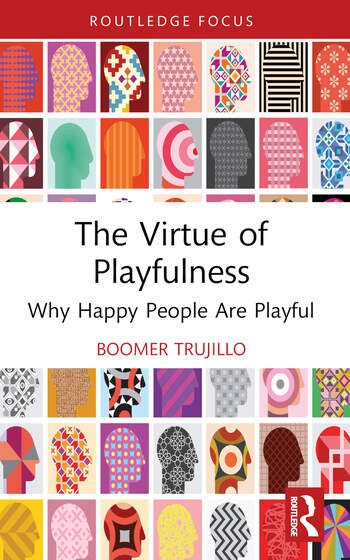
Symposium Introduction
A longstanding approach to philosophy, one rooted in classical Greek orientations to articulating wisdom and insight, is that it is centrally focused on articulating what the good life is. What are the conditions for that life, what variances are tolerable, and what means we should put to use to achieve it for ourselves (and others). boomer trujillo’s The Virtue of Playfulness is an extension of that tradition. trujillo’s orienting thought is that if we want to live well, we should cultivate our capacities for playfulness. The first part to this thought, that of the good life, is rooted in Aristotle’s notion of eudaimonia, that of a life that is complete, wanting nothing, and wherein we develop and engage our capacities. Virtues, those stable character traits inclining us to excellent actions, are the primary building blocks of that life. On the Aristotelian program, these traits range from courage, to justice, to wit, to generosity. On all of these fronts, Aristotle’s vision was one of what a person, at the height of their powers, with the right resources and connections, and employing their best judgment, would do. That person would (as courageous) resist the pull of fear and fight for (as just) what’s right. That person would (as witty) make the appropriately humorous observation amidst (as generous) doing something for others. The longstanding questions with Aristotle’s list of virtues are whether he’s got the right ones on there, and whether he’s left any off. Some hold that Aristotle’s list includes inappropriate character traits, such as great-souledness (megalapsuchia), which should instead have something more like humility. And others hold that the list is incomplete—there are other virtues that, without them, the happy life is left lacking. trujillo’s contribution is along these latter lines—that playfulness, the joyful engagement with others and with oneself, is necessary for a full, and good, life.
Critical questions abound for this project, and our commentators here have pressed a number of lines. Vivian Dong asks whether the program, as Aristotelian, is as inclusive as one might wish. Play, as a pastime of leisure, requires political and economic conditions that not all have. Are there elitist consequences that follow for the good life, then? Katherine Martha regards the bounds of what areas of our lives are sites for play. How might our sex lives be regarded as sites for play, and were we to be open about this, how might sex education be approached? And Ricardo Friaz asks whether playfulness is continuous with other virtues—whether one can cruelly play with an other, and if that is the case, whether play is an unalloyed virtue. These are all sites for fruitful exchange, and we are keen to see the critical dialogue develop.

9.30.26
Playful Sex, Serious Business
Playful Sex, Serious Business
I do not think I am very good at being playful. This is something that I did not know about myself before reading boomer trujillo’s delightful and thought-provoking book, The Virtue of Playfulness: Why Happy People Are Playful. After reading this work, I am not only convinced that I am sorely lacking in this character trait, but that the quality of my life suffers for this deficiency. trujillo argues that playfulness is a virtue that regulates leisure time, and that happy people are playful. More specifically, playful people use their time to rest, develop themselves, and engage in their communities. What is compelling about this work is the idea that play is not value neutral—we can use our leisure time in better or worse ways, in ways that make our lives better or worse for us and for others. In my comments, I would like to briefly explore the way in which trujillo’s work may offer a foothold for exploring ethical issues that plague a specific sphere of leisure time: engaging in sexual activity.
trujillo defines virtues as “excellent ways of being, especially with respect to common experiences, situations, and goods that all humans interact with” (36). Virtues are character traits we develop which, as Rosalind Hursthouse and Glen Pettigrove say, go “all the way down,” to shape what we notice, come to expect, feel, value, and desire (Hursthouse and Pettigrove 2023). These character traits regulate emotions or situations that are experienced universally amongst humans, and trujillo argues that playfulness is a virtue that uniquely regulates leisure time. Part of what is unique about play in human life is that we can do something to our play that non-human animals cannot: we can add implicit and explicit values (trujillo 2024, 51). Human play can be transgressive and creative; it can push back against hegemonic systems and practices and explore alternative ways of being in the world. trujillo acknowledges that play has made it possible for many queer spaces to arise and provide a setting for marginalized individuals to safely experiment and explore their identities (trujillo 2024, 52). I wonder whether more can be said about the way in which playfulness can be instantiated in acts of sex between individuals, and whether this may offer a promising, if incomplete, model of ethical sex and offer a unique way for thinking about sexual education for young people.
There is a substantial body of literature in sexual ethics devoted to evaluating the concept of consent as a central criterion of ethical sex (Hurd 1996; Alexander 2014; Liberto 2017; Levand and Zapien 2019; Ichikawa 2020; Tilton and Ichikawa 2021; Dougherty 2021; Rees and Ichikawa 2024). But some scholars have recognized that there is a need for thinking about the ethical dimensions of sex that extend past the boundaries of this concept alone in order to account for the ways in which oppressive political and social factors influence a permissive culture that makes rape and sexual violence against women so pervasive (Brison 2002, 2021).
Perhaps one way in which we can widen our concerns regarding ethical sex is to consider sex as being regulated by the virtue of playfulness. Of course, learning about playful sex will not be sufficient to address the variety of injustice that plague human sexual activity or culture around sex. My suspicion, however, is that a theory of playful sex could help to move us in the right direction. To determine whether sex might be an appropriate candidate for a leisure activity that ought to be guided by playfulness, let us examine the characteristics of playfulness that trujillo identifies and consider how each of these constitutive virtues and vices may manifest in the activity of sex.
First: seriousness. trujillo says that the playful person takes themselves and others seriously, which entails confronting our leisure activity with adequate concern and consideration for how to engage in these activities safely and effectively (trujillo 2024, 76). Similarly, we might think that part of what it means to be a playful sexual partner is to prioritize safety, and remain attentive to the well-being of themselves and their partner first and foremost. Conversely, the playful person, in being serious, avoids being flaky or severe. The flaky person “hastily moves on to new activities and lets each frustration or setback end his engagement with the current one” (trujillo 2024, 76). To claim that a playful sexual partner is a serious one is not to suggest that a virtuous sexual partner is always a long-term, committed partner. For trujillo acknowledges that casual play can be perfectly acceptable. But “casual” is not equivalent to “dismissive” or “thoughtless.” Similarly, the playful person avoids the vice of severity; they do not become obsessive in their pursuit of a certain singular activity, like sex, but recognize it as one good among many in their constellation of values.
The second characteristic of playfulness that trujillo outlines is creativity. The playful person recognizes the boundaries of their play, but is willing to, at times, experiment. In their capacity as creative, the playful person avoids being overly rigid or unruly. This I think is an incredibly important balance for ethical sex, as sexual partners should be mindful and contentious of their own boundaries and the boundaries of their partners, while also being willing to take the time to familiarize themselves with the unique needs and interests of their partners, given a sufficient level of trust between parties. And this piece is essential: to be legitimately creative, one must already have an intimate knowledge of the rules and boundaries that help to constitute an activity—so the creative sexual partner is always simultaneously one who understands that good sex is first and foremost safe sex, sex between persons who are consenting to identical sex acts (Tilton and Ichikawa 2021). Only from this baseline can sexual partners be empowered to safely experiment and generate new ways of realizing their desires.
Third: humility. According to trujillo, the playful person recognizes that play opens us up to the potential of experiencing failure. Indeed, if we are attempting to be creative in our play, to experiment and try something new, we need to resolve ourselves to the reality that our efforts will at times become frustrated or fail. Being able to move through instances of failure and continue with our play requires that we avoid falling into a state of fragility. The fragile person prefers to insulate themselves from risk and never perseveres in the face of challenge or struggle. Conversely, the playful person is not reckless. That is, they do not disregard the way in which their leisure time affects others or themselves (trujillo 2024, 78). In part, the failure of the reckless individual is that they do not recognize moments of failure as such, and so continue in their path of destruction. In ethical sex, we have good reason to think that we should be aiming for a similar balance between fragility and recklessness—having feedback from a partner that something we did or tried did not feel good to them should not send us into a spiral of self-doubt, but it should also not stimulate reactivity or be deflected as unworthy of our consideration. The ethical sexual partner is humble enough to recognize that they are prone to take missteps with their partners, but is willing to take ownership of them, apologize when necessary, and do what they can to correct for these mistakes.
Fourth is the characteristic of optimism. The playful person is willing to take on a certain degree of uncertainty with a disposition of optimism—knowing that even though failure is a possibility, there is a persistent belief that they can “win the game, that her craft will turn out given enough practice, and that the experience of going out or doing something will give her what she wants” (trujillo 2024, 78). The optimist person is not, however, naïve and, I would suggest, though trujillo does not name this vice: pessimistic. This characteristic of optimism seems especially important in activities of play that involve more than one person and so is of interest to us here as well. For trujillo writes that though we could perhaps find one prodigy that can excel at an instrument or a craft, it is much rarer to find teammates willing to play with a dispirited person (trujillo 2024, 79).
Fifth, finally, and perhaps most crucial for our purposes, is sociality. The playful person must be concerned with how her life, and her play, affects others, for all the virtues on an Aristotelian model entail a sensitivity to the needs and happiness of other people. Playful people, then, are considerate regarding the way in which their play affects themselves and those around them. Play takes place within a web of social and political relations and so is affected by and affects this connective tissue between ourselves and the world. trujillo writes: “[P]layful people undoubtedly help communities become just. What we do in our leisure has wider implications” (80). Finding better, more equitable ways to fill our leisure time allows us to embody and make contact with what is most important to our lives as individuals and also as members of larger communities.
This brings us to consider the work of Amia Srinivasan, who argues that even private activities like sex are impacted by our public lives. Liberating sex from “distortions of oppression” is not about disciplining desire, however; it is about emancipating ourselves from the coercive political forces that do not allow us to look at our own bodies and others’ with “admiration, appreciation, [and] want” that is free from judgment and the rigidity of hegemonic structures (Srinivasan 2022, 96). To be a playful person who pursues sex in her leisure time, we might think, thus entails sociality; and to this end, the playful person is sensitive to the forces of injustice in our sexual lives. The playful person is able to reflect on her own socialization, the kinds of biases, prejudices, and pre-formed beliefs she brings with her to her sexual encounters. She scrutinizes and rejects patterns of racism, misogyny, and ableism that “[make their] way into the bedroom through the seemingly innocuous mechanism of ‘personal preference’” (Srinivasan 2022, 84). These kinds of considerations do not only make for more satisfying and liberating sex on a personal level, but can also contribute to social movements aimed at addressing the prevalence of rape culture, and the broader, systemic and political violence against women and gender-nonconforming individuals. Here, I believe, trujillo provides us with a valuable framework for thinking about virtues, like playfulness, that we can cultivate in our sexual lives that liberate ourselves and liberate others.
These comments have been admittedly cursory and are offered in the spirit of commending trujillo for an extremely important project—one which provides us with many crucial lessons. One of which being: play is serious business. We would do well to reflect carefully on how we use our leisure time, to ensure that we use it wisely, and to consider the range of activities that might better support our own flourishing and that of others were we to infuse them with a little playfulness. Much more work is needed to determine whether an account of playful sex can offer the kind of ethical framework we urgently require, and whether incorporating instruction on playful sex into comprehensive sexual education at the university level would in fact reduce instances of sexual assault and improve sexual health outcomes. This undertaking calls for collaboration across disciplines—philosophy, social science, psychology, and legal studies. I hope that trujillo himself may take up part of this task and develop the practical implications of his account of playfulness, and I look forward to following his future work.
Works Cited
Alexander, Larry. 2014. “The Ontology of Consent.” Analytic Philosophy 55 (1): 102–13. https://doi.org/10.1111/phib.12035.
Brison, Susan J. 2002. Aftermath: Violence and the Remaking of a Self. University Press.
Brison, Susan J. 2021. “What’s Consent Got to Do with It?” Social Philosophy Today 37:9–21. https://doi.org/10.5840/socphiltoday202181983.
Dougherty, Tom. 2021. The Scope of Consent. Oxford University Press.
Hurd, Heidi M. 1996. “The Moral Magic of Consent.” Legal Theory 2 (2): 121–46. https://doi.org/10.1017/S1352325200000434.
Hursthouse, Rosalind, and Glen Pettigrove. 2023. “Virtue Ethics.” In The Stanford Encyclopedia of Philosophy, Fall 2023 ed., edited by Edward N. Zalta and Uri Nodelman. Metaphysics Research Lab, Stanford University. https://plato.stanford.edu/archives/fall2023/entries/ethics-virtue/.
Ichikawa, Jonathan Jenkins. 2020. “Presupposition and Consent.” Feminist Philosophy Quarterly 6 (4). https://doi.org/10.5206/fpq/2020.4.8302.
Levand, Mark A., and Nicolle Zapien. 2019. “Sexual Consent as Transcendence: A Phenomenological Understanding.” International Journal of Transpersonal Studies 38 (1): 154. https://doi.org/10.24972/ijts.2019.38.1.154.
Liberto, Hallie. 2017. “Intention and Sexual Consent.” Philosophical Explorations 20 (sup2): 127–41. https://doi.org/10.1080/13869795.2017.1356359.
Rees, Melissa, and Jonathan Ichikawa. 2024. “Sexual Agency and Sexual Wrongs: A Dilemma for Consent Theory.” Philosophers’ Imprint 24 (1): 1–23. https://doi.org/10.3998/phimp.2530.
Srinivasan, Amia. 2022. Right to Sex. Reprint ed. Picador.
Tilton, Emily C. R., and Jonathan Jenkins Ichikawa. 2021. “Not What I Agreed To: Content and Consent.” Ethics 132 (1): 127–54. https://doi.org/10.1086/715283.
trujillo, boomer. 2024. The Virtue of Playfulness: Why Happy People Are Playful. Routledge Focus on Philosophy. New York: Routledge.
9.30.26
Playful Sex Is Good Sex
Playful Sex Is Good Sex
“Much more work is needed to determine whether an account of playful sex can offer the kind of ethical framework we urgently require, and whether incorporating instruction on playful sex into comprehensive sexual education at the university level would in fact reduce instances of sexual assault and improve sexual health outcomes.”
—Katherine Martha
Katherine Martha expresses misgivings about the literature addressing the ethics of sex. Martha points out that much of it focuses on consent. This is almost always taken as a necessary condition for ethical sex but not a sufficient condition. Either way, the contemporary literature seems skeletal. Martha thinks that playfulness might be a way to add to the conversation, and I really hope that she develops this account because I think she is right.
I think that the arguments in the philosophy of sex are similar to those in applied ethics—the examples drive the conclusions. Even though sex seems like a defined domain, its variety challenges our ability to talk in generalities. On this point, I can recommend no essay higher than Greta Christina’s “Are We Having Sex Now or What?” (2023). Shaun Miller’s “BDSM” (2023) is a close second. I pick these two articles because they cover a wide range of sexual behavior. Christina mentions penile-vaginal intercourse, passionate over-the-clothes rubbing, using fingers and tongues and fists (and food or silicone analogues), watching others at an orgy, and stripping and masturbating at a peepshow while others masturbate to you with you watching them. Miller mentions using ropes, handcuffs, or whips; expressing dominance or submission; and (perhaps most controversially) a race play scene where a Black woman sub wants to act as a slave to a white master, which he compares to a scene between a Jewish sub wanting to be dominated by a Nazi master, which is not far from brief discussions about rape fantasies. Whether philosophers can find a definition that unifies all such actions as “sex,” people practice these things, and they negotiate how they can do so ethically.
The crux is this: we need more ways to evaluate sex in an ethical way. There are ethical foundations, such as criteria for consent. There are practical standards, as BDSM communities practice. (A long but relevant parenthetical: ethical BDSM communities have non-sexual meetups called “munches” where people can check each other’s vibes; there are extensive questionnaires about what things a person has done, how they liked it, and what their limits and desires are; there are express discussions of trust and safe words; there are plans for aftercare; there are dungeons and communities that will ostracize anyone not upholding standards compatible with SSC [“safe, sane, consensual”] and RACK [for “risk-aware consensual kink”].) I guess there are religious standards too. However, there are not many standards that give thick norms for sexual practices. Safety, consent, communication, community—those are all thin notions.
Martha argues that playfulness might help us to make more substantial contributions to celebrate ethical expressions of sexuality and deride unethical ones. Sexuality that encourages playfulness via seriousness, creativity, humility, optimism, and sociality stands a good shot at being ethical. This strikes me as right. Emphasizing my virtue of playfulness would emphasize: sex done during leisure expresses our freedom and our deepest values. It would point out: to be truly playful during sex, you must be aware of yourself and your partners, knowing when (and how) to be restful or therapeutic, and knowing when (and how) to be adventurous and exploratory. It would emphasize that learning communication and erotic technique is great, but not so great that you can disregard the specifics of your partners or the social circumstances.
I would hope that a theory of playful sexuality could also find a way to navigate, for me, what is one of the most pressing problems in the ethics of sex: distinguishing varieties of badness in sex with the subtlety sex deserves. Again, the examples are crucial here. Rape is so monstrous that it is probably better not to call it sex at all, even if we add the “nonconsensual” qualifier (Oliver 2016). Pedophilia too. I mention this because a majority of popular discourse often compares ethical faults in sex to rape and pedophilia. However, there are entire spectrums of sexuality that might fail some ethical or aesthetic standard that do not warrant the scorn that we ought rightly to give to rape and pedophilia. Sometimes sex is unfulfilling, awkward, or weird. Sometimes we regret sex, not because of anything having to do with the act or the partner, but because of how we might learn something new about who we are, grow into new identities, or make sense of our relations to others. Sex can be shallow and depleting, but it can be shallow and invigorating too. However, none of these categories are anywhere near the wrongs of rape or pedophilia. Maybe there is no ethical violation at all, at least not in a strict deontological sense where minimal duties are unmet. Maybe the violations are akin to ethico-aesthetic violations. This is where playfulness might help.
Taking Martha’s cue, playfulness, as an expression of deep values and relationships, can explain why sex can be invigorating when partners understand what you need in the moment, and you work together to improve yourselves and your relationships. Playfulness, as a place for creativity and sociality, might be able to explain the magic of queer sex, where people improvise with and improve upon inherited values and identities in order to serve and affirm one another in circumstances where wider society demeans or destroys you. Playfulness, as a virtue, might be able to explain why unfulfilling sex with a partner once or twice might be OK because, like any skill, the playfulness might yet be developed, especially with finesse. Playfulness with humility built into its standard acknowledges that virtue does not imply perfection, but it sure as hell excludes callous disregard. These subtle distinctions might help philosophers to describe and judge the spectrum of better and worse sex. Without appealing to radical harms.
Martha’s suggestion to apply playfulness to sex is novel. Playfulness takes consent as a given and basically says no further debate is needed there. Playfulness takes any obvious shirking of duty as, well, obvious. Playfulness relies on no religious metaphysics. Yet, playfulness also offers a new way of evaluating sex without direct appeal to pleasure, without importing heavy metaphysical or religious norms, and without direct appeal to moderation. This also seems right in some cases. It seems like playfulness can better explain why pain in a BDSM scene might be great in ways that hedonic- or moderation-based accounts cannot. Or it might explain why ecstatic pleasure with a masculine brute might feel great but also fail so many other standards (without reaching for morally nuclear options and without needing to say you should have φ’d on the first order when you should have ψ’d on the second one). I welcome Martha’s proposal and hope she and others develop it.
Works Cited
Christina, Greta. 2023. “Are We Having Sex Now or What?” In The Philosophy of Sex, edited by Raja Halwani et al., chap. 1. Lanham, MD: Rowman & Littlefield.
Miller, Shaun. 2023. “BDSM.” In The Philosophy of Sex, edited by Raja Halwani et al., chap. 23. Lanham, MD: Rowman & Littlefield.
Oliver, Kelly. 2016. “There Is No Such Thing as ‘Nonconsensual Sex.’ It’s Violence.” New York Times, November 21, 2016. nytimes.com.

10.2.26
Playing Fast and Loose
Playing Fast and Loose
boomer trujillo’s book on playfulness is itself playful, and the book’s content shapes its form. In keeping with trujillo’s playful book, I will respond with a similar approach in playing a bit with my response, though not necessarily writing a playful one. I respond in annoying fashion by discussing an aspect of play that is orthogonal to the book’s concern, and this is the dangers of play, or playfulness as a vice. I am interested in thinking about the capacity for ways of playfulness that don’t help us develop in our humanity or lead a good life in order to ask what, if anything, it means that we can joyfully partake of something that could be called vicious playfulness.
As the title of his introduction reads, trujillo’s aim is to take playfulness seriously. The most serious matters are those that concern good and bad or good and evil, questions of ethics and questions of morals. Taking playfulness seriously here means taking up how playfulness relates to the good. trujillo’s argument does this by connecting playfulness to a good life: playful people use their leisure time well, and all happy people are playful. This argument is made primarily through the thought of Aristotle.
trujillo shows how Aristotle takes up play without conceiving of playfulness as a virtue, and this is a lacuna that trujillo successfully rectifies. trujillo broadens his account of play by taking up how it has been addressed not only by philosophers but also scientists of various kinds, drawing on them to show that, while play is important for organisms in various ways, humans are value-driven beings for which play is something more than it is for animals. Through trujillo’s masterful and clear arguments, playfulness turns out to be a virtue connected to our leisure time, which playfulness uses to rest, develop ourselves, and engage our communities.
trujillo also takes play seriously in that he does not just write about play, but writes playfully. His book is rife with examples drawn from his readings as well as his own life, and the book references Plato’s wrestling career, Colin Kaepernick’s NFL protests, Klingons, Nacho Libre, and reflections on the sexual performance of rats. In his discussion of “jester’s privilege,” it becomes clear that trujillo himself recognizes his own jester’s privilege, slipping in sly moments of play into his work that never distract nor interrupt his serious attention to his subject, playing seriously while seriously playing.
In the spirit of the jester’s privilege now dubiously inherited by me in the space of this review, I want to seriously respond to playfulness by committing the party foul of the presentation Q&A: “Thank you for your talk, but what about this other thing your talk was explicitly not about?” Instead of asking about the virtue of playfulness and how it relates to our flourishing as humans, I want to think about those aspects of play that don’t seem to lead to our flourishing, yet nonetheless seem to be a part of us. This aspect of ourselves is our capacity for cruelty, particularly a playful cruelty all the more gruesome for its seeming pointlessness. For example, a disturbing amount of people may be okay with torture in service of the higher good in the sense committed by Jack Bauer, but those same people are likely all opposed to torture without purpose; torture for torture’s sake, or a torture engaged in playfully. Vicious playfulness is a playfulness either indifferent or actively opposed to our flourishing: playfulness that makes us worse humans. I call it vicious playfulness as a play on words: as playfulness is the virtuous ability to regulate our leisure time, vicious playfulness is playfulness as vice. As vice is the absence of virtue, my formulation might ultimately be only a contradiction, and I accept this.
At the end of chapter 3, trujillo narrates how the plurality of different aspects of play worries philosophers like Plato, who are “worried about the ways that play, especially for humans, can stunt existential, moral, and political progress by interacting with identity, values, and social coordination in the wrong ways.” It is clear that trujillo too is worried about this aspect of play that can be dangerous or empty, and the book occasionally gestures to this issue before moving from it to say that virtuous playfulness must be distinguished from its unproductive forms in order to be properly sought.
It is not a matter of rejecting any impropriety, as playfulness itself is capable of challenging and rearranging the proper, and trujillo sees this exemplified in the play of children, who play games where they mimic social roles while at the same time rewriting or playing with them. This occurs among adults in the play of parody, where the serious thing is inverted, and its seriousness becomes an object of laughter. Play can violate taboos, and in the course of the violation the taboo itself can be reexamined, challenged, and ultimately broken down.
It is of key importance which taboo is broken down. Events like the Stonewall Riots violated social taboos, consisting at times of a marching chorus line with kicks that advanced toward the police, who responded by indiscriminately using their batons to beat dancing queer people. To dance and sing in the streets in full drag violates taboos concerning gender expression, but the violation of this taboo is different from taboos against beating unarmed human beings without reason beyond anger and hate. That play can violate taboos is only descriptive, and it falls to virtuous play to guide us in knowing which to opt for.
In a Nietzschean vein, I am interested in continuing trujillo’s reflections by asking what vicious playfulness does to us. To paraphrase Nietzsche, I do not think that vicious playfulness makes us better, but perhaps it might make us deeper, and I’m curious as to what this possibility might mean for us. What does it mean that we desire to engage in vicious playfulness?
Discussions of playfulness often benefit from example, so here I offer the example of the tightrope walker. The tightrope walker may seem like a weak example given what I have suggested by my use of the words “vicious” and “cruelty,” but I think the tightrope walker, risking only their own life, makes for a more limited example easier to discuss here. The tightrope walker I have in mind is captured in Nietzsche’s Thus Spoke Zarathustra, where their rope is stretched between two towers, hanging suspended high above the marketplace. The tightrope walker risks their life as a game: they make their way between two points in a dangerous show of balance. Certainly, not all tightrope walking is vicious, as one can take all kinds of precautions that might make the performance less reckless.
trujillo’s discussion of play as pharmakon, the Greek word for both medicine and drug, is useful here. Pharmakon draws attention to the way that any medicine becomes a poison when taken in too large amounts, and the key to the correct dosage is balance, neither too much nor too little. This concept helps capture a healthy way to think about play: not too much, but neither too little, for all work and no play is itself a poison in the way that all play and no work would be too. The gamer who plays Fortnite for eighteen hours a day is not so different from the person who is always volunteering to do more in their local organizations: neither have struck a healthy balance.
In the case of the tightrope walker, the balance is gone. The most reckless thing that could be staked, one’s life, is put at stake for nothing more than daring. There is no cash prize, no menacing force holding them hostage, or else any clear benefit for walking the tightrope at such dangerous heights. Perhaps they crave a joy born of risk, but it is this capacity that is precisely at issue. I am not interested specifically in thrill-seeking behavior itself, but that we can have thrills at all, and that they seem to come recklessness. A taboo may be at stake here: the taboo that guards against not taking one’s life seriously, and this taboo may inhere in many kinds of play.
It is possible to interpret the tightrope walker in registers other than playfulness: they are after adrenaline, they are addicted to gambling, or are driven to seek attention. I think they are playful to the degree that they are doing it for the activity’s own sake: to risk one’s health and life as a leisurely activity. What does it mean that we are capable of this kind of leisure? It may be interpreted as evidence of our capacity for virtue at all: to the degree that we recognize the viciousness of our playfulness, we can also be virtuous. To the degree that we can risk our life for no particular reason, we can also become aware that we can risk our lives for better and worse reasons. That we can play with our own lives can reveal to us that we shouldn’t play with our lives, or others.
Our capacity to play with things that shouldn’t be played with may be part of the same capacity for us to cultivate our playfulness in bettering ourselves and our community. What then of that vicious playfulness in us that seems to rear up in us even as we grow and flourish? The desire to flip off a security camera, to mock our good friend’s voice, or to close the elevator doors on someone? There may be something that feels good about vicious playfulness, even and especially when it is not good for us or anyone else. This viciousness is more easily on display and chastised when billionaires are revealed to be engaging in sadistic, strange, and perverse forms of play available only to those who have accumulated incredible amounts of money. I am not sure if this same kind of playfulness is the one displayed by the toddler who comes to learn that it’s funny to push someone or throw food at them: childish, harmful play.
I speculate that vicious playfulness reveals in us a capacity for causing harm, for a disobedience and cruelty that can feel good inversely to the degree that it is a vice. This capacity is often pathologized, but I think that seeing it at play in playfulness lets us see it in a more innocent light, already at play before one has become corrupted in some way. I do not think it’s all bad, for this kind of playfulness can certainly be appropriated or redirected, but I think that it might also belong to what is usually called humanness or humanity. Humanity seems to have within it an inhumanity, or else may be in a tense relationship with what Enrique Dussel called the ego conquiro, the ego that says “I conquer” as the ground of the “I think.”
It may also be that I have played fast and loose in this review, and this sense of vicious playfulness is experienced by few or even no one. But it’s not just me, right?
10.2.26
Play It Cruel
Play It Cruel
“. . . I want to think about those aspects of play that don’t seem to lead to our flourishing, yet nonetheless seem to be a part of us . . . our capacity for cruelty, particularly a playful cruelty all the more gruesome for its seeming pointlessness . . . To paraphrase Nietzsche, I do not think that vicious playfulness makes us better, but perhaps it might make us deeper . . . What does it mean that we desire to engage in vicious playfulness?”
—Ricardo Friaz
Technically “vicious playfulness” or “cruel playfulness” are oxymorons for my theory (as “vicious courage” or “vicious justice” would be for Aristotle). However, Friaz’s concern supersedes pedantic technicality. I think that Friaz is asking, “What are the hard cases to evaluate with respect to playful acts, ones on the border between virtue and vice, ones between playfulness and cruelty?”
These are great questions because virtue ethics emphasizes subtlety. The finesse and tact of an action are central to the theory. Virtuous action requires proper behavior, thoughts, and feelings; consistency of motivation; and success of accomplishment. Additionally, the “mean between the extremes” stresses the myriad vices surrounding a nebulous virtuous center. Virtue ethics stresses adaptability to circumstances and appreciates particularities of individuals. This is where critics get uncomfortable, calling virtue ethics wishy-washy. This is where I emphasize that standards exist. While Aristotle is no deontological absolutist, he does have boundaries. For example, Nicomachean Ethics II.6 says that cheating on your spouse is not virtuous—no matter if it happens at the supposed right time and in the supposed right way with the supposed right person. (The closest Aristotle gets to knee-slapper.) In the same passage, he mentions theft and murder too. II.6 clarifies that someone who has good reasons, astute emotions, and expert tact cannot get away with anything. But maybe they can get away with some things.
Aristotelian virtue ethics includes wiggle room. Aristotle does not expect virtuous people to avoid all mistakes. Friaz, I think, is asking how much room there is for mistakes, dark ones. He wants to know what it means to desire vice in playfulness, to want to be cruel. Friaz riffs on Nietzsche, who is worth quoting here:
Only great pain is the liberator of the spirit . . . Only great pain . . . forces us philosophers to descend into our ultimate depths and put aside all trust, everything good-natured, veiling, mild, average—things in which formerly we may have found our humanity. I doubt that such pain makes us “better”—but I know that it makes us deeper. (2001, §3)
In the context of my book, I think that Friaz is asking about how we might treat ourselves or others cruelly in playfulness, and whether it is always bad, even in desiring it. Aristotelians share Nietzsche’s concerns. We change the phrasing, but we ask things like: Is it a good idea to transform into moral monsters to get through monstrous times (see Tessman 2005)? Or more subtly, can a fully virtuous person do something unvirtuous on some occasions, without losing full virtue (see Curzer 2005)?
I can only give cursory answers here. However, I think that I can defend seemingly cruel playful actions. They seem cruel, but they are not. Rather, they are playful. Context allows the seeming-cruelty to actually be playful. How?
First, we might be able to simulate cruelty via artwork or games. A popular video game right now is Tomodachi Life, but it is like The Sims, which is like a virtual dollhouse where you can make your friends (or anyone) and make them live the life that you desire for them. My friends are deviously funny, and when they play these games, my avatar is ugly, and ugly things happen to it. But, they only do bad things to me in the game, not outside of it. After all, I am important enough to my friends to be included in their games, and I am a good enough friend to tolerate cruel jokes with my avatar (and even with my real self, if my friends are funny enough).
Second, the seeming-cruelty happens with my friends. While I hate it, Aldous Huxley wrote something that many feel: “One of the principal functions of a friend is to suffer (in a milder and symbolic form) the punishments that we should like, but are unable, to inflict upon our enemies” (1932, 214). Listen, we need outlets, and we need justice, and I think it is questionable to bully friends. However, if I really love my friends, and they release their temper and stresses on me (but also apologize and take responsibility for it), I am actually OK with that. Perfection and purity are toxic to practical life and durable relationships. Ideally, such outbursts would be funny and good-hearted enough so as to maintain the “seemingly” of “seemingly cruel.” However, if the acts crossed over into actually cruel, a good friendship could handle negotiating those events. (Assuming the cruelty is not beyond the pale.)
The third and final thing to consider here is related to ritual spaces, moral holidays, or social institutions where we have tacit (if not explicit) agreements about what is acceptable at that specific time in that specific place. It is something that sociologists and anthropologists are comfortable talking about. Philosophers almost never do, though. The closest I have found is Harry Frankfurt’s discussion of “bull sessions”:
The characteristic topics of a bull session have to do with very personal and emotion-laden aspects of life—for instance, religion, politics, or sex. People are generally reluctant to speak altogether openly about these topics if they expect that they will be taken too seriously. . . . in a bull session . . . participants try out various thoughts and attitudes in order to see how it feels to hear themselves saying such things and in order to discover how others respond, without it being assumed that they are committed to what they say. (1986, 91)
A bull session might include some seemingly cruel things said—about insecurities, major mistakes in life, character defects in someone’s loved one, or worse. Again, tact protects the “seemingly” here, which is easier to practice in a proscribed space with limits and full participation, with the understood (and enforced) rule that stuff does not go beyond that proscribed space. If it does go too far, again, there will arise a need for moral and social repair.
So, can a playful person be cruel? Probably not, at least by strict definition of all terms. Though, an occasional mistake might happen and be repaired. OK, but can a playful person do or say things that seem cruel? Almost certainly yes. In fact, it might be a sign of belonging that you can make and take jokes of varying acridity. Aristotle recognizes this in his discussion of wit. That said, playfulness does not insulate the ethical or social effects of whatever is done or said. The liminal cases here are interesting, and (to be transparent) they are where some of my friendships live. I hope that more work is done in the area of Friaz’s questions.
Works Cited
Aristotle. 2019. Nicomachean Ethics. Translated by Terence Irwin. Indianapolis: Hackett.
Curzer, Howard. 2005. “How Good People Do Bad Things: Aristotle on the Misdeeds of the Virtuous.” In Oxford Studies in Ancient Philosophy, edited by David Sedley, 233–56.
Frankfurt, Harry. 1986. “On Bullshit.” Raritan: A Quarterly Review 6 (2): 81–100.
Huxley, Aldous. 1932. Brave New World. New York: Harper & Row.
Maxis. 2000. The Sims. PC.
Nietzsche, Friedrich. 2001. The Gay Science. Translated by Josefine Nauckhoff. Cambridge: Cambridge University Press.
Nintendo. 2026. Tomodachi Life: Living the Dream. Nintendo Switch.
Tessman, Lisa. 2005. Burdened Virtues. Oxford: Oxford University Press.

9.28.26 Vivian Dong
Cultivating Playfulness in a Complex World
Cultivating Playfulness in a Complex World
“To face our leisure time well, we need to be playful” (81). This quote is the central claim from boomer trujillo’s book, The Virtue of Playfulness. “Playful” appears to be an abstract term in both daily life and academia. What is the meaning of playfulness? Why do we need it, and how could it be a virtue? trujillo’s thoughtful and engaging book gives us clear answers! According to trujillo, play is an action, whereas playfulness is a virtue that regulates how to play well and how to use leisure time well. This virtue is necessary for human life because it allows people to play appropriately, which leads to a flourishing, happy life.
trujillo builds his thesis through a careful analysis of Aristotle’s philosophy. For Aristotle, play represents a double-edged sword: essential for human development and adult relaxation, yet potentially dangerous if approached carelessly. As trujillo introduced Aristotle’s ideas in chapter 1, the key insight about play’s positive aspect lies in its connection to leisure, which is free time away from direct necessities or survival concerns (11). As trujillo demonstrates, Aristotle’s claim that “people work for the sake of leisure” positions leisure time as the purpose (the end) for people working hard and as the free space where people can relax and develop capacities for reflection, creativity, and community engagement that not only make happiness more possible but also help people to better prepare for the upcoming work (10–15). Since play is a significant part of what people do in leisure (10), and leisure is necessary for living well, play has instrumental value. This instrumental value manifests in making people amused, relaxed, and connected to the community during leisure time, thereby helping them live a good life (23–24).
The controversies around play create the conceptual space for trujillo’s contribution. In chapter 2, he examines the relationship between virtue and happiness in Aristotle’s account, identifying that virtues are dispositions that enable people to respond appropriately to different aspects of life, such as courage in fearful situations (36–37). Chapter 3 later demonstrates play’s significance in human social life through contemporary empirical studies, identifying that the unique feature of human play is its engagement with social values (51–56). Then, chapter 4, the book’s centerpiece, introduces playfulness as the virtue of regulating leisure time. Given that play constitutes a significant part of leisure activities, playfulness enables people to distinguish good play from bad play (70). trujillo identifies playful people as those who exhibit five key characteristics: seriousness, creativity, humility, optimism, and sociality (75–81). Therefore, while Aristotle does not address playfulness as a virtue, trujillo develops it as a virtue by demonstrating its necessity through the Aristotelian approach. This necessity manifests in playfulness’s function of leading people to a happy life, as Aristotle endorsed, and guiding people to play (act) appropriately, which both Greek philosophy and today’s empirical studies recognize as valuable.
I think trujillo’s scholarship offers crucial guidance for navigating the contemporary challenges of the digital age. While this book is not a psychological handbook that shows people, step by step, how to cultivate a disposition of playfulness, it does show how playful people behave. This book thus demonstrates that acting playfully is the way to develop such a disposition. trujillo’s insight that playful people are genuinely self-aware particularly resonates with me. For trujillo, playful people understand what kind of fulfillment they actually need and can identify appropriate ways of bringing authentic pleasure into their lives (70–72). I think those of us living in the digital age especially need such a virtue, as social media platforms misplace the value of pleasure, leading many to indulge in endless scrolling that leaves them feeling increasingly depleted. Thus, I am very convinced that playfulness is a virtue, in trujillo’s rich sense, and that learning such a virtue is necessary for human flourishing, especially in current times.
Here, I will propose some questions that emerge from trujillo’s framework. I do not see them as criticisms, but as concerns and clarificatory questions that help both trujillo and his audience better understand the scope and implications of his contribution. First of all, I really appreciate trujillo’s consideration of the social dimension of play. Part of such a social account identifies that human play involves the practice and challenge of social values and norms. For example, trujillo mentions in chapter 3 that gender stereotypes can shape childhood play and impact children’s future development and dispositions (55). This shows that trujillo is mindful of the social factors’ impact on play as an action. Yet, he does not explicitly address the extent to which these social factors may constrain people not only in playing but also in cultivating the virtue of playfulness. After all, not everyone has equal opportunities or conditions to develop this virtue, and I think such inequities are not caused by individual failings, such as ill-will toward being playful, but by unjust social arrangements and structures.
Consider the global disparity: we may worry that people in well-developed capitalist countries typically enjoy more leisure time to explore playfulness, while those in developing nations, especially postcolonial contexts, must work harder with less leisure time due to economic necessities partly rooted in historical or distributional injustices. While I recognize people’s potential to play optimistically even in harsh circumstances and that billionaires can play awfully, I wonder how trujillo considers the social conditions for cultivating playfulness, especially when the ideal conditions can be privileges not everyone shares. In chapter 2, trujillo acknowledges that for Aristotle, people’s cultivation of virtue is subject to misfortunes beyond our control, such as health, wealth, or political circumstances (33–34). So, I think trujillo might have considered my question and wanted to answer it from an Aristotelian perspective. Also, addressing this question could help trujillo’s account avoid potential postcolonial criticism and, at the same time, inspire rather than burden audiences who may struggle with playfulness due to circumstances beyond their control.
My second question concerns trujillo’s restriction of playfulness to leisure time rather than extending it to work domains. trujillo operates within Aristotle’s work-leisure dichotomy, in which people work for the sake of leisure, play helps them relax during leisure, and they return refreshed to work (23–24). Such an interpretation of Aristotle appears to suggest that play and labor, work and leisure are two independent domains, and that the value or pleasure brought by these two domains is distinctive. While I hope to hear more on whether Aristotle actually holds such a dichotomy, I worry that if it is so, maintaining this dichotomy and developing “playfulness” through this dichotomy may prevent people from truly liberating and enjoying their free time, since they may always consider how to play better merely for the sake of working better rather than genuinely liberating themselves from survival concerns. After all, we live in a society that values work and undervalues leisure. Such a social context and work-leisure dichotomy may make the practice of playfulness stressful. Such stresses could come from the intention to play better to work better, which ends up undermining the very meaning of being playful. Or consider the institutional-level case of how technology companies implement gyms and fancy cafeterias, ostensibly to optimize employees’ leisure time and well-being, but to extract more productive labor.
Moreover, trujillo’s reliance on the work-leisure dichotomy gives the impression that working requires seriousness, time commitment, and labor investment, and that being playful violates proper work conduct, so this disposition should remain in the leisure domain and deal only with play. However, according to trujillo, the characteristics of playfulness are embodied in the middle point (balance) between seriousness and flakiness, in committing to play activities while remaining flexible, and in balancing optimism and fragility (75–79). If these are the characteristics of playfulness, I think being playful may also be required in the working domain. This is because some (or many) works require creativity, energy, attention, and positive moods. Psychological research suggests these can be sustained through dispositions and conditions similar to what trujillo describes as playfulness. For instance, psychological studies suggest that creative ideas thrive in moderate engagement activities, where both excessive focus and insufficient structure can disrupt this balance (Irving et al. 2024).
Furthermore, the boundary between work and leisure is usually fluid. For philosophers like us, writers, or self-employed individuals, the main “work” could be thinking, and we set our own working time. Also, doing philosophy, as trujillo acknowledges at the end of his book, is itself playful when it engages with the public (85). Given that work-leisure boundaries can be blurred and that work domains may need “playfulness” to remain creative, energetic, and mentally healthy, I wonder whether there is room to extend the virtue of playfulness beyond leisure and play into work and labor, and even into human life in general. Doing so might require abandoning the potentially problematic work-leisure dichotomy and reconsidering (metaphysical) natures and meanings of playfulness through other philosophical traditions, such as ancient Chinese philosophy, particularly Taoism. Zhuangzi, a central figure in Taoism, develops and values playfulness as an ideal way of being characterized by free and spontaneous wandering through life, unconstrained by rigid conventions or ethical imperatives (Levinovitz 2012, 479–96).
I have two additional questions I would like to ask trujillo. First, what role does love, especially self-love, play in cultivating the virtue of playfulness? While trujillo recognizes that caring for and loving are important characteristics of being playful, he discusses the idea of “lovingly playful” by referring to María Lugones, who considers loving playfulness as holding loving or related attitudes toward the outside world (79). But what I am curious about here is how trujillo views the role of loving and caring for ourselves, the role of self-love, which could be essential for listening to what we actually need, stopping self-blame and restlessness, and thus fully embracing playfulness.
Second, and perhaps more fundamentally, I wonder why people need the virtue of playfulness specifically to regulate how we play. While trujillo identifies that each virtue regulates a specific sphere of life (31, 65), people might reasonably ask whether a virtuous person who possesses all the classical virtues that Aristotle emphasizes, such as courage, temperance, and righteousness, could already play appropriately without needing an additional virtue. In other words, would not someone play appropriately by acting in accordance with those classical virtues?
Despite my clarificatory questions, I want to reiterate my appreciation for trujillo’s contribution to contemporary virtue ethics. He has successfully rehabilitated playfulness from a seemingly frivolous concept into a rigorous philosophical framework that speaks to urgent contemporary challenges. Most importantly, trujillo demonstrates that in our current era, learning to be genuinely playful is necessary not just for individual flourishing but also for building a cohesive, diverse, and just community.
Works Cited
Irving, Zachary C., et al. 2024. “The Shower Effect: Mind Wandering Facilitates Creative Incubation during Moderately Engaging Activities.” Psychology of Aesthetics, Creativity, and the Arts 18 (6): 1096.
Levinovitz, Alan. 2012. “The Zhuangzi and You 遊: Defining an Ideal without Contradiction.” Dao 11 (4): 479–96.
trujillo, boomer. 2024. The Virtue of Playfulness: Why Happy People Are Playful. New York: Routledge. https://doi.org/10.4324/9781032717722.
9.28.26 boomer trujillo
Playfulness Helps Us to Practice Feeling and Being Free
Playfulness Helps Us to Practice Feeling and Being Free
I think a lot about an art piece by Jeffrey Gibson. I think it an exemplary expression of the connections between the virtue of playfulness and justice, or what Vivian Dong presses me on most. The work is the size of a normal wall, and in gigantic block letters it spells: “I WISH I KNEW HOW IT WOULD FEEL TO BE FREE.” As you approach it, you notice that it is made of thousands of beads in the style of Native American beadwork. You also notice “N.S.” in the corner. The letters stand for Nina Simone, who performed a song of identical title, which became famous during the civil rights movement. Gibson himself is of Mississippi Choctaw and Cherokee descent, and even though he was born in the United States, he also grew up in Germany and South Korea, and he attended school in Chicago and London. He now lives in New York City with his partner and daughter (Pagel 2017). Each of these details adds layers to the meaning of the artwork. How can a man like Gibson be free in a world like this? How can anyone with a complicated identity be free when constrained by oppressive laws and repressive communities, when the people around you do not recognize you (much less understand you)? After all, if raised in severely unjust circumstances, people often cannot even begin to imagine what it would be like to be free in a positive way. People get that it would not feel like this, but they probably cannot get more specific. And yet, we need positive visions and feelings of liberation to take the first non-defensive steps toward justice.
I open my replies to Vivian Dong with Gibson’s work because I think it shows a complicated but real-world example of her concerns about colonialism and oppressive social circumstances in my theory of playfulness. Gibson’s work emphasizes that the impediments to freedom are not only legal, social, or practical. Rather, there are epistemic impediments too. To go from conditions of unfreedom to freedom, people must envision and enact free actions, but they must also practice and perfect free feelings. There might be no better arena for cultivating and practicing the emotions, thoughts, and behaviors of freedom than our leisure time. I hope that the virtue of playfulness draws attention to this. Sinister forms of oppression prevent you from understanding your unfreedom, imagining or feeling alternatives, or even hoping. Playfulness, I argue, works against this (esp. 2024, chaps. 3–4).
My account of playfulness ties the virtue to leisure time—the time away from direct necessity, or “free time.” What we do when we cultivate playfulness is practice our freedom. In a literal sense. So, when Gibson beads the words “I wish I knew how it would feel to be free,” he is using his free time to communicate to us that we need to keep watch of our freedom. And if we do not yet have freedom, we need to cultivate a practice of imagining and feeling freedom as best we can, hopefully to contribute toward building better communities.
Vivian Dong appreciates that I consider gender roles, socialization, and experimenting with new political arrangements. (This is why Gibson’s work resonates with me.) However, she worries that I misjudge some who are inhibited from developing playfulness. Many people who do not develop playfulness, according to Vivian, do not do so because they face economic exploitation and social oppression. I think that this is just a bullet that Aristotelians have to bite: there is luck involved in flourishing (here, the luck of just political circumstances, economic opportunities, and competent education systems). I think that acknowledging the damaging effects of exploitation and oppression generates normative urgency. Seeing the damage to a person’s playful self shows why any person, group, or institution that is involved in the harm of depriving someone of playfulness is doing something immoral. Relatedly, someone who is actively prevented from developing playfulness is ethically less culpable for that than someone who does not develop it while given ample opportunities.
Before closing, I want to mention Vivian Dong’s remarks on Taoist philosophers. In a forthcoming piece, I write that there are three extant theories of playfulness in the philosophical literature:
As far as I understand, I am the only one to use these categories. I do so to organize different senses of the word “playful,” to stave off equivocation, and to aim critiques more accurately. I am uncertain of where Vivian’s Taoist conception of playfulness fits. She proposes that Zhuangzi might characterize a playful person as someone who is free and spontaneous, which means that the playful person does not feel completely constrained by social or ethical values. This could be a fourth category to be added to the three above, or it might be a blend (likely of myself and Lugones). However, to tie this back into Gibson’s piece, maybe Vivian’s account is an in-depth proposal about the emotional comportment of the playful person toward life generally. This would be a novel idea if developed more fully (and it would align with recent pushback that I have received from Brennan McDavid and Lucy Vollbrecht [forthcoming 2026]). My book emphasizes a range of feelings that contribute to playfulness; Lugones emphasizes lovingness; and Nguyen emphasizes fun. Vivian seems to be recommending something else in her emphasis of spontaneity and carefreeness. The concern is epistemic, like Nguyen, but where he emphasizes exploring ideas for fun, Vivian and the Taoist philosophers emphasize (perhaps) fluidity, which would relate to wu wei. I hope that Vivian develops this account because it seems novel and might capture elements of playfulness that previous theories have not. It might also explain why a playful person stands a better chance at feeling freedom, even when not fully realized in political communities.
Works Cited
Pagel, David. 2017. “Jeffrey Gibson: American. Native American. Gay. An Artist’s Life outside Labels.” Los Angeles Times, October 7, 2017. latimes.com.
trujillo, boomer. 2024. The Virtue of Playfulness: Why Happy People Are Playful. New York: Routledge.
———. Forthcoming 2026. “An Elegy for the Unplayful.” Journal of Philosophical Research 51.
———. Forthcoming. “The Philosophy of Playfulness: Why Playfulness Helps You to Think Better, Be Better, and Make Better Communities.” In The Oxford Handbook of Playfulness, edited by Robyn Holmes. Oxford: Oxford University Press.