
Symposium Introduction
Experience, Moral Truths, and Principled Pragmatism: On Diana Heney’s Toward a Pragmatist Metaethics
The nature of truth is a perennial philosophical question, and it seems yet more difficult and pressing when the question is focused on the nature of moral truth. Saving the appearances in our moral lives—in particular, that there are disagreements in, ways to be wrong about, and instances of correct action and deliberation in ethics—is regularly taken to be a desideratum of a successful theory of ethical judgment. The challenge, always, in living up to these requirements is finding just what it is for ethical claims to be true or false, and for disagreements about a moral concept to be about the same thing. It is tempting, comparing the cognitive program in the empirical sciences with that in ethics, to say only the former has any clarity or claim to truths. Moral truth risks being seem as more a will-o-wisp rather than something real.
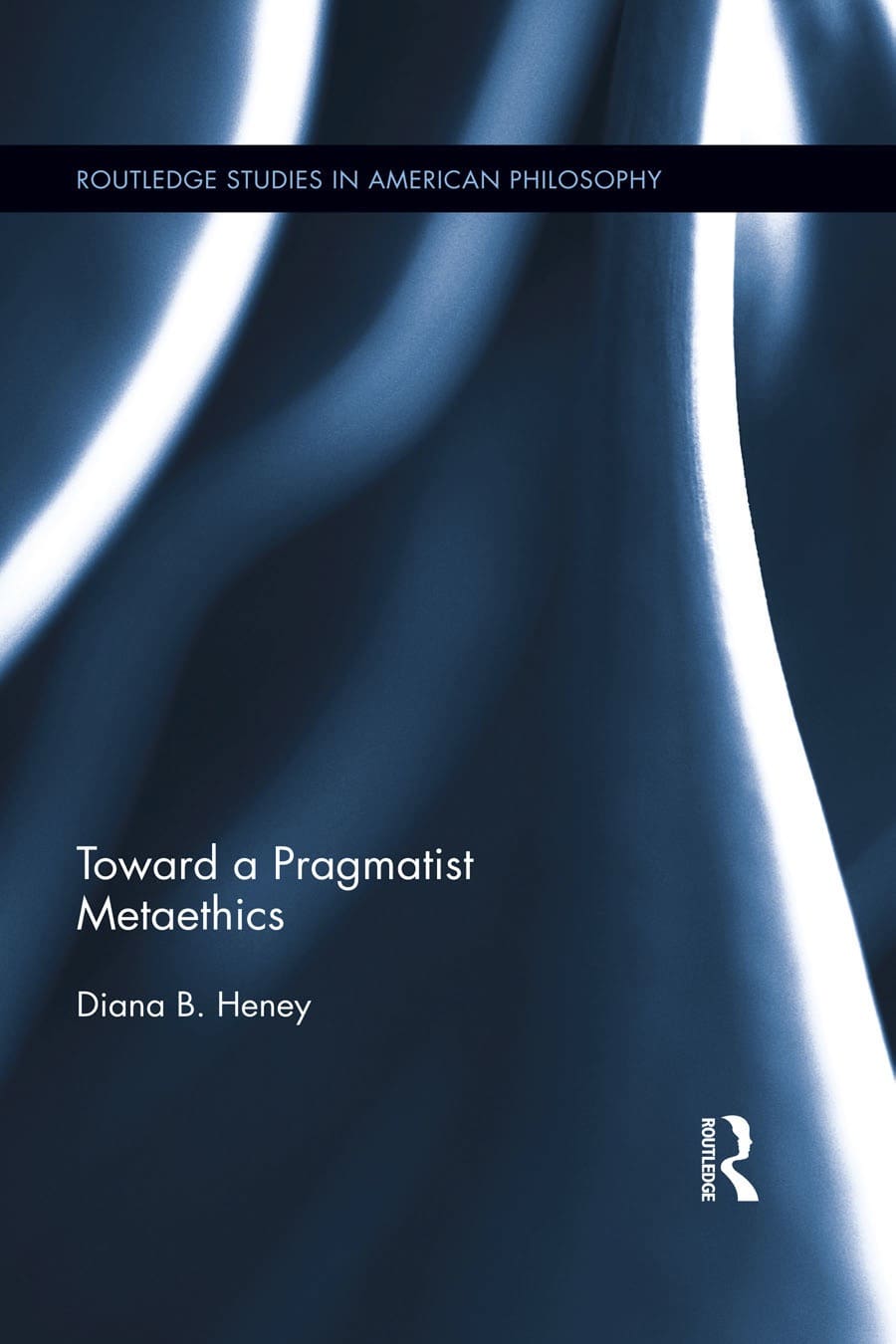
Diana Heney’s Toward a Pragmatist Metaethics is a work that is designed to address the truth problem in ethics in a way that takes the practices of moral disagreement, ethical reflection, and public deliberation about what it right and wrong seriously. Heney’s book is comprised of two arcs of argument. The first is a genealogy of the pragmatist metaethics she takes to be most defensible—one that winds its way through Charles Sanders Peirce’s theory of truth, William James’s orientation toward “vital matters,” John Dewey’s focus on context and the role of inquiry, and Clarence Irving Lewis’s model for developing a normative science. In the process of this line of finding what is living and defensible in the long and contentious history of the pragmatist program for ethics, Heney produces her own thoroughly pragmatist, and decidedly Peircian, account of ethical judgment and truth. What emerges is a theory of moral truths that is focused on lived matters in moral experience, and maintains an orientation toward ongoing inquiry.
With this pragmatist program in place, Heney weighs in on two pressing problems in metaethics: the cognitivism-noncognitivism debate, and the particularism-generalism debate. At the core of the first debate is the question of whether there can be moral truths and what constitutes them. Heney marshals a number of arguments in favor of the cognitivist side, that there are moral truths: that cognitivism is true to the “phenomenology of moral judgments” (93), that cognitivism is consistent with the “truth norm when we utter assertions” (95), and finally, that cognitivism is the only option for handling inference from moral claims (98). The pragmatist character of this cognitivism is striking, since the moral truths emerge from our practices of moral deliberation and public judgment, and the case for those truths is rooted in those first-order practices.
Heney’s contribution to the generalism-particularism debate is unique. Particularists hold that not all (and perhaps very few) moral judgments depend for their justification (and truth) on there being moral principles. Instead, the particularist argues that moral decision-making is a matter of developing discernment and producing judgment in case-by-case instances. This particularist view is one that has been very appealing to many pragmatists, as it seems it is an extension of the Deweyan focus on context and the Jamesian view that the moral universe is not made up in advance. However, Heney breaks with this arc of the pragmatist particularists, and instead argues for a form of what she calls Principled Pragmatism, one that identifies the role that general moral rules play in even highly contextual decision-making. Heney begins with the observation that particularism, in making none of the reasons extendable beyond the case and agent in question, threatens the practices of shared moral deliberation (129). Generalism, in contrast, reflects the moral principles entrenched in everyday practices of correction and deliberation. Further, it shows that general truths are indispensable for articulating what it is to learn and improve morally (134)—how else could judgment improve by case studies, unless there is a theme to unify them?
Heney’s book is at once a tour of the moral philosophies of four of the great pragmatists and is a significant contribution to pressing issues in contemporary metaethics. Both her track through the history and her take on the current problems are novel (and so inviting controversy), and this is why I am very pleased to bring this group of scholars together here at Syndicate Philosophy to discuss her exciting new book.
7.5.18
Commentary on Diana B. Heney’s Toward a Pragmatist Metaethics
Commentary on Diana B. Heney’s Toward a Pragmatist Metaethics
Diana Heney’s Toward a Pragmatist Metaethics is a model of what philosophical scholarship can achieve when engaged in both the meticulous work of historical interpretation at the same time as being dedicated to contributing to contemporary debates. Heney’s book skillfully mines and refines the resources of classical pragmatism in order to repurpose its insights for pressing debates in contemporary mainstream metaethics.
This twofold style of scholarship is a desirable combination. But it is also challenging insofar as it involves nearly twice the work. Perhaps for that reason it is not the norm. Consider for instance that much contemporary historical scholarship on classical pragmatism declines to bring its historical material into close contact with contemporary philosophical debates that do not themselves originate in the arguments motivating classical pragmatism. The result has been a swath of historical literature that appears to many non-pragmatists to be insulated from contemporary philosophical concerns. The appearance of insularity is even more vivid in the outright hostility that some of this scholarship displays to work in mainstream analytic philosophy. To decline, or even to refuse, to engage contemporary philosophical debates when doing the history of philosophy might be thought to be problematic because it amounts to neglecting philosophical options that could otherwise be made available. By contrast to those tendencies, Heney’s welcome book stands as a kind of proof of what philosophy can achieve when it presses itself into the service of both historical scholarship and contemporary argumentation.
Yet there is something that will occur to the careful reader as lamentably missing from a book with such range. This is because there is at least one philosophical controversy about which the book is rather quiet but which one might otherwise have expected it to take up explicitly: the debate concerning the status of neopragmatism within the history of pragmatism. A quiet argument with the work of Richard Rorty recurs at many points in Heney’s book (cf. 45, 125), but given the way that the book is framed one might have hoped for a more explicit argument as to why Rorty’s pragmatism is outside of its purview. I give this issue an airing here not with an eye to criticizing Heney’s arguments but rather with the intent of inviting her to now be more explicit about such design decisions structuring the argument of the book.
1. The Historiography of Pragmatism
Heney’s preface is titled “Historical Orientation, Pressing Problems.” The historiography of pragmatism she adopts is stated on its first page: “The pragmatism that I work to unpack here is pragmatism of the classical variety,” which is specified as running form the mid-nineteenth to the mid-twentieth century (xi–xii). One framing idea for the book, then, is that there is available to us today a philosophical option known as classical pragmatism that ends around 1950, prior to a later sequence that led (via two seminal papers from the 1950s by Wilfrid Sellars and Willard Van Orman Quine) to later-century neopragmatisms (in the form of Richard Rorty’s monumentally-influential books of 1979, 1982, and 1989 and later Robert Brandom’s systematic pragmatism elaborated in his 1994 book). One might fairly ask of such a conception of “classical pragmatism” if the historiography underwriting it is in fact a plausible option for us today.
Here is a straightforward way to put my question: to what extent does it make sense for scholars today to write about pragmatism as a philosophical tradition that ran its complete course in the first half of the twentieth century before neopragmatism carried it forward in the second half of the twentieth century? One can always historically identify a period in the history of ideas and excavate it for its intrinsic interest. Yet that is precisely the form of historiography that Heney’s book (and its prefatory title) wisely rejects as insulated from the “pressing problems” of today. In light of Heney’s achievement of mining resources from history in order to bring them to bear on contemporary issues, my question presses itself. To state it now more precisely: to what extent should scholars contributing to contemporary philosophical debates take up pragmatism’s resources for those debates with a guiding assumption that pragmatism as a philosophical tradition ran its complete course in the first half of the twentieth century before neopragmatism in the second half of the twentieth century carried it into close contact with our contemporary debates?
Putting the question in this way reveals a potential concern about Heney’s framing. To bypass neopragmatism is to bypass a position on contemporary debates that is already internal to the very history being excavated. Declining to engage a major position internal to what is being examined is likely to lead in turn to philosophical views that do not engage the full range of critical resources that have been brought to bear on those views.
2. Experience in Pragmatism
There is one philosophical position that the book notably bypasses. This concerns a debate that has swirled around one of the two central notions that Heney mines from classical pragmatism: its account of experience. Heney develops this notion on the basis of a careful engagement with Charles Sanders Peirce and then shows how it informed and was enriched by the subsequent pragmatisms of William James, John Dewey, and C. I. Lewis. Heney finds Peirce’s concept of experience robust in part because it “is broad in two senses” (14). First, it extends beyond traditional empiricist views insofar as Peirce’s concept of experience “is not limited to sensory experience, but can be anything which surprises one in a way that calls previously held belief into doubt” (14). Second, Peirce’s notion of experience “is broad in terms of whose experience counts” in a way that suggests an inclusive consideration of the widest possible community of inquirers (16).
I fully agree with Heney that these two expansions constitute decisive philosophical gains for pragmatist empiricism over classical empiricism. Yet I also wonder if the classical pragmatists actually saw themselves through to the best way of developing these gains. Need these expansions accrue to the concept of experience specifically? Or were the classical pragmatists asking experience to bear too much weight by hanging these expansions upon it? Could the expansions that classical pragmatism brought into view actually be better developed by shifting focus from experience to some other category of analysis?
To take these questions seriously one would do well to examine the actual history of pragmatism itself. But here we run ashore at the fact that Heney’s “classical pragmatism” ends at mid-century—which is precisely when the concept of experience was found by many pragmatists to be wanting. The linguistic turn, ushered into a pragmatist key by the likes of Sellars and Quine and then most forcefully by Rorty, urged attending to words and vocabularies rather than experience. What light might such a linguistic perspective shed on pragmatism’s expansions?
Consider first Heney’s claim that anything that surprises one can be considered as experiential. Surely one of the most common causes of surprise is being told something unexpected by somebody we trust. And in such cases, it is the content of what we are told that is surprising, rather than the experience of having been told it. If so, then in some cases what is surprising to us is better brought into view by analyzing the shift from belief to doubt at the level of linguistic contents rather than experiential episodes.
But more crucial to my point is Heney’s second pragmatist expansion involving the shift from a focus on individual sensation to the collaborative social process of inquiry. This key insight concerning the sociality of epistemic and ethical normativity is precisely what led to the mid-century philosophical prioritization of language over and against its prior privileging of experience. For it was a central aspiration of the linguistic turn to find a way of analyzing normative material in ways that would make it possible for criteria of normativity to be publicly observable and socially shareable (rather than mentalistic and private in the sense that Wittgenstein so sharply criticized). Surely language better than experience satisfies such desiderata for observability and shareability.
With respect to both sought-after expansions, then, there are developments within the history of pragmatism that give us reason to believe that experience is not the best route to these expansions. That said, it certainly remains an open question today if linguistic analysis offers us the best means of satisfying these two desiderata. In fact, I would argue, and have argued in recent work, that neither experience nor language is the most profitable path for the sought-after pragmatist expansions; rather the best approach is one that focuses on the characteristically pragmatist emphasis on practice and action.1 I call this approach “conduct pragmatism” and I find its deepest historical roots in William James’s philosophical psychology of the 1880s and 1890s, though it is visibly present in a wide sweep of pragmatists from Peirce, Addams, and Dewey to Rorty, Brandom, and Anderson, and perhaps also dimly present in some (but not all) species of early twentieth-century behaviorism.
3. The Primacy of Practice in Pragmatism
The potentiality of a conduct-centered pragmatism calls attention to a point on which Heney’s book concludes. Heney’s final chapter makes reference to “the most universal of pragmatist commitments: the primacy of practice” (143; cf. 148). This commitment to a “practice-focused methodology” (137) is more fecund than the book sometimes lets on (for instance it is not foregrounded in the preface). Heney’s closing reference to an orientation toward practice opens up the possibility of better satisfying the philosophical expansions Heney rightly sees pragmatism as accomplishing. Moreover, it may be able to do so without courting the well-known difficulties of experience-focused and language-centric methodologies.
The shift I am urging is, I hope, one that is recognizable within the terms of Heney’s argument. It may not follow the letter of how Heney’s book presents itself in its preface and its historical chapters (chapters 1–4), but it is consistent with the best argumentative work to which she puts her history of pragmatism in her chapters on contemporary metaethics (chapters 5–7). For Heney’s metaethical arguments for moral cognitivism and generalism rely more on a pragmatist concept of practice than they do a pragmatist idea of experience. Thus is the idea of experience lifted less often in those chapters than one might expect based on the historical survey in earlier chapters. When experience is on occasion employed it seems to me that it is without definitive success—as for instance when experience is said to be doing certain work in our practices alongside evidence (96, 105) when I would suspect that all of the work in these cases is the work of evidence itself since experience only bears here when it is taken to have evidential status with respect to those matters, or when appeals are made to the phenomenology of moral judgment (93) that appear to my mind to be possibly question-begging since one of the things that is at issue in the debates there under survey is precisely the issue of how to characterize moral experience. What is most convincing in these chapters is Heney’s contribution to metaethical debates in light of the perspective of non-ideal theory she announces at the outset of the book (xvi)—as for instance when she writes in favor of moral generalism that it has going for it the fact that “moral principles are deeply entrenched in our everyday moral practices” (134). This to my mind is an eminently pragmatist (because practice-first) kind of argument and one that moreover appeals to what is best in pragmatism without picking up from the early history of that tradition of thought some of its conceptual tools that later pragmatisms showed to be needlessly muddled and in need of a repair for which they are still waiting. If so, then I am curious to what extent Heney would be willing to endorse the shift I am suggesting, and what her reasons would be for refusing to endorse it full stop.
- See Colin Koopman, “Conduct Pragmatism: Pressing Beyond Experientialism and Lingualism,” European Journal of Pragmatism and American Philosophy 6.2 (2014) 145–74. ↩
7.7.18
A Further Question on Feelings and Normativity
A Further Question on Feelings and Normativity
Thanks for these thoughtful replies, Diana. I find your thoughts illuminating with respect to the various philosophical options on the table. Let me pose a follow-up question in light of these lines in your reply: "One sticking point may be in what to make of the phenomenology of moral deliberation, which I take it pulls in our experiential relation to the practice of such deliberation, and not merely in an experience-as-evidence way. It is true that such deliberation is a practice, but it is also true that it is what it is in part because of how it feels to us—or so I have tried to argue."
I agree that this is a sticking point, and perhaps one that suggests that there may be different questions central to your metaethical contribution to pragmatism than those I would myself foreground for a pragmatist ethics.
In short, my puzzlement is over your claim that it matters much how deliberation (and presumably other features of the moral life) *feels* to us. I can see how an account of such feelings in the moral life would be relevant to a descriptive phenomenology of ethics. But I had not taken that to be your project (or at least the center of it), nor would I take it to be the center of gravity of a Peircean pragmatist approach to ethics, nor (most importantly) would I take it to be the appropriate center of gravity for a project in ethics. I take the more appropriate center of gravity to be with concerns about the normative statuses of the contents of moral deliberation. Those concerns are where we find the difference between philosophical reflection on the moral life and just so happening to be a moral agent whose various actions can be described upon reflection to be possessed of various normative statuses.
If the normative status of moral acts are the appropriate center of concern for philosophical ethics, then it seems to me that how the moral life *feels* definitely has to take a backseat. Because it seems to land us squarely in subjectivism (unless feelings are by default social and shared, which I don't take you to have claimed with your argument that they are capable of a more social dimension than we sometimes assume). That would be a strange place to land for a Peircean, since most pragmatists who are attracted to Peirce's moral theory want a robustly objective account of vital matters, and see Peirce as an attractive alternative to a subjectivism they locate (wrongly, in my view, but that's a separate matter) in James (and even in Dewey).
The fuller argument for why feelings are not sufficient to account for the normative status of our moral practices is, on my view, all wrapped up in what I discussed above under the heading of the linguistic turn. In your reply, you offer many fine reasons as to why a language-only or even a language-first methodology would be insufficient. I think you and I agree on these. However, I take from linguistic pragmatism (and the linguistic turn more broadly) a crucial negative lesson about experience (and such things as experiential feels), namely that experience by itself is insufficient to account for the normative status of any content of any practice. So while language-only cannot get the philosophical job done, it does establish an important requirement that I am convinced we ought not transgress (at least until someone can show that it is not a requirement and that awareness by itself can confer normative status).

7.16.18
Experience & Inquiry – Thoughts on Koopman’s Reply
Experience & Inquiry – Thoughts on Koopman’s Reply
Thanks for your further reply, Colin! Two thoughts in response:
1) It seems that we agree on this much: language alone cannot adequately explain the normative status of our practices. You caution that experience alone also cannot – I agree. But I am concerned with a different lesson about experience than the negative one you refer to.
While I agree with you that we should be fallibilists about whether our own experiences play the justificatory role they may seem to assume in their immediacy (at least, that is what I take to be the negative lesson you refer to), it is experience itself that best supports such a stance. As James said in “Pragmatism’s Conception of Truth”, “Experience, as we know, has ways of boiling over, and making us correct our present formulas”. Peirce expressed a similar idea in his articulation of the brute force of experience (using the painful example of being punched in the face while walking down the street contemplating idealism), and in his criticism of Hegel – who Peirce said “has usually overlooked external Secondness, altogether. In other words, he has committed the trifiling oversight of forgetting that there is a real world with real actions and reactions” (CP 1.136).
Experience, when recalcitrant and immune to our redescription, reminds us that we are embedded in a reality larger than – as David Foster Wallace put it – our own skull-sized kingdoms. Or, as Scott Aikin more recently put it, the given ain’t a myth, and pragmatists can live with that. We can live with it, I think, in part by taking seriously Peirce’s careful investigation of the ways in which experience involves interpretation. Just as he insists on a symmetrical development of grades of clarity in conceptual analysis (e.g. as applied to ‘truth’), he maintains the inseparability of the elements of experience – the ‘thisness’ of what is experienced, the brute impact it has on us in experience, and the interpretative structures we bring to bear.
Experience is a source of justification for beliefs – otherwise, we would have no reason embark on inquiry. Nonetheless, beliefs underwritten by experience may turn out to be false, and so enshrining the force of individual experience as a normative standard on grounds of something like that such experience is self-evidently representationally accurate would be a mistake.
So: if neither language nor experience alone is sufficient to explain the normative status of moral acts or the truth-aptness of moral judgements, yet each is necessary, together they may be on the way to jointly sufficient. This is where I also find myself intrigued by your conduct pragmatism. Conduct in the widest sense of ‘doings’ includes linguistic doings, but more besides – and how to understand the ‘more besides’ as providing legitimacy for our shared practices of moral praising and blaming is, I think, what you and I are both interested in.
2) That brings me to the interesting point about the place of descriptive phenomenology in ethics. Andrew Howat had posted a quite detailed comment here which has now vanished, so I’ll refrain from adding to it until it (hopefully!) pops back up. In any case, what I had primarily been concerned to show is that ethics as an enterprise can appropriately modeled as an area of inquiry at all. This is why I used throughout the lens of the truth-aptness of moral judgments, rather than the normative status of acts – the former is the coinage for cognitivism, while the latter skirts closer to debates in realism/anti-realism/quasi-realism.
When we consider the question “is ‘doing ethics’ in the sense of first order normative ethics really inquiry?”, the focus on phenomenology is consistently Peircean. The impetus to inquiry is in how we feel, in real doubt and not the paper variety. In “Fixation”, the initial story of how we come to the method of inquiry is naturalistic and descriptive. So my concern about how deliberation feels to us is to argue that we put ourselves in the position of inquirers in the moral domain, and in doing so, we take on the regulative assumptions that guide all inquiry. Far from leading us into subjectivism, the phenomenology of moral deliberation includes experiences of real and disruptive doubt, which leads us out of tenacity and into inquiry with its objectivist aims.
7.30.18
Howat Reply to Koopman
Howat Reply to Koopman
Thanks to everyone who's contributed to this thus far - I'm really enjoying the exchanges, as I did Diana's excellent book. I have two things to add. First, a point about applying historical scholarship to contemporary debates, and second, a point about moral phenomenology.
I think Prof. Koopman does an excellent job in his opening reply of describing a predicament very familiar to me, and no doubt to Prof. Heney and many other scholars like her - that of being caught between two philosophical worlds. I wonder if we can also add that this feeling is not an accident, but a product of concerted collective (though perhaps unconscious) effort. That is, in my experience, philosophers tend to be particularly tribal and territorial creatures (and this is perhaps most acutely true in relation to distinctions like analytic vs. continental vs. pragmatist). This entails that being taken seriously by a philosophical community or audience, typically necessitates narrowing one's focus and methodology to the point where a project like Heney's - the application of historical scholarship to contemporary debates – risks seeming inherently transgressive, because it crosses borders that scholarly communities prefer to see rather rigidly enforced as a gate-keeping mechanism. As a result, a project like this typically upsets one or both nations - either it upsets the history scholars because it's perceived to distort classical pragmatism by applying it to contemporary issues (or by connecting it with analytic philosophy, which many still seem to consider its mortal enemy), or it upsets the contemporary philosophers by forcing them to contend with history at all.
To the extent that Heney's project is disruptive and transgressive in this way, I applaud it - I like to think it is supplying the very 'irritation' of doubt that spurs healthy inquiry, on Peirce's view. Though I think Koopman is right that it often means having to do twice the work, Heney's work inspires me to keep plugging away at this task, because she proves it can be so fruitful and productive.
------
Re: phenomenology and its relevance to meta-ethics. I don't think it's un-Peircean to give phenomenology an important role here - just look at where phenomenology sits in Peirce's classification of the sciences to see how important he thinks it is.
Moreover, I anticipate Heney might want to point out to the role that phenomenology plays in her compelling commentary on Price's 'Truth as Convenient Friction'. Why can't pragmatists just do away with metaphysics and with reality entirely, as Price and other neo-pragmatists have often encouraged us to do? Heney's response is roughly this - because the phenomenology of error involves an 'outward clash', a bumping up against an 'external permanency', something that is unaffected by what we think about it. This is how Peirce defines and motivates the need for our concept of reality (see Robert Lane's excellent new book for more on this), i.e. it's grounded (at least as I read Peirce) in his phenomenology (specifically, the category of secondness).
Thus, if we see the phenomenology of secondness also cropping up in our *moral* experience, that seems extremely telling - that looks like the surest sign that there is the same kind of robust objectivity available in the moral domain as in any other domain of inquiry. As Heney acknowledges, this might seem like a question-begging first move, so much more clearly needs to be said. But it's still a pretty vital one for getting the metaethical project off the ground (and it's something the non-cognitivist has to explain *away* if their position is to be compelling, per Heney p. 92).
7.31.18
Last thoughts on experience
Last thoughts on experience
Diana and Andrew, you both raise excellent points in your replies. Thanks for carrying the conversation forward.
My sense, at this point, is that we are at something of an impasse, and surely a most interesting one. Whenever I hit this particular impasse, I don't know what to do with it, or how to move things forward, so let me just try to state how I see the clash, and then perhaps one or both of you can offer thoughts on the next step(s) one might take here.
The impasse can be put vis-a-vis this thought from Andrew's post: "the phenomenology of error involves an ‘outward clash’, a bumping up against an ‘external permanency’, something that is unaffected by what we think about it."
To my mind, that is an interpretation of an experience, but not something that experience itself requires us to endorse. For the interpretive assumption guiding the idea here is that there is an "error" involved rather than a "disagreement" (even a disagreement between myself at two different times). Now, I'm not denying that there are errors, but I do deny that error is something that we can just read off of a phenomenology (my account would see errors as always embedded in epistemico-practical contexts).
Thus, I would disagree with James when he says, as quoted by Diana in her erply, that experience has a way of "making us correct our present formulas.” If James means by this that experience by itself makes us do anything epistemic, then that is precisely what I deny. (Can experience be a part of a broader epistemico-practical ensemble that makes us correct ourselves? Yes, of course, but then experience matters locally according to the ensemeble, and not universally and by default in the way that classical empiricists and even most pragmatist empiricists want.) So on my view, experience does not possess of itself any "brute force," as Diana puts it.
To sum up, I find that I can't make much sense of the idea of a 'brute force' or 'making'-power or 'clash' that you two seem to want to attribute to experience and experience taken by itself. Why not? Because even in the kind of case that would seem to many of us extreme, it seems to me that experience does not 'compel' in the demanded sense. Consider: sometimes experience would seem to force us to revise our beliefs on pain of death. And yet, sometimes in some of these very situations people do choose to die (be it because they believe in something greater or perhaps they just do not want to go on). What are you going to say to them (or their followers or kin) then? Are you going to say, "See, experience proved him wrong, because he died." That seems to miss the point.
So the impasse I am at seems to be this. I do not see experience doing the kind of work that others attribute to it. Yet they presumably see experience doing this work (or else there wouldn't be the attribution). What, then, are we to make of that? What do we do when two people draw radically different lessons from and about experience? (That's, of course, my problem all over again.)
In any event, thanks in advance for any thoughts on moving forward from there.

8.2.18
Experiencing the ‘Ethical Must’?
Experiencing the ‘Ethical Must’?
I found this particular exchange very interesting to read through.
On the one hand, I found Prof. Koopman's question to Prof. Heney about how exactly experience might 'deliver' truth about normativity very challenging. On the other hand, as a Peircean myself I thoroughly endorse Prof. Heney's Peircean response (also echoed by Prof. Howat, I believe) that epistemic adjustments made subsequent to the shock of Secondness are how all inquiry happens, so why should this model not explain moral inquiry also? So how to reconcile these two positions?
It seems to me that Prof. Koopman's worries center around the (deontic) *modal* dimension to moral claims and thus at least in part echo Hume's old worry about how an 'ought' may be derived from an 'is'. This is an intriguing question to consider from with the pragmatist tent. If I may be permitted a Peircean excursus into the formal sciences, my understanding of Peircean modal epistemology is that only structural or diagrammatic reasoning can deliver any kind of necessary truth. (In the ethical case such reasoning would likely turn around consistency / inconsistency between behaviours a la Kant's categorical imperative.) BUT this does not take us away from experience (and so Prof Heney is ultimately correct) because Peirce held that we genuinely 'experiment' on diagrams.
James and Dewey would not doubt have a rather different approach to these matters!
In closing I would like (if time permits) to invite Prof. Koopman to say some more about what exactly he means by 'conduct pragmatism'. I find the term itself very attractive, but to invoke the Pragmatic Maxim, what would be an example of the view being put to use in a particular context?
Reference
Legg, Catherine. "The Hardness of the Iconic Must: Can Peirce's Existential Graphs Assist Modal Epistemology?." Philosophia Mathematica 20.1 (2012): 1-24.
8.4.18
Experience as Content
Experience as Content
Thanks, Cathy, for chiming in over here. I've found all the threads on this Syndicate symposium very engaging. I'll reply very briefly (short on time here).
With your claim that "only structural reasoning" can deliver the kind of truth at stake in normative claims (at least to the extent that those claims involve some kind of necessity -- which I think is sometimes the case though not always the case [complicating my own view much, I realize!]), I think you've pointed to everything I am hoping to secure in my argument. When you follow-up and say that "this does not take us away from experience," I think I can agree with that but still defend my position by suggesting that there are two different kinds of experience at stake here.
1. If experience is such a broad term (which you argue for in your book, Diana, so the question becomes "just how broad?") that even mental cogitations count as "experience" then I believe we are using the term in a way that makes it trivially true that experience plays a role in the normative exercise of reasoning. Even an arch-rationalist like Descartes in his winter cabin would count as arguing for experience in this sense.
2. One option then is to narrow "experience" to something more classical such that it involves sense-experience--in doing so we can even use a very broad concept of that (just not so broad to extend to all possible human consciousness). With this breadth of experience in view we can then ask the question I think of as the crucial one: when we are engaged in "structural reasoning" about the normative status of some belief, what role does experience play *as a possible content* in that reasoning? The important debate, I take it (though maybe part of the disagreement is over my placing possibly too much importance on this point?), is whether first-hand personal experience by itself can claim any status within such reasoning? My (Sellarsian/Rortyan/Brandomian) argument is that it cannot play any important role *by itself* but only in concern with a host of other practical material. So experience matters, but it matters less than an overall practical ensemble, which I try to capture with my perspective of a conduct-centered pragmatism.
Toward the latter, since you ask, I think the quickest answer is this: following the triad familiar to James and Peirce of thought, feeling, and willing/acting, we can ask, "which takes priority?" I follow the early James who says: willing/action! (But not the Peirce who disagreed with him, nor the later James who backpedaled.) An longer sketch of this is argument (including reference to James and Peirce) is available at this free online article of mine at EJPAP: /img/wp-content/uploads/2014/12/Koopman.pdf (see pp.158-166; the first half is just ground-clearing).
7.12.18
Ethics and the Professional (A)Moral Philosopher
Ethics and the Professional (A)Moral Philosopher
Diana Heney suggests that ethics is a problem we all experience in our lives together,1 yet metaethics, when broken from its interconnections to applied and normative ethics in inquiry,2 is often woefully obtuse about the very concrete problems that arise from that shared ethical experience. For her, as with myself, it is not the “moral scientists” of today, with their fields of distinct research, but the classical pragmatists,3 who were on the right track given their accounts of experience and the pragmatic approach to inquiry. This kind of approach to philosophy is grounded in experience, and illuminates the different aspect of ethics, but it never tears ethics, as G. E. Moore did, into distinct specialized research fields.
To admire the classical pragmatists as a “professional” philosopher often leaves one with some nagging concerns about one’s everyday practice. Given the “interconnectedness of inquiry,” can a healthy ethics be built out of separate domains with their own positive projects? Further, and more troubling, if moral life is developed via projects of (ideally) situated inquirers settling belief, progressing toward truth in the infinitely distant future, what exactly is the job of the professional moral philosopher? Are professional moral philosophers these “ideal inquirers,” or rather is that task taken up by our great ethical practitioners, which rarely come from the training of professional philosophy.4 In what remains of this response, I carry out a metaphilosophical discussion grounded in Diana Heney’s work. I argue that a pragmatic ethical philosopher gives a reflection on what we already do, when we do ethics well, to do it “better.” They are “educators,” in a Deweyan sense to be explained.
As Borden Parker Bowne (1847–1910), an interlocutor of William James and C. S. Peirce, and both a pragmatist and personalist, noted in the beginning of his Principle of Ethics: “It is a happy circumstance, and one very full of comfort, that in the great bulk of duties that make up life, men of good will can find their way without a moral theory. One feels this especially when listening to the confusion of tongues which the history of moral science presents.”5 In true pragmatic spirit that I believe Diana Heney would approve of, he went on to say:
But probably the chief source of the confusion is the failure to bring our abstractions to the best of concrete application. Ethical theory has been a product of the closet rather than of life. A closet philosopher can build a number of plausible systems with such abstractions as duty, virtue, and happiness; and so long as he [sic] remains in the closet, no difficulty appears.6
Why do moral theorists like their closets so much? Why are they so afraid to be out and proud in the world, confronting its problems? Here Bowne’s point about people of good will is revealing. Most of the time people seem just fine at being moral, and do so entirely without the aid of moral theory.7 Although it is a relief to hear that moral life will continue without our articulating it, it puts the professional moral philosopher in a bit of a bind. Just what are they supposed to be doing?
If their job is telling us what the grounds of ethics “really are,” whatever one says, then they are all safe. Moral theorists are then a kind of positivist scientists pushing the frontier of moral knowledge. Such theorists need not make anyone ethical, but rather, can inform us daft-headed humans about the truth of what ethics “really is.”
One might reply that a pragmatic metaethicist can draw on a phenomenology of shared experience and inquiry to articulate the grounds of morality. Can’t they do a more “accurate” job of accounting for morality within just such a positivist framework? Yes, but there is a big “but” that is critical to the classical pragmatic tradition: Pragmatists cannot divorce their task from the very experience they draw from; instead it must serve the kingdom of experience or be relegated to wander as a useless vagabond. The problem with the castles in the air of many moral theorists, and especially metaethicists, is not a matter of their questionable reality, but whether their loyal knights move us toward a more stable and reliable round table of beliefs. If metaethics doesn’t affect such stabilization, it floats off into what Whitehead called “vacuous actuality.”8 In actual experience, such metaethics are vacuous when it comes to advancing our inquiries. The problem of professional moral theorists, and especially metaethicists, is to figure out their contribution to responsibly firming up the settlement of our beliefs via inquiry.
The task is one that could be demanded of professional philosophers more generally, but it seems especially appropriate to ethicists. Here I think Dewey can provide us an insight into just how we are supposed to create superior ethical inquiry, better situated to advance ethical life: “If we are willing to conceive education as the process of forming fundamental dispositions, intellectual and emotional, toward nature and fellow-men, philosophy may even be defined as the general theory of education. Unless a philosophy is to remain symbolic—or verbal—or a sentimental indulgence for a few, or else mere arbitrary dogma, its auditing of past experience and its program of values must take effect in conduct.”9 Whether they like it or not, professional moral philosophers are in a sense suggesting a form of moral education. They are hopefully helping us learn something for some meaningful purpose, to make some kind of action or inquiry in the future. This includes theoretical actions or inquiries, like educating us on how we ought to systemize our ethical inquiries. If they don’t really address something meaningful for future actions and inquiries, as is often the case today, then, as is often the case today, philosophy becomes the “sentimental indulgence of a few.” Though Rorty’s own proposals leave much to be desired, he was not wrong to be concerned about what exactly professional philosophy was doing. It is not a matter of just the right words about ethics, but making better practice. Dewey’s living example, as an educator and activist, supplements and concretizes his words, but not many professional philosophers would have comparable records. Perhaps they should. An ethical theorist who lacks a strong record of educating the broader community is like an aesthetician who spends no time with beautiful things—or an epistemologist who studies and practices no science.
Dewey can be a bit vague as to what this process of ethical education looks like as a life practice. How does an ethical philosopher go about their job of ethical education? Here I leave with a final suggestion from outside the pragmatic canon. Pierre Hadot spent his career reminding us that for the ancients, philosophy (as for the classical pragmatists as well) was not just a discourse but a way of life. Hadot suggests that ancient philosophers advocated for mutually reinforced “spiritual exercises,”10 or exercises that limit, expand, inhibit, organize, and refine one’s free activity in service of a shared commitment to enriching ethical praxis. These practices were often mutually reinforced through the support of a community in philosophical schools and other forms of associated living. The exercises included everything from the disciplined journal writing of Marcus Aurelius,11 to meditation, therapies of the passion, staying attentive to the present, and other activities.12 Hence, the Greeks were aware of the same problem we have today and acted to counterbalance the tendency to theorizing without educative practice. The techniques themselves were fixed through inquiry over generations. These spiritual exercises were aimed at making ideal disciplined inquirers, who could, with others, face the problems of the ethical life with strength, integrity, and intelligence. The grounds of ethics (metaethics), were postulated from experience, and applied (applied ethics) as regulative norms (normative ethics) of praxis for ethical situations, to advance a rich and fuller ethical life (progress of the moral life).
Different aspects of ethics might be articulated, but the best ethical philosophers utilize metaethics, normative ethics, and applied ethics as part of a full reconstructive effort at improving our ethical life. Ethics is not a scholastic field for the advancement of ethical truth for its own sake (whatever that would mean anyway), but a normative component of refining our inquiries, via educative practice. Philosophers are ideal inquirers of cultivating good inquirers, including in the ethical domain. If we are to take Diana Heney’s call for a pragmatic metaethics (and general ethics) seriously, then the philosopher, whatever “specialty,” ought to recognize that their work is the old task, to be a Socratic guide in the quest to create the development of responsible inquirers.
- “Insofar as ethics is disturbing because it forces us to contemplate our own conduct critically, it is a battle to justify participation in conversations about the nature of good and bad conduct as a worthy (or even necessary) pursuit, worthy of the time and attention of not just professional philosophers or college sophomores but people quite generally.” Diana Heney, Toward a Pragmatist Metaethics (New York: Routledge, 2016), 144. ↩
- “When metaethics prizes its ascendency to the abstract and away from the problems of applied ethics or the calculus and casuistry of much of normative ethics, there is a real danger of losing sight of the interconnectedness of the branches of ethics.” Heney, Toward a Pragmatist Metaethics, 146–47. ↩
- In the context of this book the classical pragmatic tradition runs through C. I. Lewis. Diana Heney’s inclusion of Lewis in the tradition of classical pragmatism is controversial. I will not address her inclusion of Lewis in this essay. ↩
- Martin Luther King Jr. being a notable exception. ↩
- Borden Parker Bowne, The Principles of Ethics (New York: Harper & Brothers, 1892), III. ↩
- Bowne, Principles of Ethics, III–IV. ↩
- One hears Rorty anticipated in this view, but Bowne won’t be as easily pinned as a relativist. ↩
- For more, see Alfred North Whitehead, Process and Reality: An Essay in Cosmology, edited by David Ray Griffin and Donald W. Sherburne, corrected ed. (New York: Free Press, 1978), 28–29. ↩
- John Dewey, “Democracy and Education: An Introduction to the Philosophy of Education,” in The Collected Works of John Dewey: The Middle Works of John Dewey, 1899–1924, vol. 9, edited by Jo Ann Boydston (Carbondale and Edwardsville: Southern Illinois University Press, 1980), 341. ↩
- Pierre Hadot, Philosophy as a Way of Life: Spiritual Exercises from Socrates to Foucault, edited by Arnold I. Davidson (Malden, MA: Blackwell, 1995), 81–124. ↩
- For more, see Pierre Hadot and Michael Chase, The Inner Citadel: The Meditations of Marcus Aurelius (Cambridge: Harvard University Press, 1998). ↩
- For lists from Philo of Alexandria of Stoic-platonic spiritual exercises, see Pierre Hadot, Philosophy as a Way of Life: Spiritual Exercises from Socrates to Foucault, 84. ↩
7.13.18
The Philosopher and Our Urgent Moral Situation: The Academy and the Agora
The Philosopher and Our Urgent Moral Situation: The Academy and the Agora
I realize I may have come off as a Diogenes (of Sinope) who used to call “Eukleides’ School (Scholēn) ‘bile’ (Cholēn) and Plato’s instruction (diatribēn) ‘a waste of time’ (katatribēn).”1 I do not mean to dismiss the situation we as professional philosophers find ourselves in today, nor demand of us that we immediately forsake our current situation for some kind of homeless cultural politics out in the wider world. As I have written elsewhere, I think the professionalization of philosophy was a necessary measure, and helped philosophy survive within the university.2 That said, I am concerned that professional philosophy (including but not limited to moral philosophy) has a dangerously scholastic structure of education, professional development, promotion, and tenure. Whether we like it or not, we all find ourselves talking to a rarified audience and it is sometimes quite difficult to see just what in our philosophical discussions has made a “difference that makes a difference.” If pragmatism is to be more than another dogmatic school of philosophy, it has to be affective for our lives, communities, cultures, and arguably civilizations.
You wrote that “…moral philosophers are supposed to be doing better…I mean better than we have done qua moral philosophers.” You then clarify that doing better moral philosophy than we have previously done as moral philosophers requires a more diverse and historical deep inquiry into moral philosophy’s history. We should also come into “contact with the urgent moral problems encountered in ordinary human lives.”
While, as you rightly suggest, I endorse such activities for moral philosophers, I am still left wondering how you would frame “the difference that makes a difference” about expanding the canon for our urgent moral situation. I also am unclear what sort of “contact with our moral problems” you propose.
To put it bluntly: What meaningful place can and should professional pragmatist, moral philosophers have in helping to ameliorate our most urgent moral problems? As I suggested, a close study of the history of moral philosophy, such as Hadot’s broader studies of the Hellenic period, might give us suggestions of how philosophy has and can be a positive force in the shaping of our personal and cultural life.
To make matters more complicated, our urgent moral problems are ever more urgent. Yet, the ability of current civilization to develop ideally situated communit(ies) of moral inquiry, is increasingly strained. While I endorse us meeting in the middle, recognizing our limits within the current conception of professional philosophy, I grow increasing concerned about our ability to support progressive amelioration. Are their times where we cannot reasonably ameliorate ourselves out of crises? If so, and in such a situation, does the professional, pragmatist moral philosopher have to reconsider their place within cultural life? Does our vocation need to adjust? As you astutely note in your reply to Sabeen Ahmed, “[y]et we do not live in the city of philosophy. When considering real, rather than ideal communities, we must confront the fact that not all communities are epistemically reliable, and that conversation across epistemic communities that have accidentally or deliberately become insular is fraught.” In this age of authoritarianism, filled with fraught, ruptured, and insular communities, and in a time where hyper saturated symbols take predominance over reflection, the situation looks glooming for incremental moral progress.
You do give us some suggestions of where we might turn for models. For example, in your response to Ahmed, you note: “Jane Addams’s brilliant writings on daily life at Hull House offer a persuasive demonstration of what we might learn when we let go of the idealization of epistemic peerhood as a marker of the most philosophically illuminating cases of disagreement, and take seriously the friction of disagreement rooted in difference.” Yet it is not just Addams’ writings, metaethical, normative, and applied that are important here, but her very philosophical work itself, from which those conclusions were drawn. She was not in a university, did not have a tenure-track position, and she was not developing peer-reviewed research in philosophy, to be methodically organized in research journals and books. Her contact with urgent moral problems was through her service as part of a community of inquiry, “a school as social center,”3 as Dewey put it. Hull House was a site of ethical reflection, inquiry, and action. Her metaethics, normative ethics, and applied ethics, were drawn from, and then informed, her work as part of a community of inquiry situated to advance moral intelligence.
Should the professional, pragmatist moral philosopher then be looking to make their own “Hull Houses,” (albeit often in more modest ways) or is a “wider intellectual community” in the academy all we can hope for? If the latter is the case, is that the kind of philosophy that can make a significant difference in our urgent moral situation?
References
Dewey, John. "The School as Social Center," in The Collected Works of John Dewey: The
Middle Works of John Dewey: 1899-1924: Journal Articles, Book Reviews, and Miscellany in the 1902-1903 Period, and Studies in Logical Theory and The Child and the Curriculum. Volume 2. Editor Jo Ann Boydston. Carbondale and Edwardsville, IL: Southern Illinois University Press, 1976.
Kramer, Eli. “Introduction: Richard Rorty as a Transitional Genre,” in Rorty and Beyond. Editors Randall Auxier and Chris Skowronski. Lanham, MD: Lexington Books. Forthcoming.
Laertius, Diogenes. Lives of the Eminent Philosophers. Translator Pamela Mensch. Editor James Miller. New York, NY: Oxford University Press, 2018.
Lynch, John. Aristotle’s School: A Study of a Greek Educational Institution. Berkeley: University of California Press, 1972.
- As quoted in: John Patrick Lynch, Aristotle’s School: A Study of a Greek Educational Institution (Berkeley: University of California Press, 1972), 44. Original: Diogenes Laertius, Lives of the Eminent Philosophers, trans. Pamela Mensch, ed. James Miller (New York, NY: Oxford University Press, 2018)270-271 [Book 6: 24]. ↩
- See: Eli Kramer, “Introduction: Richard Rorty as a Transitional Genre,” in Rorty and Beyond, eds Randall Auxier and Chris Skowronski (Lanham, MD: Lexington Books), forthcoming. ↩
- John Dewey, "The School as Social Center," in The Collected Works of John Dewey: The Middle Works of John Dewey: 1899-1924: Journal Articles, Book Reviews, and Miscellany in the 1902-1903 Period, and Studies in Logical Theory and The Child and the Curriculum, volume 2, ed. Jo Ann Boydston (Carbondale and Edwardsville, IL: Southern Illinois University Press, 1976). ↩
7.19.18
Legg on Diana B. Heney’s Toward a Pragmatist Metaethics
Legg on Diana B. Heney’s Toward a Pragmatist Metaethics
This poised and articulate volume addresses an area of pragmatist philosophy as yet relatively unexplored in pragmatism’s welcome revival. Neopragmatism’s preoccupation with changing philosophers’ view of the relation between language (or as Rorty puts it: “vocabularies”) and reality, has largely focused their discussions on the “metaphysics & epistemology,” rather than the “value” side of philosophy, apart from Rorty’s brief flirtations with edifying Western political discourse. Yet the nature of truth in ethics has been a topic of keen discussion in recent mainstream philosophy, and it’s widely acknowledged that pragmatism has original and interesting things to say about truth.
This book seeks to contribute in particular to discussions of objectivity in ethics which are arguably somewhat bogged down in a wealth of finely divergent terminologies and positions: prescriptivism, fictionalism, intuitionism, quasi-realism and expressivism, to name just a few. Heney organises her own discussion around a distinction between cognitivism and non-cognitivism about moral claims: this boils down essentially to the issue of whether such claims are truth-apt (xvii). Since the area of mainstream philosophy specifically devoted to discussing truth and objectivity in ethics is known as metaethics, the book sets out to provide an alternative pragmatist metaethics, and it is this particular choice that my brief discussion will focus on.
Where many current philosophical treatments of pragmatism present its ideas without investigating the original view, this book is a beacon of scholarship. Its first half consists in careful expositions of Peirce, James, Dewey and C. I. Lewis with specific reference to their ethical ideas. In the book’s second half Heney turns to the more syncretic task of conceiving a pragmatist metaethics. She engages deeply with many key arguments in mainstream analytic metaethics, such as Moore’s open question argument, and the Frege-Geach embedding problem, and presents chapters on a pragmatist account of truth in ethics, principles in ethics, and—as might be expected from a pragmatist—how metaethics can be useful (an issue I have wondered about myself).
Heney initially defines metaethics as, “the study of the preconditions (and presuppositions) of moral thought and discourse” (xvi), and later refers to it as an account of truth in ethics which can “license and explain our normative theories” (101). What kind of an account might achieve such an aim? Here Heney’s work moves in an interesting phenomenological direction, appealing to our experience of moral life and moral inquiry. She highlights how important it is that that moral life is shared; we have “respect for communities as the means and targets of improvements in . . . moral matters” (148). She also highlights how our statements about ethics feel like assertions of truth, for which we are responsible in a game of giving and asking for reasons. To illustrate her pragmatist conception of moral guidance, Heney presents a real-life example which is interestingly different to the abstractly imagined scenarios one often finds in mainstream ethics publications, such as saving drowning children or connecting ailing famous violinists to one’s kidneys. She describes (and, crucially, actually links to) Room for More: a volunteer organization in Toronto who take Syrian refugees into their homes and assist them with immigration, thereby role-modelling tolerance and generosity for the community at large.
All of this shows us, helpfully, that the epistemology of ethics need not founder in Humean utter bafflement at how an “ought” might be derived from an “is,” as invoked by error theorists such as Mackie. Nor need it seek and fail to find, further objects, ethical truthmakers, in misguided adherence to a correspondence theory of truth. Rather, ethical inquiry grows naturally from, is continuous with, and consists in nothing more than, the kinds of discussions about ethical questions that humans have always felt drawn to engage in. Such discussions just don’t feel the same as talk of simple preferences such as whether one enjoys pineapple ice cream, and as Peirce taught, the opinion that would be agreed to by all who investigate is what we mean by the truth.
Heney has done her homework admirably across two philosophical traditions. This book is well-positioned to not only connect pragmatism with mainstream metaethical debates, but also make its own valuable contribution on that turf. Nevertheless as a working pragmatist philosopher myself, I would like to broach two questions for further critical reflection.
(1) Does the very idea of a “pragmatist metaethics” contain some essential tensions? Contemporary analytic philosophy sharply distinguishes metaethics as the theory which explains and justifies ethical claims from “normative theory,” which recommends what we should do. This is arguably a holdover from the positivist fact-value distinction—normative ethics’ normativity is considered somehow antinaturalistic, and thereby requiring explanation and justification. (Consider by contrast chemistry. Few philosophers have suggested that a special area of philosophy—“metachemistry”—is needed in order to “license and explain” this subject matter, and show that it is genuinely truth-apt.) But Putnam taught us that one important goal of pragmatism is unbuilding the fact-value distinction. So should pragmatists retain a distinction between metaethics and normative ethics? After all, pragmatism is widely defined against representationalism and the ultimate message of Peirce’s “How to Make Our Ideas Clear” is that the meanings of all our terms consist in imperatives of the form, “If you want experience X, do Y.”
(2) My second question concerns Heney’s phenomenological approach. Is merely reflecting on our own moral debates sufficient to fully address “the preconditions (and presuppositions) of moral thought and discourse”? Heney’s favored pragmatist Peirce had an interesting trajectory here in his thinking about ethics. Whereas in his 1898 Harvard lectures he famously suggested that ethical claims should spring solely from instinct, or sentiment, due to the fallibility of our logical reasoning, by 1902 he began to see the value of a separate “normative science.” The way he describes it, this science’s method seems far from reflecting on and sophisticating current ethical debates. Rather, he claims that ethics’ normative character
may equally have its origin in the circumstance that the science which presents it is so very abstract, so alien to any experiential lineage, that ideals alone, in place of positive facts of experience, can be its proper objects. (Peirce, CP 2.46)
How might such “ideals” be studied? Unfortunately Peirce gives few hints about this. He does however make the useful observation that right and wrong is a dualism, to which (keeping in mind that prior even to phenomenology in Peirce’s philosophical architectonic lies mathematics) further studies of the number two might contribute. He also notes that the key to keeping the two poles of right and wrong separate is self-control. (“Moral Conduct is self-controlled conduct,” Peirce, CP 8.240.) I believe that further investigations should be pursued here, but Heney has laid down a helpfully broad and wonderfully clear framework in which they might be advanced.
8.2.18
Taking the ‘Meta’ out of ‘Metaethics’?
Taking the ‘Meta’ out of ‘Metaethics’?
Prof. Heney's responses to my commentary are careful and thorough, and her pushback on my two main challenges to her pragmatist metaethics forces me to think further about them in a useful way.
Second challenge
My second challenge concerns whether epistemic self-reflection one one's own ethical deliberations (in one's own tiny corner of the world) can generate enough resources to build a theory of the preconditions and presuppositions of moral discourse. Heney suggests that it can because, however humble, our own ethical deliberations will be guided by *some* sense of what counts as an adequate answer to them, and why, and this already constitutes metaethics as it's generally understood. Fair enough! I can accept this answer. But it will have implications for our debate over the first challenge, to which I now turn.
First challenge
The first challenge, then, concerns whether the very idea of a pragmatist metaethics contains unavoidable tensions. This is because a popular way to understand pragmatism is that it dissolves traditional distinctions between theory and practice, and metaethics is predicated on separating ethical theory from practice. Heney responds that our metaethical commitments have real implications for practice. They show up and make a difference in the ways in which we conduct our ethical deliberations. She cites specific differences in argumentative strategy pursued in her classes by students with divergent metaethical commitments. (I found this a fascinating snapshot from the chalkface!)
In response, I say - I'm happy with all of this. My question is really this. Why take our implicit, ever-evolving sense of what makes a move in ethical deliberation acceptable and put it on a special 'meta-' level? Why do we treat decisions about acceptable reasoning for an ethical position as somehow a 'meta matter', while we treat decisions about other kinds of choices (e.g. whether to recycle soft plastics) as an ethical 'ground floor'?
Aren't these all just human choices, which can be brought under critical scrutiny if good enough reasons are found to do so? Aren't choices about which kinds of reasons to accept as justification for an ethical position simply choices about how to flourish along a particular domain of human life - fixing belief (a normative ethics of inquiry, if you will)?
I really appreciate the invitation to comment on this book.


6.28.18 Sabeen Ahmed
Reply by Sabeen Ahmed
Reply by Sabeen Ahmed
In Toward a Pragmatist Metaethics, Diana B. Heney extends C. S. Pierce’s account of truth across the works of three classical pragmatists—William James, John Dewey, and C. I. Lewis—to articulate an account of moral inquiry capable of bridging the gap between metaethics, applied ethics, and bioethics. In so doing, she offers a novel rehabilitation of metaethics that stands the test of human practice and, indeed, works to compatibilize our everyday ethical actions and decisions with a theory of morality rooted in truth. Structurally, the book advances Heney’s theory of pragmatist metaethics by applying insights from classical pragmatism to contemporary and ongoing debates in metaethics. More simply, Heney shows us how a pragmatist account of morality can offer a theory that is both truth-apt and provides general principles for moral inquiry in everyday human practice.
It is in part 2 of the book that Heney develops pragmatist metaethics as an intervention in contemporary metaethical discourses. Heney distinguishes two camps of recent pragmatism: expressivism (such as those of Richard Rorty and Huw Price) and cognitivism (whose advocates include Robert Talisse and Cheryl Misak). Heney herself aligns with the camp of cognitivism, insofar as she believes that (at least some) moral quandaries are suitable candidates for genuine inquiry. Heney never appears to advocate for the primacy of rationality in ethical deliberation, however, as she emphasizes the role of naturalist phenomenology in shaping our shared moral life. In her own words, her pragmatist view of truth aims to demonstrate that “our experience of the phenomenology of moral judgment is of a cognitive enterprise, and that our assessment of such judgments as expressed in both private deliberation and public discourse hold moral assertions up to a norm of truth” (91). Moral cognitivism, for Heney, allows us to develop regulative assumptions—not as a means of producing moral truths, but as hypotheses that guide us through moral deliberation. To its great benefit, Heney’s view is a moderate generalism compatible with the concept of moral progress; we “learn” morality by “doing” morality, and we test our moral commitments over time against the wider community in which we are immersed.
The novel takeaways of Heney’s metaethics are its commitments to human context—which Heney (and the classical pragmatists) argues always has embedded within it a moral dimension—and phenomenology—which highlights the affective dimension of human experience as that which motivates inquiry. That Heney attempts to frame metaethics within the classical pragmatist maxim of truth is certainly a compelling way to ground metaethics in a distinctly human reality, avoiding the metaphysical and transcendent—and, more to the point, ahistoric and apolitical—pitfalls with which classical metaethics is often charged. Nevertheless, there are certain facets of the application of Heney’s metaethics that, I believe, remain unaddressed. In order to better illustrate my worries, I will first outline the crux of Heney’s support for pragmatist metaethics: the principle of regulative assumptions.
Heney, in order to express the stability and indefeasibility of moral truths, appeals to the principle of regulative assumptions as integral to engagement in moral inquiry. Not only are regulative assumptions, for Heney, those that structure our schema of inquiry and systematize our approach to moral problems, but they are “pragmatically a priori to the business of settling any moral question” (118). These assumptions are neither utilitarian nor deontic in nature, concerned with neither moral actions nor consequences, but rather frame-setting: they are assumptions by which “we might develop moral principles with determinate content” (120). More simply, Heney holds that the moral pragmatist take certain, general moral reasons—such as the pursuit of justice and the avoidance of abusiveness and depravity—as invariant. That is, “we do take certain reasons to stand as invariant in moral reasoning: that something is just or fair is always a reason to do it; that something is abusive is always a reason not to” (135). On Heney’s account, these invariant reasons supply moral life with “generalist tendencies” that “furnish us with principles for moral deliberation” (135). What we deliberate about, then, is how to adhere to these reasons in contexts of moral disagreement. And because this framework is general rather than prescriptive, Heney endorses “moderate generalism” in lieu of moral particularism.
I am rather sympathetic with Heney’s analysis of moral deliberation, not only because it avoids reliance on a deflationist theory of truth, but also because it reinforces the significance of the contexts—which I take to be the constellation of historical, economic, political, and social factors as the background against which moral disagreements emerge—which undergird our deliberations about ethics. Nevertheless, there appear to be significant differences between cases of invariant virtuous reasons and invariant vicious reasons, which remain unaddressed. Though her view is not identical, Rebecca Stangl (2010) differentiates between the virtuousness and viciousness of actions in terms of their deontic variability, arguing that certain actions—vicious actions—are deontically invariant: “If any action is vicious in some respect Y, then Y is always a wrong-making feature of any action whatever that has Y” (Stangl 2010, 37). On Heney’s account, Y might include depravity and abusiveness, as Heney herself classifies these as invariant reasons not to do some action.
The most obvious differentiation between Heney and Stangl’s views is that Stangl frames her theory—which she calls “asymmetrical virtue particularism”—in terms of the morality of action, rather than in terms of the reasons for action. However, if Heney’s theory is meant to answer to human practices, we might justifiably ask how it is to apply when these practices are actually carried out. Indeed, it is for the adherence of action to invariant reasons that we embark on moral inquiry at all. As such, invariant reasons—particularly in the context of vicious reasons—seem to logically result in deontically invariant possibilities. According to Heney, for example, it is not an open question whether genocide is ever morally acceptable; its absolute immorality is a belief we hold with conviction, with phenomenological assertion, and with the confidence that we are, objectively speaking, right.
However, Heney does not make the same invariant claims about action in cases of justice (the only type of invariant virtuous reason mentioned explicitly). Similarly, Stangl categorizes her view of virtue particularism as asymmetric, not because we disagree about which reasons count as virtuous ones, necessarily, but because “the virtuousness of an action in any particular respect, X, is deontically variant” (Stangl 2010, 37). Said another way, there are multiple manners by which we can act in certain contexts that are conducive of virtuous ends. This seems rather uncontroversially true, and something which is compatible with Heney’s own view. That being said, the question emerges as to how the “correctness” of moral action is to be measured, if it is to be measured at all. In other words, if pragmatist metaethics can, at most, guide our assessment of moral actions in terms of their adherence to the moral reasons we take as invariant, and if we want to avoid declaring certain virtuous actions to be deontically invariant (as Heney suggests), it becomes more difficult to measure the degrees to which different actions adhere to those invariant reasons, if they adhere at all.
The example of Adolf Eichmann might be a helpful illustration of this concern. Eichmann, charged with the deaths of thousands of Jews between 1942 and 1944, was found guilty of war crimes and crimes against humanity, and was accordingly sentenced to death by hanging. His guilt did not, however, necessitate capital punishment; the judges could just as well have sentenced him to life in prison. Both outcomes could have “served justice,” so to speak, and yet only one of those outcomes could be taken. It is here that I fail to see how Heney’s pragmatist metaethics might be applied: how are we to assess whether his execution was, in fact, the most just outcome of his trial? More simply, how does truth-aptness translate to assessment of moral actions?
To complicate things further, we can easily imagine an agent who takes capital punishment to be, categorically, unjust. This belief need not be epistemically verifiable, since Heney suggests that phenomenological responses are expressions of first-order (moral) inquiry. Our agent, then, may not simply believe that capital punishment is immoral, but believe so because she feels a visceral repulsion at the thought of capital punishment itself. Accordingly, she might assert that sentencing Eichmann to execution did not carry out justice at all, and that the decision the judges should have made was life imprisonment. Knowing and accepting that we must work in the service of justice—which, again, Heney identifies as an invariant moral reason—how do we decide which ends are the “right” ends to act upon? Indeed, how do we know if moral actions taken in cases where the outcome, though made in the service of justice, turn out to be unjust? As Gary Kitchen notes in his analysis of Habermasian moral cognitivism, “it is possible that we will discover as a matter of fact that no norms can be thought acceptable to everyone” (Kitchen 1997, 319). If we consider Kitchen’s concern in the context of Heney’s theory, as I suggest we do, how are we to apply Heney’s pragmatist metaethics to these sorts of moral dilemmas, to those that concern us most profoundly?
Of course, these concerns are rather simplistically illustrated, and Heney might concede my worries and respond that the only way to “resolve” these dilemmas is through appeal to the judgment of the wider community. As such, if most of the moral community believes that Eichmann’s execution was a just punishment, then we should take it as the “correct” outcome of our moral deliberation in this particular case. However, if one’s affective, immediate feeling toward a certain moral view is one of genuine disconcertion, and if that agent stands in the minority of the wider community, it becomes harder to see how, precisely, moral progress is to be made, as in the case of grassroots movements or, more generally, the expansion of the moral community such that it is “understood in maximally inclusive terms” (Heney 2016, 110).
My concerns are by no means defeaters of Heney’s view, nor are they concerns unique to her view. (Indeed, Stangl herself cannot answer to the question of assessing degrees of virtuousness in any definitive sense.) They are, rather, problematizations that Heney might consider if she is to expand upon this thesis in future work. Toward a Pragmatist Metaethics is, given Heney’s scope, a theoretically rich and articulate defense of pragmatism’s utility in solving moral dilemmas. Heney’s commitment to pragmatism’s applicability to metaethics is a deeply compelling and, if true, remarkable reorientation of metaethics more generally. It is her endorsement of human practice and experience as a key feature of metaethical inquiry that sets Heney’s argument apart from prevailing metaethical philosophies, and which I believe has the most to offer us moving forward. And indeed, that we continue to inquire about metaethics at all is a testament to its feasibility: despite its theoretical shortcomings, it certainly does seem that, even in the most difficult of contexts, we are intellectually, phenomenologically, and ethically driven to inquire and to keep inquiring. Overall, Heney successfully illustrates how morality still stands as a genuine question of concern for, not only philosophers, but how we interpret the world and act within it every day.
References
Heney, Diana B. Toward a Pragmatist Metaethics. New York: Routledge, 2016.
Kitchen, Gary. “Habermas’s Moral Cognitivism.” Proceedings of the Aristotelian Society 97 (1997) 317–24.
Stangl, Rebecca. “Asymmetrical Virtue Particularism.” Ethics 121.1 (2010) 37–57.