
Symposium Introduction
On Why “The Impossible Will Take a Little While”1
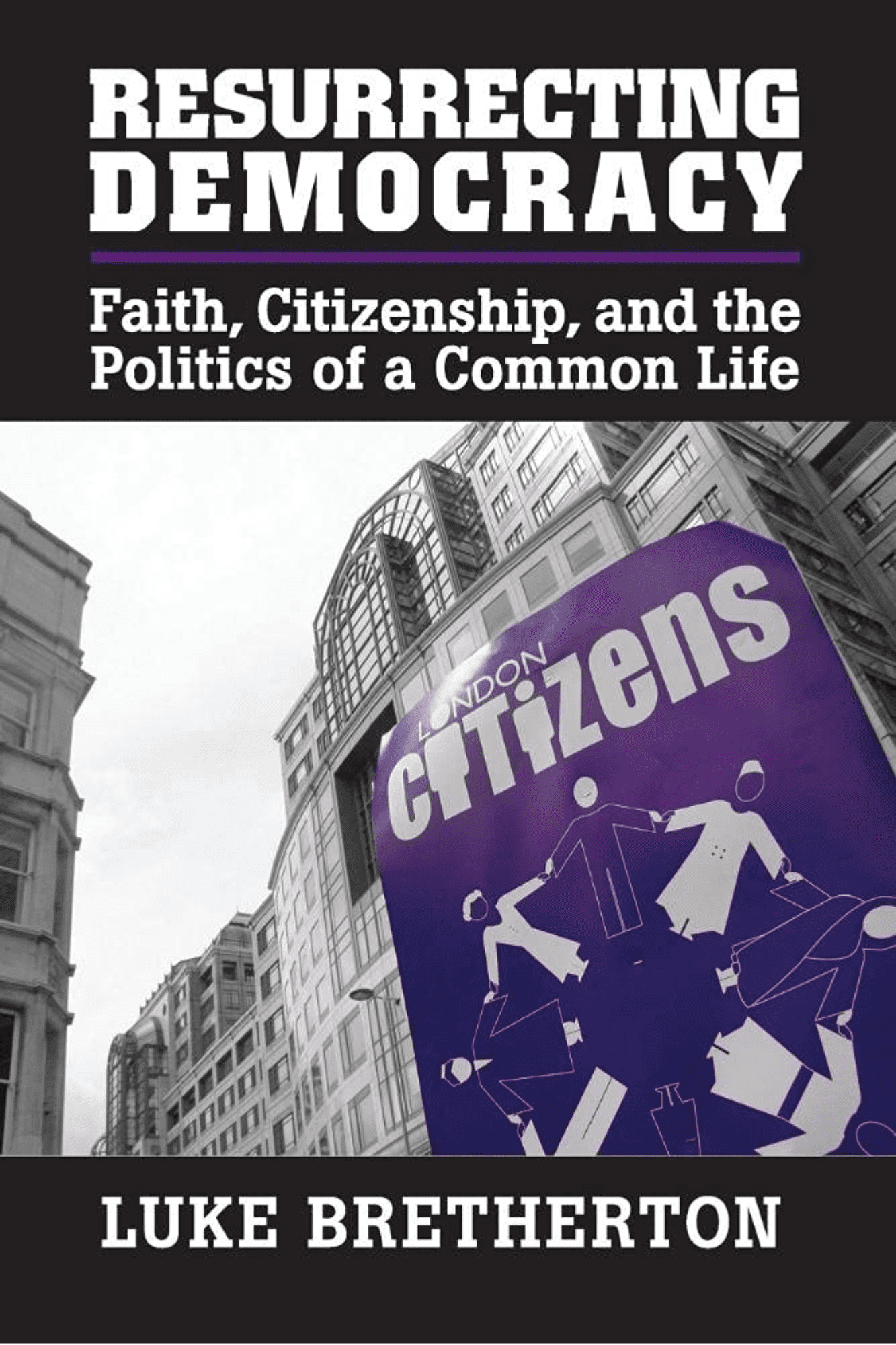
Democracy is hard. The fact of human nature, diverse population groups, and complex intersectional interests make it seem all but impossible. Luke Bretherton, in Resurrecting Democracy, argues that community organizing—broad based community organizing (BBCO) to be more specific, modeled on Saul Alinksy and the Industrial Areas Foundation (IAF)—has normative significance for religious groups, faith communities, and their various political theologies of society. His normative argument has an empirical center; that is, ethnography is its theoretical frame, IAF and other BBCO groups, its descriptive basis. Bretherton turns to their version of ‘consociational democracy’: “a mutual fellowship between distinct institutions or groups who are federated together for a common purpose” (6). If theology or political theory is listening and wants to know, this is what democracy looks like.
This week, we are excited to feature four excellent essays on Bretherton’s book. They all recognize the values of this book: the ways it breaks barriers, raises critical methodological and substantive questions and creates opportunities for new conversations and restarts old ways in a fresh way. But the essays often, as they wind through the complex and loquacious arguments of Resurrecting Democracy, stretch beyond the book itself, turning to not just to Bretherton’s theory of organizing, or his theological ethics of democracy, (a debatable characterization, to be sure), but also to fundamental questions of power, sin, and justice. Indeed, Bretherton’s work asks us to reconsider the nature and tasks of Christian social ethics. These essays bring us both to foundational questions (the role of faith communities and religious groups in participative forms of democracy) and emerging issues (professionalization of organizing and activism), while also giving us a chance to analyze Bretherton’s actual positions, which merit careful consideration.
In Resurrecting Democracy, Bretherton gives a theological-ethical account of community organizing that, in turn, generates a full theory of civil society and pluralist democracy. Broad-based models of community organizing, argues Bretherton, help us chart a return to Aristotelian modes of civic life aimed at deliberating about and forming the requisite associations for the life we collectively desire, the kind that generates conditions of freedom and well-being for all while remaining “faithfully secular.” And yet, contemporary society suffers from a severe paucity of collective belonging, of shared traditions. This is precisely the problem, as Bretherton sees it: his work points to a lack of shared traditions and values in civil society as the problem which plagues democracy and which consociational theories, as practiced by BBCO, try to address. There is not enough agreement about shared interests within very diverse populations, and any coalitions that may develop in response to immediate problems break apart once the issues become less localized. The benefits of BBCO in this regard is its ability to generate virtues and values for the politics of the common life, a politics that is both institutionally focused and relationally generated, even if it stands in adversarial relation to the state and the market. Admittedly, this description is cursory at best, but hopefully it provides an entry point into the featured essays, all of which give far more adequate accounts of Bretherton’s complex positions.
The four essays in this symposium offer both critical and constructive readings of Resurrecting Democracy. Preeminent Christian social ethicist Robin Lovin commends Bretherton for his significant contributions to the growing discussion on the relationship between community organizing, Christian social ethics, and political theory, but wonders aloud whether BBCO will able to sustain its openness to the contributions of faith communities, religious groups, and their theologies, and whether these communities and groups have the requisite theologies to position them well within the sensus communis as described by Bretherton. Vincent Lloyd is less convinced that Bretherton (and the model of BBCO for which he advocates) properly appreciates the burden that sin places on the social order. The problem with the world, as Lloyd sees it, is not that of a puzzle broken apart, but rather of an idol who reproduces a world that is systemically distorted, an idol that speaks the language of capital’s inner logic. The social world as imagined by Bretherton cannot come into view unless this idol is smashed—and this requires a prophetic and iconoclastic model of ideology critique that can only come from the very economic classes (and their political epistemologies) left out of Bretherton’s book: the ordinary poor. C. Melissa Snarr registers a similar concern by pointing to her own research and experiences concerning the complex role that gender plays in the inner workings and dynamics of BBCO networks in general. What kinds of work are women doing—and does Bretherton pay adequate attention to the gendered structures and dynamics at play in community organizing? Furthermore, there are particular concerns, both theological and ethical, with BBCO models of organizing and activism, both with regard to how they interact with other forms of political engagement and activity. Does their call to pluralist pragmatism cover over a latent allergy to intersectional variety, or what Snarr calls “an ecology of accountability and democratic development?” Gary Dorrien’s essay highlights perhaps the most endearing—and enduring—aspect of Bretherton’s work: the interdisciplinary character of his research and integrative spirit of his positions, both of which present a political theory of democracy that is thoroughly realist and gradualist, all the while fixed to its Social Gospel roots. And yet, Dorrien continues, Bretherton does not engage economic democracy theory itself, and makes little mention of the Christian ethics tradition of social justice. Dorrien eagerly makes this case to Bretherton, both historically and theologically, arguing, among other things, that both can help leverage faith communities and religious groups into cooperative relationships in various sectors and across interests, particularly in service to emancipatory social movements that are committing to taking on structural privilege and institutionalized forms of oppression.
These four essays are rich, complex, and can only be treated fairly by conversations between the contributors themselves, complete with responses from Bretherton. This symposium will further clarify the value of long-standing debates about community organizing within political theory, its relationship to social activism, and its place in theological inquiry and ethical engagement.
- Billie Holiday’s “Crazy He Calls Me” ↩
2.3.16
Of Puzzles and Idols
Of Puzzles and Idols
THERE ARE TWO GOOD reasons that community organizing has recently attracted the attention of theologians and religious studies scholars. First, on the ground, community organizing groups are working extensively with religious communities, and they are achieving results. Second, in theory, a robust landscape of intermediary institutions, existing between the level of the individual and the state, promises a path towards post-secular politics. If God’s sovereignty has been secularized into the sovereign self and the sovereign state, theorizing intermediary institutions offers a way forward. Writing about religion and politics starting with community organizing groups speaks to a reality that has in some senses pushed ahead of theory. A robust landscape of intermediary associations need not be imagined for a distant future from the ivory tower. It is visible today, and placing the results of participant observation of community organizing in dialogue with political theology can improve both. That is what Luke Bretherton’s book promises to do, and it delivers. Through a case study of one community organizing effort, London Citizens, in dialogue with political theological reflections, Bretherton makes thoughtful suggestions about how to understand community organizing and how community organizing refines political theology.
The political theological picture that Bretherton paints, adding color to the outlines sketched by John Milbank’s account of “complex space” and Gillian Rose’s account of “the middle,” is very appealing. It offers a theoretically sophisticated response to the antinomies of modernity. I once thought this picture was not only beautiful but also good and true. Now I think its seductive appeal leads political theology astray.
At the most basic level, my concern about Resurrecting Democracy has to do with sin. The world is fallen. Bretherton takes this seriously (more seriously than Milbank). On Bretherton’s account, while the world is good, it is in disorder. No aspect of the world—no individual, no political system, no economic system—can be identified with God. Our job is to search for hints of the right ordering that is to come, to try to align our actions and lives with this order to come, and so to participate in the divine. This is to happen at the individual level, through self-examination, and at the level of social institutions, as individuals collectively discern the right ordering of the world—and these two processes are closely connected. Our relationships with others, our participation in community activities, and our own ascetic practices are all part of shifting our orientation from worldly disorder to divine participation. Community organizing efforts are particularly fruitful, spiritually, because they include relationship building, self-examination, ritual, and collective efforts to discern the good. In other words, the practice of community organizing, not just the results, turns individuals and communities towards God. The results of community organizing also matter: following from the action of a collective oriented towards the common good, community organizing makes the political and economic system more just.
On this view, the fallen world is like a jigsaw puzzle with all the pieces randomly scattered. There are a huge number of pieces, so many that there is no chance that the whole puzzle can be reconstructed in the foreseeable future, but with careful, collective work, and with sustained reflection on the puzzle box with its picture of the finished puzzle, a few pieces can be put together. The problem with this image is that the puzzle pieces are not randomly scattered. The world is systematically distorted. There is layer upon layer of systematic distortions—racism, sexism, provincialism, and many, many more. These distortions do not simply move around puzzle pieces. They affect our perception, preventing us from seeing some pieces altogether, drawing our attention to insignificant pieces, and skewing our view of the picture on the puzzle box. All of these distortions are malicious, even if some arise naturally, as individuals with shared experiences become invested in certain stories about themselves, stories that make the world appear in ways that are false. Some of these distortions do not arise naturally: they are spread to advance the interests of certain groups, usually the wealthy and the powerful. The idol is a figure more apt (and more biblical) than the puzzle: the idol draws our attention with its dazzle and distorts our perception not only of the idol but of everything else in the world. We live in a world full of idols. We must name them, recognize their influence on us, and then right our perception, all the while knowing that there are so many idols in the world that we will never be able to see, and so act, without their influence. Indeed, it is not a picture on a puzzle box but rather the darkness of God, the darkness that appears when the dazzle of idols is gone, to which we should aspire. Living in such darkness means participating in the divine.
Bretherton is dismissive of political theologies that would privilege the perspective of the poor because, he asserts, in this fallen world even the poor are sinners. But idolatry does not affect all equally. There are individuals, families, and communities that are deeply corrupted by the allure of a particular idol and others who resist its appeal. To push the metaphor: there are those who are dazzled by an idol, those who constructed the idol, and those who are disadvantaged by the idol. Those whose perception is most distorted are those who are dazzled by the idol. Those who constructed it, even if they profess belief in it, know that it is a construction, made to serve their interests. Those who are disadvantaged by the idol, even if they profess a degree of belief in the idol’s power, are disposed to be suspicious. They have an intuition that something is amiss, that the idol is not all it claims to be, even if they do not have the language to articulate their misgivings. Over time, the idol’s manufacturers die or begin to forget, but those disadvantaged by the idol never lose their feeling of ambivalence, for their disadvantage persists no matter how firmly entrenched the idol becomes. Idols are thus precarious. Racism, sexism, and homophobia can be named, their inner workings exposed, and their allure diminished—or transformed. This experience is essential spiritual formation: naming idolatry and recognizing that, collectively, it can be named and disarmed. The more disadvantaged one is by idolatry, and by compounding idolatries, the more potential for spiritual formation there is. This is the epistemological privilege of the poor: the surest way to learn how to participate in the divine is to attend the lessons of the poor. Conversely, and crucially, the surest way to close your heart to the divine is to immerse yourself in the world of the middle class, those whose vocation it is to be dazzled. Unfortunately, this is where Bretherton turns for spiritual nourishment.
While Bretherton’s book is less of an organizational hagiography than, for example, Jeffrey Stout’s Blessed Are the Organized, Bretherton is interested in a particular style of community organizing, codified by Saul Alinsky and his followers. Religious congregations and a few community groups join together to support a community organizing effort, staffed by professional organizers and headed by “leaders,” members of those congregations or groups who become the face of the organizing effort. Through one-on-one meetings, small group meetings, and mass meetings, the organization builds relationships among participants and so builds power. The organization identifies community problems, chooses targets who can fix the problems, and uses its collective power to persuade those targets to fix the problems, usually through a repertoire of “actions” (such as protests, often with a festive feel, often including clergy in clerical robes). Such community organizing efforts are funded through a mix of foundation grant support and dues from supporting congregations and community groups. This money goes towards paying the staff and renting office space. Rarely is government support directly accepted so as to preserve the organizing group’s independence, as it is often government officials who are targeted.
Unlike activism—holding a sign at a protest, making a speech, writing a letter to the editor, or signing a petition—organizing against elites exposes the machinations of the powerful to those doing the organizing. Elites almost always respond to challenges posed to their authority in ways that demystify that authority, exposing themselves as manufacturers of idols. Organizing exposes idolatry, and it teaches participants to suspect idols elsewhere. As Melissa Snarr has shown so well in her book All You That Labor, organizing at its best is a religious-ethical practice—a stark contrast with activism which does minimal work on the self. As Charles Mathewes has persuasively argued, a virtuous citizenry certainly has political consequences, and participation in various forms of civic and political organizations can promote the virtues, including the theological virtues. Bretherton’s claim is different, that broad-based community organizing is a political theological practice, that this form of organizing, if we take his title literally, can resurrect democracy. The specific form of community organizing Bretherton describes not only transforms citizens but also fits perfectly with the theoretical picture privileging intermediary associations that he advances. All the world is fallen—except the followers of Saul Alinsky. This is an overstatement: Bretherton is sometimes critical of the group in which he conducted participant observation, but he does present this style of organizing as redemptive.
Resurrecting Democracy does make a compelling case for why Alinsky-style community organizing groups should be seen among the many intermediary associations that play an important role in social life, and that develop citizens’ virtues. I am not persuaded that such groups do this much better than knitting clubs or bridge leagues. Such organizations are all quite good at cultivating the virtues, and they are all quite good at reproducing social capital. The Alinsky slogan that organized capital can only be opposed by organized people is true, but what many Alinsky-style organizations do today is oppose economic capital with social capital. Organizing is understood as relationship-building among community “leaders,” so that now they all have an acquaintance-of-an-acquaintance in Parliament (to extend one of Bretherton’s examples). Economic and social capital are not the same but they can be readily exchanged (witness, for example, the well-compensated profession of the “consultant”). The result is that the struggle between London Citizens and London’s big banks is quantitatively, not qualitatively, different from the struggle between, say, Barclays and Morgan Stanley. The organizing group purports to represent “the people,” or “citizens,” more directly than representation through elected politicians, but the selection procedure for this supposedly more democratic form of representation is based on quantity of social capital coupled with, and inextricable from, performance of middle-class status. The “leaders” of organizing groups do not all come from tony neighborhoods, but within their neighborhood they are “those who have followers,” and through participation in organizing they build relationships with others who have followers and develop their leadership capacity, compounding their social capital.
My point is that there is a subtle but crucial distinction that is elided when organizing “ordinary people.” I agree that organizing ordinary people is the path to resurrecting democracy, but I think ordinary people means poor people. As soon as ordinary people comes to mean a mix of middle class and poor people, and an organizing playbook designed from a middle class perspective (poor people don’t use acronyms, which lard Alinsky-style organizing manuals), the pull of capital comes to dominate the organizational dynamic—social capital at first, but often soon enough financial capital as organizing groups become fully incorporated into the nonprofit industrial complex. The centripetal force of such community organizing should not be underestimated: as those who have interacted with them can attest, the homogeneity in self-presentation of seasoned “leaders” is often rather creepy. Capital is, after all, the most dangerous idol of all: with drug-like addictiveness, it perverts all desire and molds personality. It is the middle class that is most dazzled—the aristocracy stands aloof and the poor are ambivalent. Organizing that begins with paid organizers and is dependent on middle-class support to maintain its “broad base” is necessarily beholden to the interests of capital.
Yet there is something quite powerful and right in the instinct to organize among ordinary people. The challenge is to organize in a way that builds power without leveraging capital. This means organizing with the poor, i.e., those disadvantaged by idolatry: working class people, black people, people with disabilities, incarcerated people, immigrants, and so on. (Rich people do not go to heaven, and they should not organize—we need organized people, not more organized capital.) It means organizing by and for the poor, not catalyzed by professional staff. It means drawing ecumenically on various traditions of organizing, from labor organizing to social movement organizing to Alinsky-style organizing, as well as the organizing traditions that are always already present in poor communities. And it means reflecting on how particular organizing efforts in which you participate has theological significance—for example, how it attacks one of many linked social pathologies caused by capital.
Such an approach to organizing may sound quite fanciful, but only because of the desiccated state of the Left. It is a commonplace that the Left has been marginalized, but an even greater problem is that the academic Left, particularly in the United States, has been almost entirely severed from grassroots Leftist organizing, but the academic Left still positions itself as the Left. Non-academic Leftist participation in grassroots organizing of many types persists, and various formations (usually quickly dismissed as “sectarian”) provide a space for their members’ reflection on organizing and its links to systematic injustices. In the United States, groups like Solidarity, Unity and Struggle, Kasama, the Malcolm X Grassroots Organization, and others inspired by C. L. R. James, Grace Lee Boggs, and Raya Dunayevskaya ought to provide a model for religious communities. At their best, they nurture organizers, offer mentoring relationships, sharpen critical judgment in community, and, like many other civil society groups, cultivate the virtues. What should be most appealing about the model offered by such groups is their embrace of fallenness in two senses. First, they recognize that the injustices of our world are systemic, that they not only distort the world but distort our perception of the world, and that capital is the most pernicious cause of systemic injustice. Second, they recognize that every organizing effort—even those by and for the poor and wary of the distortions of capital—is inevitably flawed. That is why a separate space is needed for ongoing, scrupulous, collective reflection. Organizing is a tactic in the struggle against idolatry, which is to say in the struggle for human flourishing. As the social landscape changes, with energy growing or waning around this issue or that, organizing priorities ought to change. The goal, however, remains the same: to smash idols. After the idols have been smashed, then we can join with Bretherton in envisioning a society based on a model of gift exchange. If we conjure that vision prematurely—by which I mean before the eschaton—it will necessarily be contaminated by layer upon layer of distortion that the world’s many idols ungraciously give to us.

2.3.16
Congregation and Demos
Congregation and Demos
Polemic is always a difficult gift to receive, particularly when it is directed against one’s own work. I take Lloyd’s review to be a polemic that agitates me to clarify my position and forces me to think harder about what I am arguing for. But let me begin by saying I am deeply appreciative of Lloyd’s work, have learnt a great deal from him, and think the issues his work addresses are some of the most important for the field of political theology.
Lloyd thinks that, when it comes to democratic politics, the best is the enemy of the good. I don’t. And my book is an attempts to honor and understand the hard, tiring but good work thousands of people do every day in the United States and around the world to make the world a little more just and a little more equitable through involvement in community organizing. The Industrial Areas Foundation is currently focused on campaigns to address gun violence, to reinvest in disinvested communities, to address the roots of mass incarceration, and to ensure police accountability through a campaign entitled “Organizing for Policing to Serve and Protect but Not Brutalize or Neglect Our Communities.” According to Lloyd, involvement in these campaigns and working alongside those developing them is hopelessly “middle class” and as such it is to be avoided, otherwise one will, on his account, imperil one’s soul.
Lloyd’s charge that community organizing is bourgeois and therefore reinscribes the iniquities and inequities of capitalism repeats a bromide first leveled at Alinsky in the 1930s by Communists and repeated by the New Left in the 1960s. It is now the clichéd critique offered by “the academic Left” in the name of either an ideological purity or a faux realism that is suspicious of everything but its own fetishization of suspicion. Time and again when, as Alinsky puts it, the powerless who “have a little” but want some more do organize for themselves but do so in a way that fails to conform to the canons prescribed by the vanguards of the Left, they are derided as petite bourgeois or subject to false consciousness. The reality is that while left-wing academics opt for the poor, the poor often opt for movements such as Pentecostalism and the Prosperity Gospel. Unlike the academic left who disdain such movements, community organizing begins where people are, taking seriously their own beliefs, customary practices, institutions and forms of leadership. It thereby puts people before program.
Aligned with their scorn for the populist movements poor people often create for themselves, Marx’s self-appointed heirs are equally disdainful of civil society initiatives. I specifically address this kind of critique in chapter 6 within a broader analysis of why leftish ideologies have been suspicious of civil society, seeing it as a stalking horse for capitalism. Lloyd studiously avoids any discussion of this section of the book.
The hollowness of the charge that community organizing is middle class becomes apparent when one tries to understand who are the sheep and who are the goats. Lloyd presents himself as taking a stand for forms of organizing that privilege the poor, but—as often happens when academics intellectually colonize the position of the poor, instrumentalizing them for polemical purposes—he trades in abstractions. Poverty is not one kind of thing. “The poor” come in many shapes and forms; so when Lloyd refers to the poor does he mean the afflicted, the destitute, the powerless, the displaced or the humble and poor in spirit? The semantic field of poverty encompasses all these kinds of poverty and many more besides. Moreover, the class filter Lloyd deploys wholly ignores questions of intersectionality. His review operates with a Monty Python caricature of class as involving the working class, the middle class and aristocrats. Given the sophistication of Lloyd’s other work, this is an oddly simplistic set of distinctions to apply to the globalized contexts I describe in the book. If we learn anything from the analysis of class from Marx, Weber and Durkheim through to Anthony Giddens and Geoffrey Ingham, it is that class, like poverty, is not one kind of thing.1
Processes of stratification and exclusion are changing constantly and are context specific. For example, Dr. Abdulkarim Khalil, director of the Al-Manaar Muslim Cultural Heritage Centre and Mosque, is one of the leaders I worked with, interviewed and whom I quote in the book. He has a tertiary education and is by no means economically destitute. But he is religiously and culturally marginalized and his life is rendered precarious through policies of securitization and the rise of anti-immigrant and racist political populism across Europe and the United States. Yet for Lloyd, unless one is “working class” it is not just that your social exclusion does not count, it is “creepy.” To hear leaders I worked with and quote in the book, leaders such as Hugh O’Shea, a trade union leader, or Abdulkarim Khalil described as “creepy” is chilling. Use of the word “creepy” stigmatizes them as monstrous and therefore to be feared and treated with contempt.
The charge that community organizing is middle class has little analytical merit. Rather, it functions as a handy way to delegitimize community organizing in order to maintain a simplistically either/or, goodies vs. baddies, Manichean picture of the world. Such a picture of the world feeds into a politics of denunciation that refuses to listen to others because it already knows who the enemy is, already knows what the solution should be, and refuses to acknowledge that the wrong is not all on one side. Instead it demands that you take its side. Anyone who asks questions or tries to have a more nuanced understanding is denounced as a reactionary.
Echoing this kind of denunciation, what Lloyd objects to is that community organizing involves many different kinds of people from a variety of socioeconomic as well as racial, religious and other backgrounds. Its sin seems to be building a common life between different kinds of people, including the marginalized and precarious, rather than just identifying with the poorest of the poor (whoever they may be). The important substantive point Lloyd develops is that faithful political engagement should begin with an epistemological privileging of the poor if it is to become alert to its own idolatries. Far from being dismissive of this, as Lloyd claims, the book is an attempt to work out what this might mean in the contemporary context when poverty and otherness often intersect and overlap. However, unlike Lloyd (at least in his less careful moments), I do not elide an epistemological privileging of the poor/the other with a moral/ontological privileging and thereby postulate a “subject of history” who simply because of who they are, whatever they do, can do no wrong. We must beware converting a preferential option for the poor into a doctrine of election.
A central argument of all my work to date is that listening to and encountering the poor / the other via democratic politics is a vital way in which Christians can learn to tell the truth about themselves, the church and the world. But if a “preferential option for the poor” is to be more than a slogan then there have to be meaningful and constructive ways to listen to and build reciprocal relationships with the poor / the other so as to identify and name our idols, love our neighbors, and concretely address the fabric of injustice. My contention is that community organizing is precisely a means through which to do this kind of work with rather than for “the poor”—whether these poor are the socioeconomically precarious, the religiously securitized or the racially oppressed. And it is a way of doing so that ensures the poor are not treated as subject populations on whom are imposed various bureaucratic, colonial, collectivizing, or commodifying programs. Lloyd seems to admit this at the end of his review when he identifies community organizing as able to contribute to what he prescribes. Yet in other places he wills its ends but dismiss it as a means.
Lloyd is however right to highlight how pursuing a “preferential option for the poor” through democratic politics is an inherently ambiguous task, one that is itself prone to self-idolizing. This is a point that I make repeatedly in Resurrecting Democracy, one of the central themes of which is the question of how to de-totalize political and economic life. Part of the problem is that the identity of the demos/people is ambiguous. On the one hand there is the aspirational sense of the term “people” as denoting the whole; on the other there is its factionalist use as a term for one section of the whole, the “have-nots.”
As I argue in the book, one way to coordinate these divergent emphases is by understanding how the aspirational use of the term “the people” can denote heterogeneity rather than homogeneity (171–73). The people as a whole are not monolithic and should not necessarily be equated with either a particular class, a nation-state or form of identity. Rather, the people can be an intricate, differentiated, consociational and faithfully secular body. An emphasis on wholeness rather than oneness encourages a vision of peoplehood as about mutual exchanges between different and often conflicting parts of the whole. A whole body politic is not one where everyone is the same but one in which all may be recognized as having gifts to bring and whose experience can call into question what is taken to be normal. But for wholeness to stand there is a need to identify and pursue goods in common, and community organizing (that is, a form of democratic politics that aims at forming a people as a whole through distributing political agency as widely as possible) is one ongoing way by which to do this. It is at this point that we can see how the practices of community organizing and theo-political concerns about how to pursue a preferential option for the poor intersect.
Lloyd seeks a politics chastened by eschatology and with built-in means of idolatry detection. Amen. If anything I am more skeptical about the possibilities of democratic politics necessarily being a vehicle for “participation in the divine” than Lloyd is. On my account the ekklesia and the demos are neither contiguous, nor can one be taken as a species of the other. But there can be a mutually disciplining, yet critically constructive relationship between them. They are not the same, but each can help the other to be itself and, at the same time, to render all forms of social, political and economic life contingent. In joint action in pursuit of common goods (through something like community organizing), the congregation has to listen to and learn from its neighbors (and perhaps, thereby, encounter the fresh work of the Spirit). Conversely, the congregation, as part of a moral tradition with an eschatological vision of the good, brings a wider horizon of reference and relationship to bear upon the immediate needs and demands of the demos. This mutual disciplining helps ensure that when it comes to earthly politics, both congregation and demos remain directed towards merely penultimate ends.
Contrary to what Lloyd suggests, I make clear time and again in the book that community organizing is not salvific in any ultimate sense. Nor does the book claim that community organizing is the only form of social and political engagement that Christians should be involved with. It does however seek to give an account of what a thoroughly penultimate politics looks like in theory and practice. Moreover, it identifies in community organizing a witness to a way of “resurrecting” democratic politics in a context where democracy has been eviscerated by plutocracy and reduced to electioneering. The term “resurrecting” is used in a deliberate play against expectations of what is considered “religious” and what is considered “political” language. Like community organizing, the book’s title instantiates a form of faithful secularity and points to how political and theological beliefs and practices are often co-emergent, and can simultaneously be mutually reparative and stand in critical relation to each other.
Lloyd’s review makes a number of important points that I am wholeheartedly in agreement with, namely, the need for chastened expectations when it comes to politics, the epistemological privileging of the poor, and the corrupting influence of capital on democracy. Our differences lie in how he understands my work: I think that only a polemical distortion of the position I develop in the book could sustain the interpretation he gives in his review. That said, his review has helped me to see where I must be much more specific and clear in my future work so as to avoid being misconstrued.
- On this see Luke Bretherton, “Sharing Peace: Class, Hierarchy & Christian Social Order,” in The Blackwell Companion to Christian Ethics, ed. Stanley Hauerwas and Sam Wells, rev. ed. (Oxford: Wiley-Blackwell, 2011), 329‒43. ↩

2.8.16
Broad-Based Community Organizing and the Complex Redemption of Relational Power
Broad-Based Community Organizing and the Complex Redemption of Relational Power
RESURRECTING DEMOCRACY IS AN abundant text. Even after multiple readings, the chapters offer invitations to learn from a different organizing practice or walk down another fertile theoretical path. Certainly, much of this richness comes from the interplay of ethnographic description, historical discovery, and careful, creative theoretical exploration. In theological ethics, Luke Bretherton is of the vanguard in scholars turning to ethnographic methods in order to understand lived faith and ethical practice. Moreover, he pushes an essential edge by focusing on the political practices of faith, which is crucial methodologically in light of the collapse of the secularization thesis and the complex realities of our post-secular lives.
But Resurrecting Democracy is also compelling because it offers sophisticated hope. Most political theologians and theorists are all too aware of narratives of decline associated with the atrophying political agency of the demos. The rise of checkbook politics, dismantling of campaign finance reform (in the US), rabid growth of individualism and consumerism, and dominance of technocratic/bureaucratic policy tinkering contribute to the increasingly anemic capacities of persons to advocate for their own needs, let alone politically collaborate across difference. Or as Bretherton claims, our understanding of citizenship has been reduced to a mostly legal status related to the nation-state, which neglects fulsome participation in all levels of politics and requires the cultivation of political identity, political vision, and political rationality (4).
Bretherton finds hope in the ways broad-based community organizing (BBCO) develops the “capacity and virtues necessary to relate to and act with others in diverse settings and ways” (5). Through careful historical exploration of Saul Alinsky and his Industrial Areas Foundation (IAF) inheritors alongside an account of the contemporary work of London Citizens, Bretherton explicates a form of democracy that takes pluralism seriously while also building the “faith” necessary to forge a “politics of a common life” (8). While his insightful historical overview highlights the explicit theological inheritances of the IAF model, the faith to which Bretherton ultimately points is not a particular doctrinal stance or ecclesial allegiance. Rather faith(fullness) is about the discipline and loyalty necessary for developing relational power (27). For Bretherton faith “denotes both an identifiable habitus of belief and practice (whether explicitly ‘religious’ or not) as well as a virtue that entails loyalty, reliability, commitment and trustworthiness” and is most vital when we realize that “it implies attention to a world we did not make, as well as people we do not control, but with whom we must order our relationships, whether we like it or not” (3). In BBCO, though heavily populated by congregations, he sees a form of “faithful secularity” that encourages persons to bring their varied commitments (religious and other) into plural and open common spaces for intentional navigation and coordination. This processural faith works towards a common life, bringing persons together without the imposition of translating their worldviews or forcing hybridization. By building a necessary practical rationality in particular times, places, and communities, it creates a common life politics that resists the dominance and destruction of social life by both the market and the state.
As Bretherton moves into deeper engagement with political theory, he connects BBCO practices to democratic forms of “consociationalism” which pluralize sovereignty and emphasize self-organized, federated relationships among institutions that politically pursue common purposes. In contrast to an autonomous rights-based top-down social contract basis for political life, consociationalism focuses on the body politic’s discernment and implementation of common goods through the disciplined roil of relationship building in the context of more localized, interdependent institutions. Through emergence in stable institutions and then structured engagement among multiple institutions, persons build political relationships and learn how to rule and be ruled (developing political judgment related to justice and flourishing), recognizing not only their community’s needs but also the shared goods of a larger geographic community. The committed, self-organizing, outward-looking institutional relationships of BBCO inculcate precisely the kinds of habits necessary to build a potent relational citizenry that is not merely a consumer or client of the centralizing sovereignty of the nation-state and market.
Bretherton builds on early seventeenth-century reflections by Johannes Althusius (extended in Roman Catholic and Calvinist thought) on plural local forms of institutional political practices that disrupt monist conceptions of sovereignty. This foundation stands in marked contrast to the contemporary state-centered consociationalism of Arend Lijphart, which has been deployed heavily in post-conflict transitional justice theory and practice. Bretherton’s distinction is important because Lijphart’s form of consociation has been criticized not only for its lack of clarity, its technocracy, and its elitism, but also for its gendered impact. Feminist international relations and legal theorists argue that post-conflict consociational governing arrangements, experienced in places like Northern Ireland and Bosnia, reified group and/or ethnic identities for governing coalitions that relied on masculinist logics while simultaneously erasing the crucial work and leadership done by women in bringing about peace. Such reification and neglect subsequently leads to continued cycles of violence with particular brutal effects on women.1
Although Bretherton’s non-statist emphasis is crucial, the strong feminist criticism of consociational manifestations should prompt us to ask about how this form of consociationalism takes into account the labor of women in politics and incorporates them in its ruling dynamics. While Bretherton mentions women leaders in London Citizens and BBCO networks, the protagonists of his historical and contemporary democratic narrative are decidedly male (Arendt serving as a noticeable exception). This absence should invite questions in both theoretical and methodological directions. What might Bretherton be missing by not asking how gender is being performed, reified, and represented in these BBCOs? Building and sustaining relational power is central to BBCO theory and practice, yet little in Bretherton’s account attests to how this power is formed—in detail—in London Citizens or other BBCO networks. In my own current ethnographic observations of BBCO, women bear the load of this work, reminding folks to schedule one-on-ones, performing the bulk of such conversations, providing food and messages of comfort to network leaders who are sick, and enacting much of the coalitions’ emotion work by mediating the goals of the network to its member congregations. Yet for all the discussion of public relationships in Bretherton’s text, there is a decided lack of more intimate accounts of how public relationships (neighborliness) are themselves formed and maintained, likely often by women, in these coalitions. Here the social movement literature on women as bridge leaders (including Belinda Robnett’s work on women in the US black civil right movement) should provide an important prompt for anyone analyzing activism and community organizing. What work are women doing in these coalitions? Why, even when they are the lead organizers of the four major sections of London Citizens, are they named only briefly and neglected in Bretherton’s explicit theorizing?
Here we run into a core, and obvious, challenge of relying on existing religious institutions for community organizing: they are decidedly patriarchal. As we know, women still do the bulk of the work in congregations without fully recognized and funded leadership roles. In what ways do BBCOs replicate and/or counter the patriarchal conception of leadership of their member institutions? Bretherton is optimistic that congregations and the demos can “mutually discipline” each other when it comes to BBCO common life politics—but how is that happening in relation to women’s lives and leadership? Responding to such questions provides entrée into how such institutions and their cultivated practices expand full participation or reify a plethora of oppressive dynamics. BBCOs can cultivate and often are engaged in disruptive gender work (offering trainings for women, consciously distributing public performance roles, providing childcare at events, etc.), but it is essential that we specifically describe and explicitly theorize how this is happening. Without these reparative practices, BBCOs (or theories about them) are not doing common life politics; they are enacting benevolent grassroots patriarchal proxyism.
A thicker ethnographic account could prove elucidative, but I also contend that these gender dynamics are connected with a larger issue in the growing interest in BBCOs displayed by theologians and ethicists: they sometimes adopt too fully the Alinsky-style dismissal of other forms of political engagement and community organizing. Although Bretherton undercuts this tendency at points, there is still a recurring denigration—often for rhetorical and theoretical punch—of identity politics, interest group politics, social movements, and rights-based advocacy (e.g., 34, 40–41, 92, 142). Beginning with Alinsky, this emphasis is meant to foreground place-based organizing for the benefit of a whole community, an outcome Alinsky saw as inherently impossible in other more “partial” forms of activism and organizing. Echoing Sheldon Wolin and others, Bretherton argues that BBCO offers a better way of constructing citizenship because, and here I quote at length,
To be a democratic citizen is not simply to be a lone voter or volunteer, neither is it to be an individual and private consumer of state, business, or philanthropic services, even though all of these may contribute to our practices of democratic citizenship if constructed in such a way as to have a public, cooperative dimension. Nor is citizenship best instantiated by being a participant in a social movement or identity group . . . As a specific ascesis or discipline regime of formation and training in democratic citizenship, BBCO enables a perspective of commonality to emerge precisely by enabling participants to move from being ‘groupies’ with unreflective self-interests to citizens who are reflective about their self-interests and actively seeking mutual interests with others beyond their immediate identity or interest group. (142)
While the logic may hold in abstract, it ultimately falters in two ways: (a) by ignoring the complexity and richness of counterexamples, and (b) by under-theorizing BBCO institutions’ necessary disciplinary partners in light of the persistence of sin.
First, by not ethnographically offering a turn to their counterexamples, Alinsky-inheritors miss the complex moral identity and citizenship formation happening in social movements. How might attention to the depth of organizing in, for example, the Central American Peace movement help us understand the formation of transnational relationships, beyond self-interest, that have sustained lasting personal and institutional partnerships for immigrant rights and even the birth of Worker Centers in the United States? While all democratic formations have gifts and temptations, we are stronger theoretically when the ethnographic sensibility is extended even to those we criticize.
Bretherton performs some of this analysis when he briefly discusses BBCO’s resonance with the commitment of early civil rights movement leaders, particularly Septima Clark and Ella Baker, to building grassroots leaders in contrast with the important, but more ideological, work of the Black Power movement (185–88). Bretherton commends the necessary cultural work of the Black Power, LGBT, and other movements who enable “out-groups” to become a “full participants in the body politic” (187). But he distinguishes BBCO from this ideological culture work by noting that BBCO ultimately seeks to “combine in- and out- groups together” through a set of non-ideological practices that “identify areas of shared interest and thereby foment a common life” (187). BBCOs have “rules of action, but not ruling thoughts” (188) and do not require persons who disagree ideologically to absent themselves from the organizing process as long as they “demonstrate loyalty to a common work” through the practices of BBCO.
Yet Bretherton does not wrestle enough with how the ideological regimes of member institutions constrain the script and performance of BBCO discussions of common life politics. For example, what does it mean for me as a queer woman to sit, as I did again last week, in my monthly BBCO meeting and read in the first paragraph of the “Policy for Working on Issues” that “there are issues that can divide us such as Israeli-Palestinian conflict, same-sex marriage, and abortion. These issues can be addressed by any member of [Network] but not under the [Network] banner.” In a state where one can lose their job and housing because of their sexuality and, until recently, could not have marriages and second-parent adoptions recognized, how does one engage in common life politics when much of what defines the basic parameters of their life is excluded at the start? Why exclude this possibly constructive conflict from the curriculum of neighborliness when much of community organizing is about civic repair?
In the end, I am not arguing that my BBCO network necessarily must engage these issues, although their exclusion through bylaws seems problematic. More concerning to me is how the circulation of exclusionary power should requires us to better theorize the ecology of democratic forms and practices, including social movements and issue advocacy, necessary for constructing our fragile but vital relationships for a politics of common life. Without such attentive work we risk advocating yet another disciplinary regime that sets aside those of particular situations or embodiment as in need of regulation, modification, or erasure for the sake of the group’s sanctity. Bretherton’s focus on BBCO provides a vital contribution to efforts to extend a vital politics of common life, and BBCO should be expanded as an essential pillar for democratic renewal. But we should not be looking for institutional saviors . . . whether in a certain ecclesial or political form.
Perhaps I am questioning at a deeper level any project that seeks to “resurrect” democracy, not because I have a Hauerwasian worry about sacralizing democracy, but because I worry about how the call or promise of resurrection overlooks the complexity of the redemptive work that must involve multiple kinds of institutions holding each other accountable. We need an ecology of accountability and democratic development with an even more realistic account about the necessary interrelationship of varied democratic forms, activisms, and organizing efforts. This ecology must emphasize that even the most seemingly open and just institutional forms still will be sites of necessary confession and metanoia in light of the expansive work of God. What we need is an even more Augustinian impulse that supports multiple forms of faithful politics. This ecology is the wide faith for which I think Bretherton calls throughout this brilliant book, and at several points explicitly acknowledges (242). Certainly, he provides one of the best accounts of grounded practices and political theory traditions that can support the faithful secularity necessary for our deeply complex, interdependent world. But even that tradition remains in need of repentance and stronger theorized and practiced relationships of accountability to other protagonists and other forms of activism. Despite this criticism, do not be mistaken . . . BBCO should be an even more essential part of our liturgical political rhythms and if we do not learn from them, if we choose to underfund or abandon them—the shadow of the valley of death will grow only wider for democracy and for increasing numbers of its subjects.
- Kris Brown and Fionnuala Ní Aoláin. “Through the Looking Glass: Transitional Justice Futures through the Lens of Nationalism, Feminism and Transformative Change.” International Journal of Transitional Justice 9.1 (2015) 127–49. ↩
2.8.16
Agitations of the Spirit
Agitations of the Spirit
I am deeply grateful to Melissa Snarr both for her work and for this enormously insightful and compelling review. It was through reading Snarr that I came to realize I had paid insufficient attention to gender in my analysis of community organizing—she helped me see that had I focused on gender as a constitutive dimension in the research, a richer and more granular account of organizing would have emerged. Her review amplifies and intensifies this point of learning.
In fairness to the book, there is a sustained engagement with some feminist thinkers who deeply influenced key elements of my thinking. The work of geographers Jane Willis and Doreen Massey, the sociologist Saskia Sassen, and to a lesser extent, the anthropologist Aihwa Ong, undergirds my reflections on the intersection of place, democratic citizenship and globalization. And alongside Arendt, the work of Margaret Canovan and Chantal Mouffe are key interlocutors for the development of my conception of populism. It must also be said that given the nature of ethnographic fieldwork, wherein the body of the investigator is the primary research tool, I encountered certain limits when attending to how gender was being performed and represented. Two brief examples exemplify this. I was keen to pursue my observation that in a number of the mosques involved in London Citizens it was Muslim women who were some of the key leaders in the organizing work. This seemed to contrast with the limited leadership roles available to them in their mosques. However, trying to arrange interviews or asking informally about this proved highly sensitive and difficult to pursue. Likewise, when in interviews I asked female organizers about whether the culture of organizing was characterized by a certain machismo, they were not forthcoming, and I had to reckon with how my own body and persona were a block to them feeling comfortable and confident talking to me about it. I do note in a number of places the deeply patriarchal nature of many of the institutions in membership and how this is a point of tension and conflict both within coalitions and with other forms of democratic politics such as contemporary anarchism. All of that being said, Snarr is exactly right to press me to ask what work women are doing in these coalitions and exhort me to explicitly include gender in my broader theorizing about organizing. So let me take the opportunity to respond with some further reflections on this theme, one’s that engage with some issues that Snarr has raised in her own work.
One aspect of the book that Snarr draws attention to is my discussion of how questions of identity and conflicts over understandings of gender and sexuality are often bracketed in community organizing. Since finishing the book I have come to see that the work of the feminist political theorist Nancy Fraser would have been extremely helpful in discussing this dynamic. Fraser’s articulation and assessment of the tensions between a focus on distribution, recognition and representation in democratic politics helps clarify what is at stake within the different repertoires of democratic politics I identify and discuss in the book.1 Fraser’s work could be a key resource in further description and theorization of how gender and sexuality are at times addressed and at other times rendered invisible in community organizing.
At a less formal level, as I was completing the book, I became mindful of, but struggled to know how to incorporate, an insight best articulated in Audre Lorde’s seminal essay “The Uses of the Erotic: The Erotic as Power.” Lorde states: “In order to perpetuate itself, every oppression must corrupt or distort those various sources of power within the culture of the oppressed that can provide energy for change. For women, this has meant a suppression of the erotic as a considered source of power and information within our lives.”2 Lorde expands and in a profound way redefines how we should understand the erotic, rejecting the sequestration of the erotic to sexual intimacy. Rather, she sees it is a form of creative, life-giving energy that is generated out of sharing deeply and joyfully any pursuit with another person. For Lorde, erotic energy requires physical, psychic, spiritual and emotional discipline in relationship with others if it is to be fruitful. Erotic energy and the knowledge that comes through this kind of connection with another person is a way of overcoming numbness and self-negation, and unsettles us from accepting what is convenient, shoddy or conventionally expected. It is for Lorde the “forerunner for joint concerted actions not possible before.” Lorde names something deeply important to, yet largely absent within, discussions of community organizing and related forms of democratic politics. There are, however, some notable exceptions. For example, alongside Snarr’s helpful suggestion of Belinda Robnett’s work, another resource is that of Francesca Polletta.3
As I note in the book, community organizing in its formal training and discursive frameworks tends to focus on certain kinds of grief and anger as sources of energy for change (123–26). Yet organizers and leaders rarely talk about the kind of energy that Snarr rightly identifies as undergirding the solidarity on which organizing depends: the affective ties and intimacies generated between participants, particularly between women, through the work of organizing and that often are not fostered in their congregations. One to ones, house meetings, the sense of being listened to and taken seriously, shared work on a campaign, the fun and laughter had while wrestling with what tactic to pursue all generate the kind of connection Lorde names. My discussion of the role of what I call “the festive” in organizing (158–66), of different forms of sociality (267–73) and the critique of dominant “Weberian” conceptions of politics throughout the book were an attempt to get at something of this. To use a venerable theological term, erotic energy is a kind of quickening that allows new forms of common life to emerge, often across cultural, socioeconomic and religious divides and should not be marginalized by labeling it “pre-political.” What is less clear, but what Snarr’s review presses all those interested in organizing to consider, is whether and how this kind of quickening enables participants to disrupt or challenge the conventions and constraining scripts within their “home” institutions.
The account of “neighborliness” the book develops is a way of framing the sense of connection and responsibility to and for others across differences and amid conflicts that community organizing can generate. Even though it has its own intensities and emotional register, neighborliness does not have the same structure of memory, feeling or relations as that which Lorde identifies. My sense is that the two are interlinked but in tension with each other. But how to name and analyze the relationship between them was beyond me at the time of writing the book and is something I am still trying to work through. Since moving to the States I have begun reading bell hooks as well as some womanist theologians and find there an enormously generative and rich exploration of the kind of energy Lorde names. I have also just begun to read the literature around affect theory and wonder whether this might be another resource to help bring to speech some of these tacit yet animating elements of democratic politics. At the same time, any such reflection would have to wrestle with Silvia Federici’s account of how women’s affective labor (and the erotic energy it may generate) is both a source of the commons and exploited as an ongoing form of primitive accumulation (or more accurately, primary extraction and expropriation).
What one is to make of the relationship between neighborliness and erotic energy theologically is another matter. On my account, neighborliness works across boundaries while respecting and working creatively with conflict and difference. Erotic energy collapses or reconfigures boundaries in ways that can disrupt established forms of life. The characterization of the erotic as Dionysian is not without force. Building on this insight, Rene Girard’s theory of mimetic desire should alert us to the shadow and potentially deeply destructive side of eros. Yet the work of the Spirit, who blows where the Spirit will, is to bring new ways of being alive, birth communion beyond the boundaries of the visible church and break down ossified structures and walls of hostility. Erotic energy, as Lorde characterizes it, and neighborliness can both be signs of the Spirit, and can catalyze and be manifested through particular forms of democratic politics. Yet in saying this, do I thereby sacralize radical democracy and lack a robust conception of sin? There is always a danger of conflating the penultimate pursuit of goods in common through democratic means with pursuit of the kingdom of God, for mistaking a worldly, idolatrous teleology for an eschatological one. Yet there is the equal and opposite danger of failing to hear and witness to the work of the Spirit beyond the bounds of the church; beyond the limits of tradition; outside of formal, theologically normed scripts and conventions.
In the European context Jürgen Moltmann explores this tension in a systematic way. But he is often judged as over-identifying the work of the Spirit with social movements such as the environmental, women’s and peace movements. It is also examined by Henri de Lubac in The Un-Marxian Socialist: A Study of Proudhon (1948): a meditation on one of the founding figures of anarchism. Proudhon as a figure represents a summation and paradigm of a broader question that haunts de Lubac: Do modern revolutionary and social movements represent a move of the Spirit that supersedes the institutional church? De Lubac is concerned to listen to and learn from this “secular” figure in order to generate a critique of the legacy of how the Roman Catholic Church was enmeshed in and legitimated an authoritarian counter-revolutionary reaction in France. For de Lubac, Proudhon helps us think about the modern quest for freedom and its pathologies. Ella Baker and Saul Alinsky could be said to represent similar figures in the North American context: but importantly, while Alinsky himself displays some of these pathologies, Baker experiences them as directed against her, patriarchy and white supremacy being two of the most obvious ones.
I am now riffing off of Snarr’s review. But the challenge I hear within it is the need to locate democratic politics within an account of mission, one that can encompass both a strong pneumatology and an “Augustinian impulse” that, as Snarr puts it, abides with “the complexity of the redemptive work that must involve multiple kinds of institutions holding each other accountable.” My account of consociational democracy and civil society as a body politic does I think do the latter through its advocacy and theorization of the kind of meshwork of repair and critique Snarr calls for (179–242). The more explicit, “Augustinian” and missiological basis for this is outlined in Christianity and Contemporary Politics (2010). However, Resurrecting Democracy does not develop a pneumatological account of faithful politics. Attention to gender would have to be central to any such account. According to the scriptural witness, from Shifra and Puah on, it is women who are consistently heralds of the Spirit’s new life-giving and liberating energy. I am indebted to Snarr’s review for testifying to the agitations of the Spirit to contemplate this dynamic more deeply.
- See Nancy Fraser, Scales of Justice: Reimagining Political Space in a Globalizing World (Cambridge: Polity, 2008). ↩
- Audre Lorde, “The Uses of the Erotic: the Erotic as Power,” in Sister Outsider: Essays and Speeches (Freedom, CA: The Crossing, 1984), 53. ↩
- Francesca Polletta, Freedom Is an Endless Meeting: Democracy in American Social Movements (Chicago: University of Chicago Press, 2002). ↩

2.10.16
Democratic Organizing, Social Ethics, and Economic Democracy
Democratic Organizing, Social Ethics, and Economic Democracy
COMMUNITY ORGANIZING IS VERY belatedly getting its due in political theory and political journalism. Until recently there was hardly any theoretical literature about it, even though community organizing has a long and esteemed history in the United States. Community organizing is said to be beyond politics and ideology, yet its base of moral and financial support is overwhelmingly on the religious and political Left. It burns people out and it has trouble scaling up, but the virtues of community organizing are sturdy, robust, always relevant, and enduring, and today there is more of it going on than ever. Thus the theoretical literature is beginning to catch up to the on-the-ground reality.
Luke Bretherton’s rich, perceptive, copious, sprawling, engaging, sophisticated, and highly compelling book is a major contribution to the catching up. Aside from Saul Alinsky’s two primers and the journalistic literature about Alinsky and the Industrial Areas Foundation (IAF), there was hardly any literature about community organizing until the 1980s. Then the ascension of the Reagan/Thatcher Right threw the entire progressive political spectrum into crisis, turning “liberal” into a scare-word. The communitarian upsurge occurred, not coincidentally, in that political context. Alasdair MacIntyre’s After Virtue (1981) and Michael Sandel’s Liberalism and the Limits of Justice (1982) yielded a gusher of books on civic republicanism as a third-way alternative to welfare state liberalism and throwback hyper-capitalism. Bretherton does not discuss the surge of communitarian criticism that revived the field of political theory as a whole in the 1980s and 1990s, although he refers occasionally to MacIntyre and Sandel. He says that the fall of the Berlin Wall in 1989 unleashed a flood of talk about civil society, but that discussion already dominated political and social theory when Communism imploded. Back then it mattered very much that there were different kinds of communitarians, ranging from Socialist to very conservative, with a large squishy middle of “responsible society” moderates and liberals. Progressive communitarians, in particular, made arguments that echoed community organizers, especially the “broad-based community organizers” that Bretherton commends.1
Bretherton briefly describes Saul Alinsky, recounts the founding of the IAF, notes that community organizing theory was short on theory and scholarship for decades, and cites two notable political thinkers who turned the discussion in the direction of community organizing: Harry Boyte and William Grieder. For Boyte, the relevant text was Commonwealth: A Return to Citizen Politics (1989), although Bretherton cites his later book Everyday Politics (2004). For Grieder it was the bestselling Who Will Tell the People? The Betrayal of American Democracy (1993). Both authors, Bretherton judges, were essentially journalists, not scholars. Both criticized the erosion of public life and civic education in the United States, and Boyte drew on his experience as a community organizer to offer a constructive response. Bretherton, at this point, could have made the connection between the communitarian upsurge and broad-based community organizing, because Boyte epitomized it.2
Boyte’s father was one of Martin Luther King Jr.’s lieutenants in the Southern Christian Leadership Conference (SCLC). Boyte grew up in movement politics and was a veteran of the social movements of the 1960s and 1970s. In the mid-1980s, when the communitarian surge was hot and the Bellah-bunch’s Habits of the Heart was a bestseller, Boyte pushed hard for a communitarian alternative in progressive politics. He founded the Communitarian Caucus in Democratic Socialists of America (DSA) and tried to persuade DSA’s collection of Old Left social democrats, New Left social movement veterans, and independent radicals to replace its Socialist myth with his communitarian Leftist ideology. But that proved frustrating and Boyte concluded that he was still too ideological, like DSA. He rethought what it meant to work out of his own community organizing perspective and background. Specifically, he fixed on the idea of a politics of public work shorn of ideological over-commitments. That comes very close to describing Bretherton’s project, right down to the difference he identifies between himself and the two scholars of community organizing closest to him, Romand Coles and Jeffrey Stout.3
Coles, in Beyond Gated Politics (2005), and Stout, in Blessed Are the Organized (2010), conceived community organizing as a crucial resource and model for a post-liberal account of democracy, much like Bretherton. But for Coles and Stout, Bretherton says, broad-based community organizing groups like IAF were merely exemplary. Coles and Stout already knew what good democracy looked like before they studied community organizing. They had a prior model of grassroots post-liberal democracy in their heads when they commended community organizers for approximating the model. Bretherton aspires to be more inductive than that, allowing the practices and internal discourses of IAF and other community organizing groups to determine his theoretical frame. In this move, he replicates the oldest debate in Christian social ethics over how social scientific the field should want to be if it privileges Christian norms. Bretherton takes the all-in view that the field’s founder, Francis Greenwood Peabody, aspired to take, but Bretherton pulls it off more successfully, as Peabody equated his mild idealism with Christian ethics and what was out there.4
It helps that Bretherton has a valuable body of social scientific scholarship on community organizing to draw upon, most of it written since 2000. He draws adeptly on the seminal sociological work of Mark Warren and Richard Wood, which demonstrates how community organizers help religious congregations build networks of community action leadership and think theologically about what they are doing. The key texts in this venue are Warren’s Dry Bones Rattling (2001), Wood’s Faith in Action (2002), and the Warren/Wood coauthored Faith Based Community Organizing (2001). More recently, Melissa Snarr’s study of the Living Wage movement in the United States, All You That Labor (2011), provides a model of social ethical scholarship on the role of community organizing in facilitating trans-congregational activism on labor issues.5
Bretherton has a different aim, however, than Warren, Wood, and Snarr. They stick closely to what community organizers do and how community organizers talk about it. The aversion to theory that many organizers exude does not count as much of a disadvantage in these books, although Warren, Wood, and Snarr employ social theory as a framing device. Bretherton’s aim is more ambitious, and unusual. His book is chock full of empirical accounts, including his own experience as an activist in London Citizens, replete with a tongue-in-cheek picture of his award certificate for participating on its Economic Crisis Action Team. But Resurrecting Democracy is primarily a long, detailed, and sustained conversation with a variety of theoretical frameworks, especially in political theory, pretty far off the ground. It is every bit as theoretical as the books by Coles and Stout, but determined to theorize out of IAF and similar groups, investigating what democracy looks like through the perspectives of faith based community organizing.
This is a dubious project in much of the academy, so Bretherton lays down several “what I mean by” definitions of crucial terms. Pigeonholed concepts of faith, citizenship, democracy, religion, and secularity will not cut it. For Bretherton, “faith” is both religious and not, it involves habits of belief and practice, and faith-based communities do something valuable merely by upholding the virtues of loyalty, commitment, and trustworthiness. Faith-based communities, at their best, realize that things are not in their control, but nurturing good relationships with all individuals and communities is imperative. Second, citizenship is an identity, something performed in democratic politics, and a shared rationality. Bretherton accepts the Aristotelian / civic republican / communitarian principle that citizenship is primarily about exercising the virtues necessary to create a good society, not about possessing given rights authorized by the nation state. The state is not the arena in which citizenship operates optimally as an identity, a performance, or a common understanding. If one is seriously committed to a trade union, Bretherton says, or the Catholic Church, or an environmental organization, one has an experience of citizenship that runs deeper and higher than the nation state. Though Sandel rates an occasional mention on these themes, Bretherton favors the political philosophers favored by Alinsky and IAF tradition: Jacques Maritain, Martin Buber, John Neville Figgis, Hannah Arendt, and Sheldon Wolin. All were theorists of consociational democracy, “a mutual fellowship between distinct institutions or groups who are federated together for a common purpose.”6
Consociational democracy, in its IAF version, does not set the state against the market, or itself against both. It channels the state and market to work together toward good ends—avoiding violence, mediating conflicts, addressing common challenges, attaining common goods—and it employs the language of the good without committing bad religion. Bretherton is okay with the contemporary jargon of “post-secularity” and “sociotheology,” though he prefers to call his perspective “faithfully secular.” Religious people belong in public conversation. They should not have to squelch their identities, their religious beliefs, or their reasons for having beliefs to contribute to public life, but they have to play well with others who hold a different religion or no religion. Bretherton appreciates that post-secularity is increasingly respectable in philosophy and social science; it helped when Jürgen Habermas stopped saying that theological talk is unsuitable in public discussion. But the “post-secular” notables, even when they use a smattering of theological language, do not interrogate the lived experiences and practices of religious communities. On the flip side, Bretherton aligns himself with the Stanley Hauerwas / John Milbank / Jürgen Moltmann critique that too many theologians self-censor when they write about politics, perhaps out of embarrassment. Religious people must not hide their religious reasons for caring about justice issues; otherwise they end up sounding fake and defensive.
Bretherton has taken a fruitful path, building on two decades of scholarly work on community organizing and taking for granted that the liberal versus conservative debate is as worn out and boring in theology as it is in politics. He has sufficiently immersed himself in the US American experience to make a highly useful argument about the enduring relevance of IAF-style organizing for politics, democracy, and theology. He correctly contends that community organizing grew out of the US American tradition of Populism more than anything else. He wrestles engagingly with a barrage of authors, correcting Joseph Schumpeter for reducing democracy to party politics, explicating the civic republican and IAF preference for Aristotelian practical reason over Platonic idealism, and explaining the common life concept of self-interest and critique of materialism that Alinsky and IAF leader Ed Chambers took from Arendt. Bretherton describes the movement for Blue Labour in which he participated in London, and he puts Alinsky’s notorious Machiavellianism into perspective by stressing Alinsky’s debt to Maritain.
Nearly every writer on Alinsky notes that he treasured Maritain for his emphasis on individual dignity, common goods, and the principle of subsidiarity. Bretherton adds that Maritain pushed Alinsky to acknowledge something he already believed—that one must use moral power to overcome evil, as in just war theory. Maritain helped Alinsky reconcile his attraction to Machiavelli’s rhetoric of power and interest with his moral sensibility. He persuaded Alinsky that power is moral when it is relational, not unilateral or dominating, and when it responds to others as ends, not as means. But Maritain went on to enlist democracy as an article of the church’s faith, a mediating creed that facilitated entry to public conversation, not merely a set of practices. Alinsky drank too deeply from Machiavelli to sacralize democracy. On Maritain’s terms, Bretherton explains, the church was subordinate to the political order, which reduced Christianity to a civil religion. Maritain, on this account, would have done better to uphold Augustine’s dualism of realms, like Alinsky.
My favorite chapter of Resurrecting Democracy is the last full one, on “Economy, Debt, and Citizenship.” Here Bretherton takes up arguments about economic democracy, Karl Polanyi, and guild socialism that I have pressed for thirty years, so of course, I was hooked. Bretherton aptly draws on Stout’s description of community organizing as a grassroots democracy response to domination. He accepts both sides of Stout’s contention that the state is needed to mediate the struggle between labor and capital, but that capitalist elites in the United States have so wholly captured the state that the United States is actually a plutocracy, not a democracy. Bretherton and Stout envision a legal and constitutional state that is devoted to a civic republican idea of freedom as non-domination and is constantly challenged by grassroots democratic associations. Bretherton supplements Stout’s analysis of domination with a discussion of debt bondage, which takes him back to Polanyi versus Ludwig von Mises and Friedrich von Hayek in the 1930s. Polanyi argued that capitalism turns everything into a commodity, including labor and land, turning citizens into debt-ridden consumers. The market does better than the state at getting prices right, but market relations are not spontaneous and self-regulating, so government has to establish and regulate legal limits for the economy. In a real democracy, the state does not fence off production and exchange from associational freedom and democratic politics. We need democracy in the economic realm for the same reason we need it in politics: To prevent capitalist elites from capturing the state and turning the rest of us into pawns and enablers of their rule.7
Polanyi saw what was wrong with capitalism and wrong with the Mises/Hayek arguments for not worrying about it. Bretherton is near the end when he gets to this point, and he says that Polanyi’s guild socialism was too cumbersome to be implemented. So we have inherited a story that sees what was wrong, what is wrong, and what could be better, but we have no solution either. We have only scattered groups aiming at something better. The lack of a real breakthrough anywhere apparently persuades Bretherton that it doesn’t matter if he skips over the history of guild socialism, Christian socialism, economic democracy theory, and almost the entire history of modern Christian social ethics. Whatever happened back then, we live in the super-capitalist utopia of the One Percent, where the big banks are giant hedge funds trading on their own accounts and are too big and powerful to be regulated anyway. Bretherton calls us to support the various movements advocating participatory and economic democracy, which contend for “more consociational, decentralized, and agency-centered forms of coming to political judgment” in all sectors of society, especially the economic sector.8
This endorsement of economic democracy, though heartily welcome to me, surprisingly yields no discussion of economic democracy theory. Bretherton offers a footnote citing two veteran utopian syndicalists, Michael Albert and Robin Hahnel, who have done much of their work as a team. There is no other discussion of, or reference to, economic democracy theory, even though building up economic democracy is the major social justice aim of community organizing and the book. It is strange to me—although it happens all the time—that a Christian social ethicist would write a big book on Christianity, politics, community organizing, and economic democracy while almost completely ignoring the literature on Christian social ethics and economic democracy.9
Bretherton’s field was invented by the Social Gospel movement, which espoused economic democracy. This field had no basis whatsoever and no history for over fifty years apart from the Social Gospel. Even after Reinhold Niebuhr blasted the Social Gospel in the 1930s and took social ethics in a Niebuhrian realist direction, Niebuhr and the social ethics guild took for granted the fundamental conviction of the Social Gospel: that Christianity has a mission to transform the structures of society in the direction of social justice. This was not just a US American Protestant story, although social ethics had a distinctly US American Social Gospel caste in the United States. German Christian Socialism and English Anglican Socialism struggled long and hard over the very issues about democracy, liberalism, markets, and economic democracy that Bretherton takes up. There is a rich Roman Catholic tradition in this area centered on the papal encyclicals Rerum Novarum (1891) and Quadragesimo Anno (1931), and in the early 1940s Anglican archbishop William Temple prefigured the renewal of economic democracy theory by four decades, by formulating a worker ownership scheme based on an excess profits tax payable to worker funds. Temple was incredulous that modern democracies tolerated private banks.10
In the United States, the Social Gospel was complex and unwieldy. In black churches and the remnants of the old abolitionism, the Social Gospel gave highest priority to the struggle against racial tyranny. In white churches, the early Social Gospel gave highest priority to the problems of industrialization and poverty. In both cases, the Social Gospel responded to accusations that churches did not care about the struggles of poor and oppressed people. The ministers who founded social ethics realized it was pointless to defend Christianity if the churches did not take up what was called “the social problem.”
There was a Social Gospel mainstream that was proudly middle class, reformist, optimistic, and moralistic. It supported the Progressive movement and cooperatives, and sometimes it supported trade unions and municipal Socialism. Notable figures in this line included Washington Gladden, Francis Greenwood Peabody, Graham Taylor, Jane Addams, Richard R. Wright Jr., John Ryan, and Shailer Mathews. There was a left flank that spoke the customary language of progressive idealism while advocating Christian Socialism or radical economic democracy. They included Walter Rauschenbusch, Harry F. Ward, Vida Scudder, Reverdy Ransom, George W. Woodbey, George Herron, Albion Tourgée, W. D. P. Bliss, and Kirby Page.11
Some figures in the latter group advocated a Social Democratic fulfillment of social contract liberalism, construing power as an exchangeable thing to be managed by good politics. Others were straightforwardly Marxist in construing power as a commodity that is quantified, bought, owned, given, exchanged, or stolen. In both cases, Social Gospel radicals contended that economic justice was the precondition of individual opportunity. Debates over pacifism were not field dividing during the heyday of the Social Gospel; the politically liberal and radical wings of the Social Gospel both had numerous pacifists and non-pacifists. The dividing issue pitted liberal idealists, who spurned class analysis and did not want to talk about power, against Social Gospel radicals, who fixated precisely on democratizing power.
Social Gospel radicals did not say that middle-class idealism could transform society. Rauschenbusch said emphatically that idealists alone never achieved any social justice cause. Rauschenbusch said exactly what E. P. Thompson famously said fifty years later—that class “happens” when socially awakened workers “make” it. Class is made when exploited people feel and articulate their interests in distinction from other classes, and justice is made when they fight for their rights. Walter Rauschenbusch worked hard at persuading his churchgoing readers not to dread the Wobblies—the anarcho-syndicalist Industrial Workers of the World, who dreamed of one big union. I don’t know many theologians who write like that, which is why I am stubborn about reminding people that a century ago there was such a thing as radical social Christianity.12
Every Social Gospel moderate and nearly every Social Gospel radical contended that cooperative ownership was the ideal. The cooperative idea instilled Christian virtues, it required virtues to succeed, and it promoted community and fellowship. For twenty years the so-called “father” of the Social Gospel, Washington Gladden, advocated profit sharing as a realistic halfway house to achieving the ideal. Fighting is bad, he implored. Sharing is so much better and more reasonable. In the 1880s and early 1890s Gladden gave the same sermonic lecture about good will and the common good to union groups and business groups. The church had a role to play as an honest broker that helped labor and capital come together. Gladden won much applause for this spiel, which compounded his aversion to choosing sides. Every Sunday morning he preached to the capitalist class of Columbus, Ohio. Gladden did not want to say that the Social Gospel could achieve its economic ends only by aligning itself with a fighting, striking, fractious, pro-labor, usually racist, usually anti-clerical Left. But he moved reluctantly in that direction because he saw the struggle between labor and capital turn into a rout.
Rauschenbusch said it robustly: democracy is radically transformative. In the age of monarchs, God was construed as a monarch. In the age of democracy, God had to be conceived as relational and fellow-suffering, the justice-demanding Spirit of love divine. The “kingdom” or commonwealth of God is social, ethical, indwelling, and eschatological, a here-and-not-yet that is not to be passively awaited.
Rauschenbusch got many things wrong, and the movement he championed famously got more things wrong. He employed the terms “Christianize,” “moralize,” “humanize,” and “democratize” interchangeably, which was already quaint in his time, he said nothing about racial injustice for most of his career, and he was painfully conflicted about feminism. But he was prophetic about economic power without reducing Christian ethics to a merely oppositional discourse. To Rauschenbusch the root of the problem was the predatory logic of capitalism, which theologians addressed much too timidly. In Catholicism, the dominant power was the dogmatic mythology of a priestly class. In Protestantism it was the financial and cultural power of a ruling capitalist class. Rauschenbusch applied the same test to the political and economic spheres: Does a given system reward cooperation and the common good, or selfishness and will to power? Does it call people to the good or tempt them downward?
He answered that capitalism is essentially corrupting. Anticipating Daniel Bell's "cultural contradictions of capitalism" thesis by sixty years, Rauschenbusch argued that capitalism saps its own foundations by degrading the cultural capital on which its economic success depends. Capitalism turns labor, nature, and everything else into commodities, reducing citizens to small-minded consumers. It gives autocratic power to owners and managers unrestrained by democratic checks. To Rauschenbusch it was incredible that a worker could labor thirty years in a factory and still possess no more rights over property than a medieval serf. Workers labored on industrial property that was too expensive for them to own, but which was financed by the savings and labor of working people. The law was on the side of the capitalists, because they made it.13
Reinhold Niebuhr, when pressed on the question, sometimes admitted that the Social Gospel had advocates who were not squishy, moralistic, sentimental, optimistic, and averse to power politics. But whenever Niebuhr wrote on this subject, he opted for ridicule. Liberals were stupid, he said, by which he usually meant that liberal idealism made them stupid. Politics is about struggling for power. Human groups never willingly subordinate their interests to the interests of others. Morality belongs to the sphere of individual action. On occasion, individuals rise above self-interest, motivated by compassion or love, but groups never overcome the power of self-interest and collective egotism that sustains their existence. Liberal idealists failed to recognize the brutal character of human groups and the resistance of all groups to moral suasion. Secular liberals like John Dewey appealed to reason; Christian liberals appealed to reason and love; both were maddeningly stupid.
Niebuhr took most of the field of social ethics with him, moving, as he put it, to the left politically and the right theologically. Liberalism and capitalism were finished and no amount of New Deal tinkering would save them. Mass production needed mass consumption, but capitalism was too predatory and class-stratified to sustain mass consumption. Thus it was disintegrating on the contradictions of a system that required, but could not accommodate, continually expanding markets. There was no third way; there was only the choice between revolutionary state socialism and reverting to some kind of fascist barbarism. Economic democracy was serious only if it meant outright government control of the economy.
Niebuhr revived the radical wing of the Social Gospel, but not wisely. Wrongly, Niebuhr and the radicals of the 1930s equated socialization with nationalization and rejected production for profit. Wrongly, they claimed that state planners could replicate the pricing decisions of markets. Wrongly, they wanted government planners to organize an economy not linked by markets. In the late 1940s, when Niebuhr gave up on all of this, he made his peace with welfare state liberalism, joined the Democratic Party establishment, and stopped writing about economic justice—which is a pretty good summary of the field that he influenced.
On these issues Rauschenbusch was better than the entire generation of Niebuhrians that panned him for being too idealistic. Rauschenbusch advocated mixed forms of worker, community, and state ownership. He contended that democratic control was the heart of the matter and that markets cannot be abolished in a free society. He had a strong concept of personal and collective evil coupled with an overcoming message of social salvation. On the other hand, even Rauschenbusch recycled the totalizing rhetoric of state socialism, and he claimed that prices under socialism would be based entirely on services rendered. His concept of economic democracy was a patchwork of socialist and progressive themes that did not always fit together. He could be sloppy in failing to distinguish between different kinds of social ownership, and he did not critically analyze the problems that come with them. Above all, Rauschenbusch trusted too much in the overcoming tide of social idealism.
I am not quite a Marxist and I do not believe that the factors of production trump everything. But I do believe that those who control the terms, amounts, and direction of credit play a huge role in determining the kind of society that the rest of us live in. Marxist theory usually defines class in terms of a fundamental class-process of surplus production and appropriation. Today, Rick Wolff and Stephen Resnick are able proponents of this tradition. There is a neo-Marxist variation espoused by Michael Zweig, Stanley Aronowitz, and Joerg Rieger in which class is primarily about the relationships that shape us, defined by the respective positions that classes hold in the power grid of a society, not by mere strata. I am a fusionist in this debate, like my Union Seminary colleague Jan Rehmann. Exploitation is still a highly condensed and ossified power relation, but not the only one, and I think of power as the ability of people to attain their self-determined ends, not as super-ordination that sensitive people avoid.14
I think that Bretherton is right in suggesting that Maritain’s concepts of just war and common goods helped Alinsky make moral sense of his Machiavellian predispositions concerning power and interest. In my view, Niebuhr would have worked better for this purpose, but that is not what happened, so I will leave Niebuhr aside. I appreciate that Bretherton works hard at constructing his position out of the IAF tradition and framework, and that “faithful secularity” imposes another set of conditions and limits. But the IAF canon is patchy and idiosyncratic. It was largely a product of Alinsky’s personal history; thus, IAF leader Ernesto Cortés has spent decades trying to broaden the IAF canon to assimilate complimentary perspectives and traditions. I do not believe that my points about the paucity of Christian social ethics in Bretherton’s book and its lack of economic democracy theory can be put aside by saying that the book explicates the IAF worldview, not these other things. Bretherton has ample discussions of political theorists far removed from IAF. Carl Schmitt, for example, comes in for his usual on-and-on about the terrible failings of liberal democracy and the necessity of distinguishing friends from enemies. I am astonished that it is somehow still obligatory in books of this kind to pay heed to a Nazi theorist on these subjects. Please, enough about Schmitt, although I was similarly incredulous when the Schmitt bandwagon began thirty years ago.15
The roots of economic democracy theory go back to the cooperative and guild socialist movements of the nineteenth and early twentieth centuries, notably the French section of the First Socialist International, which stressed cooperative networks of production and consumption, and the guild socialist section of the British Labour Party, which advocated a decentralized third way between syndicalism and state socialism. This story quickly gets complicated, so we often begin with G. D. H. Cole on guild socialism or Oscar Lange on market socialism. The political theory guild and sometimes the early IAF tradition both esteemed Cole and Harold Laski for making pioneering contributions to the pluralist theory of the state. Whether or not one skips the backstory, there is a rich literature on economic democracy of recent and contemporary vintage in the work of Alec Nove, David Miller, John Roemer, Radoslav Selucky, Saul Estrin, Raymond Plant, Robert Dahl, Rudolf Meidner, Gar Alperovitz, Ota Sik, Joanne Barkan, David Winter, Severyn T. Bruyn, Samuel Bowles, and Herbert Gintis. These thinkers take seriously the failures of state socialism, the necessity of theorizing and developing post-liberal forms of radical democracy, and the need to build up highly capitalized forms of economic democracy.16
Economic democracy, to me, begins with expanding the cooperative sector and turning the big banks into public utilities. But it only begins there. Cooperatives usually prohibit nonworking shareholders, so they attract less outside financing than capitalist firms. They are committed to keeping low-return firms in operation, so they stay in business even when they can’t pay competitive wages. They are committed to particular communities, so they are less mobile than corporate capital and labor. They maximize net income per worker rather than profits, so they tend to favor capital-intensive investments over job creation. Banks don’t like cooperatives, so cooperatives don’t get adequate financing.
Most of these problems are virtues, and the problematic aspects can be mitigated with tax incentives. But economic democracy, as a movement, is too much like community organizing and the cooperative sector: It doesn’t scale up and it lacks political power. Economic democracy needs a movement that pulls together the thousands of grassroots organizations and worker-owned firms that already exist. It needs forms of social ownership that facilitate democratic capital formation, are more entrepreneurial than cooperatives, and have a greater capacity for scaling up. That requires public banks and mutual funded holding companies in which ownership of productive capital is vested. The companies lend capital to enterprises at market rates of interest and otherwise control the process of investment. Equity shareholders, the state, and/or other cooperatives own the holding companies or public banks.
Mutual fund models contain a built-in system of wage restraints, they have nothing to do with nationalization, and investors still seek the highest rate of return. The distinct advantage of the mutual fund approach is that it diversifies forms of risk sharing and promotes greater efficiency by forcing firms to be financially accountable to a broad range of investors. Essentially, it is a solution to the entrepreneurial deficiencies of worker-owned firms, addressing conflicts of interest between cooperative owners and profitability that often cause cooperatives to miss market signals. This approach does not rest on idealistic notions about human nature, and it does not need a blueprint. Economic democracy is a brake on human greed and domination. The whole point of it is to fight the universal propensity of dominant groups to hoard social goods and abuse disenfranchised people. Neither should any particular model be absolutized, for the blueprint mentality was one of the worst things about the Old Left. I have favorite models to push, but the key thing is to expand the social market in ways that make sense in particular communities. Economic democracy must be built from the ground up, piece by piece, breaking from the universalizing logic of state socialism, taking seriously that there are different kinds of capitalism.17
There is also a role for old-fashioned, large-scale publicly controlled companies in certain areas. Most of the world’s economic powers have them. In France, Spain, Belgium, Germany, Italy, the Netherlands, Turkey, and South Korea, governments run high-speed rail systems that make US systems look pathetic. Japan has the world’s largest public bank—Post Bank. Brazil has more than one hundred publicly owned or controlled enterprises, including major banks and utilities. The US animus against public ownership looks increasingly strange as the rest of the world selectively uses it as one powerful tool among others.
From a democratic perspective, the chief problem with the mutual fund idea is that it trades some democratic control for market efficiency. It empowers designated experts to invest collectively owned social capital by weakening the power of workers at the firm level. To the extent that the holding companies are granted supervisory control over their client enterprises, worker control is diminished. To the extent that the holding companies are kept in a weak position, the advantages of the mutual fund model are traded off as the client enterprises essentially become cooperatives. Economic democracy theorists are usually radical democrats politically, so we place as much control as possible in human-scale organizations in which the distance between management and workers is minimized. But that can be deadly in competing with huge, aggressive, integrated corporations that focus ruthlessly on the bottom line. Any experiment in full-orbed economic democracy has to grapple with difficult trade-offs between the responsibilities of the holding companies and the rights of worker-managed enterprises. Moreover, democratic management is hard to pull off in any sector with large financing requirements.
There is no unitary answer to these problems; there is only the variable and challenging work of making gains toward democratizing the factors of investment and production in particular contexts. On the control problem, I favor a circular model that is biased toward upholding the authority of the public banks or holding companies. To minimize trade-offs between democratic control and efficiency, cooperative firms become shareholders in the holding companies or public banks. The famous Mondragon network in Spain would have crashed decades ago lacking a strong bank. Its second-degree cooperatives offer a useful model of circular ownership and control, one that diversifies risk and builds up new sources of investment capital.
In most religious traditions the local congregation is the fundamental organizational vehicle of religious practice. But congregations have never been at the forefront of social justice activism. In the religious sphere, the strongest social justice organizations are the ecumenical and interfaith networks that Bretherton focuses on, which create coalitions of religious leaders across a geographic area and work on justice issues. IAF is the longtime gold standard; Gamaliel is strong here and there; PICO is surging; and DART specializes in training organizers. PICO has been around since 1972 and for many years it was decidedly number three in interfaith organizing, but that is changing. Instead of organizing on the basis of common issues, PICO employs a congregation-community model that focuses on building relationships and networks sharing social justice values.
PICO is surging because it has modified the Alinsky emphasis on confrontation and fighting for interests, and it has taken with new seriousness the necessity of struggling against white supremacy—a structure of power based on privilege that presumes to define what is normal. Resurrecting Democracy says very little about that, regretfully. Perhaps Bretherton is constrained by some version of the liberal view or a British view that it is impolite to talk about race. Perhaps he is adjusting to US political culture and is uncertain of how he should talk about racial justice in this context. I don’t know. There is a case to be made that community organizing empowers marginalized communities, fights racial oppression, and builds bonds of trust across racial lines better than any kind of social justice activism. Warren and Wood have made parts of that case, but Bretherton has not made it, partly because he does not address how racism plays out differently than other forms of exclusion and oppression.
Bretherton aptly recounts Stout’s argument that the issue of hereditary chattel slavery framed how emancipatory discourses were and are spoken in the United States, and elsewhere he has a three-paragraph aside about the civil rights movement, noting that Ella Baker was a grassroots organizer and Septima Clark ran the SCLC’s citizenship school. He does not consider that SCLC itself was mostly a fire-fighting operation led by high-voltage Baptist preachers who spurned community organizing. SNCC ridiculed King and his lieutenants precisely because they were not community organizers, they were insufficiently radical and democratic, and for a while, they put off getting arrested. Then the fire-fighting preachers of SCLC raised hell in the worst places they could find, making history in Birmingham and Selma, something that only SCLC could have done. King wanted very much to enlist the power of the state to establish a minimum guaranteed income and a democratic socialist economy. He forcefully and unequivocally enlisted the power of the state to break the chains of racial caste. And he had no fantasy whatsoever about abolishing the state.
Community organizing is like union organizing and building cooperatives in being hard and in being something that should be supported wherever it might work. We also need organizations for workers that are pushed into part-time, free-lance work, who have no benefits and no organizing power. The Freelancers Union is a model, founded by Sarah Horowitz twenty years ago, with over 240,000 members in New York state alone. It helps freelancers find new clients, get health insurance, build “sharing economy” enterprises, and create communities of workers that it calls “the new mutualism.” We need organizations that help small businesses work together to transform local economies into thriving and sustainable communities. BALLE is a model, the Business Alliance for Living Local Economies, founded by Judy Wicks and Laury Hammel in 2001. BALLE morphed out of the Social Venture Network and it works to expand Social Venture localism to the national level by developing healthy ecosystems. It brings together company founders, private investors, and social entrepreneurs who are committed to building a just and sustainable world through business.
We need organizations that help cooperative enterprises, community development groups, and hybrid social enterprises band together to share their knowledge and resources. That describes the National Cooperative Business Association and the Social Enterprise World Form. The National Cooperative Business Association operates a global financial cooperative, Oikocredit, that provides loans, equity, and capacity building investments to partners in poor communities, and it has earned a sustainable 2 percent return over its entire forty-year history. The World Forum, far better known, occurs every summer, supporting the growth of social enterprises worldwide. Debt resistance, another enormously important issue, has a flock of new activist organizations—the Debt Jubilee Coalition, Strike Debt, the Gulf Labor Coalition, and the Committee for the Abolition of Third World Debt.
Community organizing, though inherently limited, builds personal relationships across racial, ethnic, religious and class lines, and the interfaith model of it described by Bretherton does these things better than any kind of social justice activism. Religious activists are big on faithfulness and hanging in there. We are stubborn in holding out for face-to-face meetings and building relationships. We usually recognize that giving voice to grievances is a major part of social justice work and that grievances mobilize individuals to join movements. In other words, progressive religious activists have long practiced what is now ubiquitously called “framing.” Despite the terrible shrinkage of the very religious communities that fund and constitute interfaith organizing, there is more grassroots, interreligious, social justice organizing going on than ever. Resurrecting Democracy is all over that development and its potential for reinventing democracy.
- Alasdair MacIntyre, After Virtue: A Study in Moral Theory (University of Notre Dame Press, 1981); Michael Sandel, Liberalism and the Limits of Justice (Cambridge University Press, 1982); Philip Selznick, The Moral Commonwealth: Social Theory and the Promise of Community (University of California Press, 1992); Amitai Etzioni, The Spirit of Community: Rights, Responsibilities, and the Communitarian Agenda (Crown, 1993); Charles H. Reynolds and Ralph V. Norman, eds., Community in America: The Challenge of Habits of the Heart (University of California Press, 1988). ↩
- Harry Boyte, Commonwealth: A Return to Citizen Politics (Free Press, 1989); Boyte, Everyday Politics: Reconnecting Citizens and the Public Life (University of Pennsylvania Press, 2004); William Grieder, Who Will Tell the People? The Betrayal of American Democracy (Simon & Schuster, 1993). ↩
- Robert Bellah et al., Habits of the Heart: Individualism and Commitment in American Life (University of California Press, 1985). ↩
- Romand Coles, Beyond Gated Politics: Reflections for the Possibility of Democracy (University of Minnesota Press, 2005); Jeffrey Stout, Blessed Are the Organized: Grassroots Democracy in America (Princeton University Press, 2010). ↩
- Mark R. Warren, Dry Bones Rattling: Community Building to Revitalize American Democracy (Princeton University Press, 2001); Richard Wood, Faith in Action: Religion, Race, and Democratic Organizing in America (University of Chicago Press, 2002); Warren and Wood, Faith Based Community Organizing: The State of the Field (Interfaith Funders, 2001); Melissa C. Snarr, All You That Labor: Religion and Ethics in the Living Wage Movement (New York University Press, 2011). ↩
- Luke Bretherton, Resurrecting Democracy: Faith Citizenship, and the Politics of a Common Life (Cambridge University Press, 2015), quote at 6; Jacques Maritain, Man and the State (Catholic University of America Press, 1951); Maritain and Saul Alinsky, The Philosopher and the Provocateur: The Correspondence of Jacques Maritain and Saul Alinsky, ed. Bernard E. Doering (University of Notre Dame Press, 1994); Martin Buber, Paths in Utopia (Macmillan, 1950); Paul Q. Hirst, ed., The Pluralist Theory of the State: Selected Writings of G. D. H. Cole, J. N. Figgis, and H. J. Laski (Routledge, 1993); Hannah Arendt, The Human Condition, 2nd ed. (University of Chicago Press, 1958); Sheldon Wolin, Politics and Vision: Continuity and Innovation in Western Thought (Princeton University Press, 1960). ↩
- Karl Polanyi, The Great Transformation: The Political and Economic Origins of Our Time (Beacon, 1957). ↩
- Bretherton, Resurrecting Democracy, quote at 262. ↩
- Michael Albert, Parecon: Life after Capitalism (Verso, 2003); Robin Hahnel, Of the People, By the People: The Case for a Participatory Economy (Soapbox, 2012). ↩
- Pope Leo XIII, Rerum Novarum: The Condition of Labor (1891), in Catholic Social Thought: The Documentary Heritage, ed. David J. O’Brien and Thomas A. Shannon (Orbis, 1982), 14–39; Pope Pius XI, Quadragesimo Anno: After Forty Years (1931), ibid., 42–79; William Temple, Christianity and the Social Order (Penguin, 1942). ↩
- Gary Dorrien, Social Ethics in the Making (Blackwell, 2009); Dorrien, The Making of American Liberal Theology: Idealism, Realism, and Modernity (Westminster John Knox, 2003). ↩
- Walter Rauschenbusch, Christianity and the Social Crisis (Macmillan, 1907); E. P. Thompson, The Making of the English Working Class (Victor Gollancz, 1963). ↩
- Daniel Bell, The Cultural Contradictions of Capitalism (Basic, 1976). ↩
- Richard D. Wolff and Stephen A. Resnick, Economics: Marxian versus Neoclassical (Johns Hopkins University Press, 1987); Michael Zweig, ed., What’s Class Got to Do With It? American Society in the Twenty-First Century (Cornell University Press, 2004); Stanley Aronowitz, How Class Works: Power and Social Movement (Yale University Press, 2003); Joerg Rieger, No Rising Tide: Theology, Economics and the Future (Fortress, 2009); Rieger, ed., Religion, Theology, and Class (Palgrave, 2013). ↩
- Ernesto Cortés, Rebuilding Our Institutions (ACTA Publications, 2010); Cortés and Leo Penta, “Reweaving the Fabric: The Iron Rule and the IAF Strategy for Power and Politics,” in Interwoven Destinies: Class and the Nation, ed. Henry G. Cisneros (Norton, 1993). ↩
- Alec Nove, The Economics of Feasible Socialism (Allen & Unwin, 1983); Nove, Socialism, Economics, and Development (Allen & Unwin, 1986); David Miller, Market, State and Community: Theoretical Foundations of Market Socialism (Clarendon, 1990); John Roemer, "Market Socialism: A Blueprint," Dissent 38 (1991) 562–69; Radoslav Selucky, Marxism, Socialism, and Freedom (Macmillan, 1979); Julian Le Grand and Saul Estrin, eds., Market Socialism (Oxford University Press, 1989); Robert Dahl, A Preface to Economic Democracy (University of California Press, 1985); Rudolf Meidner, Employee Investment Funds: An Approach to Collective Capital Formation (London: George Allen & Unwin, 1978); Gar Alperovitz, America beyond Capitalism (Wiley, 2005); Ota Sik, For a Humane Economic Democracy (Praeger, 1985); Severyn T. Bruyn, A Future for the American Economy (Stanford University Press, 1991); Samuel Bowles and Herbert Gintis, Democracy and Capitalism: Property, Community, and the Contradictions of Modern Social Thought (Basic, 1986). ↩
- This is a condensed summary of arguments that I make in Dorrien, Economy, Difference, Empire: Social Ethics for Social Justice (Columbia University Press, 2010); Dorrien, The Obama Question: A Progressive Perspective (Rowman & Littlefield, 2012); and Dorrien, Soul in Society: The Making and Renewal of Social Christianity (Fortress, 1995). ↩
2.10.16
On the Social Gospel, Economic Democracy, and Race
On the Social Gospel, Economic Democracy, and Race
In the first flush of finishing a book I am full of excitement and evangelistic zeal about its merits. However, after a couple of months, what appeared to me as a garment of rare beauty morphs into a dirty rag full of holes that needs cleaning up and mending. All I can see are the weaknesses and problems. Such are the pathologies of my writing process. Good criticism is like smelling salts, it wakes one from a reverie by helping to develop a more honest appraisal of the strengths and weaknesses of a piece of work. Criticism helps identify the things a book does well and the things it lacks, as well as both the problems and the possibilities of its arguments. So I am immensely grateful to the four contributors to this forum as they each help me develop a truer picture of the book beyond my oscillation between overvaluing and undervaluing it.
Each contribution brings a distinct filter that illuminates a different texture, color and density in the work. Garry Dorrien views the book through the prism of two linked and directly relevant filters: the Social Gospel and economic democracy. Whether it was necessary for the book’s coherence to engage with either of these in the way Dorrien suggests is a matter to which I will return.
But I will begin with a few pedantic points made in response to some of Dorrien’s side remarks. Dorrien points to an absence in the book of any extensive discussion of the liberal-communitarian debates from the 1980s and 90s. This is something I have treated at length in my other writings and the book is an attempt to move beyond these debates. Moreover, Dorrien overlooks how I locate a theoretical turn to civil society in the work of Gramsci and Polanyi, a turn which significantly predates the 1980s (203–4). And while he is right that talk of civil society featured in discussions of political philosophy in the 1980s, it was not a mainstream feature of debates in public policy prior to 1989, which is a point I was making. At an even more technical level, he is wrong to see Hannah Arendt and Sheldon Wolin as theorists of consociational democracy. They are better characterized as contributing to a civic republican strand of democratic thought.
More substantively, the sketch Dorrien gives of the connections between the Social Gospel and community organizing deepens and enriches the historical account of organizing the book develops. I should also add that my teaching about and understanding of the Social Gospel movement are deeply indebted to Dorrien’s work. It is in the light of Dorrien’s own account of the relationship between the emergence of the social sciences in the United States and the Social Gospel movement that I have come to see this book as a contribution to and in continuity with Christian social ethics. However, rather than say what figures in the Social Gospel movement said, as Dorrien seems to want me to do, the book does what they did. The book works in a different idiom to the likes of Walter Rauschenbusch and Jane Addams, and draws on a different set of theological and philosophical resources. Nevertheless, the book echoes their attempts to develop normative yet contextual social and political claims about how to move from the world as it is to the world as it should be. Indeed, Addams’s inductive methodology is very much a forebear to my own ethnographic approach. Likewise, Dorrien argues that Rauschenbusch helped frame the anarchist “Wobblies” positively for the church. Resurrecting Democracy fulfills a parallel service in relation to community organizing and other forms of participatory democratic politics, including contemporary anarchism.
The second filter Dorrien deploys is economic democracy. We share a common commitment to this and we draw from many of the same wells in how we conceptualize economic democracy. However, in my experience, both inside and outside of the academy, it is the plausibility of the vision of economic democracy we share that needs to be established. The kind of non-state-centric position he and I hold is a marginal one in contemporary social ethics, where a politics of recognition and/or a politics of redistribution hold sway. An emphasis on legal and social inclusion of minorities and greater redistribution of resources via taxation and welfare provision are state-centric positions. We are a long way from being in a place to engage in the kind of technical, detailed discussions of this or that scheme of economic democracy that Dorrien wanted me to include in the book. What the last chapter seeks to do is establish the plausibility of a commitment to economic democracy and provide a robust rationale for why such a commitment is essential in the context of current debates in political theory and political theology.
Dorrien criticizes certain forms of economic democracy and community organizing for being unable to “scale up” and thereby lacking in political power. But this skates over a key argument of the book, which is that we need to move beyond what the geographer Doreen Massey calls a “scalar geographical imagination.” Politics is now, more than ever, site and time specific: in a globalized world, scale is the wrong metric. Power is generated through acting strategically at the right time and in the right place so as to influence globalized value chains and interdependencies. My focus on community organizing in the context of a world city allows for analysis of what a politics that is both place-based and simultaneously woven into broader, globalized flows and networks entails.
Dorrien makes a passing remark about the absence of any extensive treatment of race in the book. As he acknowledges, and as I say in the introduction to the book, race was an explicit focus of Warren and Wood’s prior treatments of community organizing on which my work builds. What is entirely absent from previous studies is a consideration of how community organizing contributed to inter-faith relations or vice versa. In the light of remarks by certain GOP presidential wannabees, and the fraught nature of inter-faith relations around the world, particularly in world cities such as London, Lagos and Paris, the focus on inter-faith relations is more salient now than ever. Yet it is striking that none of the reviewers comment on or responds to this aspect of the book, despite it being a central focus of the work. This reflects a broader myopia in US Christian social ethics and political theology that I hope the book will help address.
But in response to Dorrien’s remark, let me take the opportunity to develop a point that is only tacit in the book. A key argument of Resurrecting Democracy is that community organizing is a way to recalibrate the terms, conditions and structure of feeling that shape the performance and understanding of democratic citizenship. In a number of places I draw parallels between community organizing and how the Black Power movement radically reconfigured democratic citizenship. The Black Power movement and community organizing, each in their own way, seek to address both the objective and subjective conditions of powerlessness: the former through seeking to create new forms of community and identity, the latter through drawing on existing institutional forms of community and identity (most notably, congregations).
In the light of some recent revisionist conceptions of Black Nationalism the connections between Black Power and community organizing can be made more explicit. These revisionist accounts take the view that black solidarity does not require territorial separation, a homogenous identity or even a shared consciousness. For example, Tommie Shelby questions whether these are morally justifiable, politically fruitful or even empirically possible.1 In their stead, he makes an argument for a “pragmatic” vision of Black Nationalism as an alternative way to conceptualize the need for black political solidarity.
Shelby argues that rather than being measured in terms of the “thickness” of someone’s identity, a “political mode of blackness” entails “loyalty to the collective struggle” and particular kinds of civic engagement.2 We can extend his argument to say that anti-racist political solidarity, whether black or multiracial in form, requires a commitment and contribution to shared democratic practices that generate non-white supremacist forms of civic identity, performance, and rationality. I contend that community organizing is a way that is open to the kind of political solidarity that the likes of Shelby, Cornel West, Lani Guinier and others envisage.3 It is one that takes the need for a distinctive corporate life and institutional independence as basic, but in such a way as to allow for multiple identities and loyalties to intersect. And it is one that makes central the constructive role of power, anger, and conflict. With its emphasis on participation and agency it also represents a very different framework to either political liberalism (which emphasizes equality but leaves untouched asymmetries of power) or multiculturalism (which emphasizes recognition by the prevailing structure of power rather than the need to change the power structure as such). So while community organizing is not compatible with essentialist forms of Black Nationalism, it is compatible with community-based and cultural forms that are pluralist in orientation. This is born out historically.
In his 1969 book entitled Black Self-Determination, Reverend Arthur Brazier, pastor of the Apostolic Church of God in Chicago, details the work of The Woodlawn Organization (TWO).4 TWO was a community organizing coalition of churches, businesses and civic associations situated in a poor, majority black neighborhood on the South Side of Chicago. It was affiliated with the Industrial Areas Foundation (IAF). Brazier, who was president of TWO, explicitly envisages its work as embodying a form of Black Power, stating:
Black people must always remember that equality and freedom are two things that will never be handed to them on a silver platter. These things will not come as an act of charity or as an act of good will. When they have the strength to take them, and by the very act of taking them, black people will achieve personal dignity, self-respect, and pride of color. It is to this end that The Woodlawn Organization came into being.5
Minister Franklin Florence in Rochester echoed Brazier’s understanding of community organizing as a way to achieve meaningful black self-determination and black political solidarity. Florence was the first president of FIGHT (Freedom, Independence, God, Honor, Today) in Rochester, New York, when it was founded in 1965.6 FIGHT was another affiliate of the IAF that Alinsky helped organize and was explicitly established as a blacks-only coalition. FIGHT’s slogan, “self-determination through community power,” was a clear expression of a key concept of Black Power. Or as Florence once put it: “When you say ‘black power’ in Rochester, it’s spelled F-I-G-H-T.”7 Stokely Carmichael echoed this sentiment, stating in 1967: “If you want an example of black power, look at FIGHT.” Even though white IAF organizers like Alinsky, Edward Chambers and Nicholas von Hoffman played a crucial role in FIGHT and TWO, both black participants and external Black Power activists saw community organizing as wholly compatible with Black Power and by extension, certain expressions of Black Nationalism. In the present moment, with the advent of movements such as Black Lives Matter, organizing coalitions could do much more to intentionally make these kinds of connections.
Let me close by reiterating my thanks for Dorrien’s careful and penetrating engagement with the book and saying that I look forward to further discussion of and advocacy for economic democracy and a non-state-centric vision of radical democratic politics.
- Tommie Shelby, We Who Are Dark: The Philosophical Foundations of Black Solidarity (Cambridge: Harvard University Press, 2005). ↩
- Ibid., 246–47. ↩
- For Shelby’s constructive conception of black political solidarity, see ibid., 136‒60. Shelby’s constructive proposals for action seem far too diffuse to be efficacious. However, his definition of black self-determination is not merely compatible with but would seem to require something like a consociational account of democracy (248‒54). For a different but parallel account see Lani Guinier and Gerald Torres, The Miner’s Canary: Enlisting Race, Resisting Power, Transforming Democracy (Cambridge: Harvard University Press, 2002). ↩
- Arthur Brazier, Black Self-Determination: The Story of The Woodlawn Organization (Grand Rapids: Eerdmans, 1969). ↩
- Ibid., 21. ↩
- “Independence” was subsequently changed to “integration.” ↩
- Mike Miller, “The Student Movement and Saul Alinsky: An Alliance That Never Happened,” in Too Many Martyrs: Student Massacres at Orangeburg, Kent & Jackson State during the Vietnam War Era, ed. Susie Erenrich (forthcoming). Miller notes that when Florence asked Malcolm X about whether he should become involved with a white man to organize a black community, Malcolm X told him Alinsky was the best organizer in the country. For more on FIGHT see Sanford D. Horwitt, Let Them Call Me Rebel: Saul Alinsky, His Life and Legacy (New York: Random House, 1989), 450–505. ↩

2.1.16 Robin Lovin
The Possibility of Politics
The Possibility of Politics
RESURRECTING DEMOCRACY IS A remarkable book. Community organizing, even “broad-based community organizing” (BBCO), seems designed to make a difference to problems that are urgent, local, and specific. We associate it with drives to improve working conditions and housing in Chicago’s Back of the Yards, demands for access to financial services among low-income residents of London, or high profile events like the “Occupy” movements of 2011. As Luke Bretherton’s analysis unfolds, however, the local problems are connected to global networks and integrated into enduring traditions of faith and politics. BBCO implies an entire theory of civil society, and its successes suggest that we should take the theory seriously. Bretherton uses the story of community organizing to provide a comprehensive view of politics, at least as it is lived in large urban centers, and possibly as it will be everywhere in the global system that increasingly depends on those places.
Documenting the achievements of BBCO requires a good deal of work, because the changes it makes are particular and local. That is not to say they are small. They are measured in thousands of homes upgraded, hundreds of families who gain access to new skills or new services, and whole communities that achieve quantifiable improvements in quality of life and a new experience of dignity and empowerment. These things may escape the notice of people who live just a few miles away, and the cumulative impact of hundreds of groups in dozens of cities is rarely seen as a whole, in the way that Bretherton helps us to grasp it here. Community organizations have their own networks of expertise and training, and their leaders often have a profound grasp of the history and sociology behind what they are doing. But by and large they do not write books about it, nor are their skills studied and taught in departments and schools of community organizing, the way that business skills are taught in universities. So most of us, even those who stay fairly alert to what is happening in the society around us, do not notice what is going on. Resurrecting Democracy will help to change that, as will the important works of academic sociology on which Bretherton draws for his “anatomy of organizing” chapters in the first part of his book.
Important as this operational understanding of BBCO is, theology and social ethics will learn more from the political theory developed in part 2, especially the chapter on “Civil Society as the Body Politic.” Here, Bretherton joins the work begun by Jeffrey Stout’s Blessed are the Organized, making an important social movement available for normative reflection as well as enlarging public awareness and sociological understanding of what is going on in complex local communities.
There are important differences between the two books. Stout is part ethicist and part ethnographer. He focuses on the organizing methods of the Industrial Areas Foundation (IAF) pioneered in Chicago by Saul Alinsky, drawing contemporary cases from local communities in the Southwestern United States. His interpretation of these movements draws on his previous work in Democracy and Tradition, where he discerns a vigorous tradition of American democracy, alive in local communities and energizing concern for the common good. This activism finds expression through a variety of religious commitments, notably in Blessed Are the Organized through the Hispanic Catholicism of the American Southwest. Catholic faith is important in these movements, but as Stout sees it, the experience that shapes the activists’ moral and political convictions is democratic and distinctly American.
Bretherton, by contrast, is part ethicist and part theologian. His account of the history and philosophy of BBCO also begins with the IAF, but his case studies are drawn largely from the London metropolis where he was based before his recent move to Duke University in the United States. Where Stout detects an underlying popular democracy that sustains community activism, Bretherton is concerned by the lack of shared traditions and values among the diverse residents of the metropolitan areas in the United Kingdom. For them, it is religious traditions—Christian, Jewish, Muslim, Hindu—that motivate an interest in the welfare of their neighbors. Each faith in its own way transcends the alienation of urban life and the group conflicts of modern politics, but there is little in the way of shared tradition on which to draw. Moreover, Bretherton the theologian is unwilling to elide the differences between the faith traditions present in the secular context. Their collaboration is sometimes a wary one, and like Augustine’s Christians praying for the earthly city in which they find themselves exiled, they do not confuse the source of their welfare with the source of their hope.
These are quite different descriptions of modern life and the space available in it for love of God and love of neighbor. The differences may reflect the different cultures of the US and UK, different social realities between a global metropolis and regional cities in the US Southwest, different mixes of religious traditions with different historical experiences in their local settings, or just differences in theology and temperament between the two authors. It will repay the effort for others to join this discussion, elaborate on the two descriptions, and test them against other local settings. Part of what makes Resurrecting Democracy important is that it suggests a body of future scholarship and further discussion that might grow from different ways of answering the questions it raises.
Those questions are about political theory as well as about sociology, for one point on which Stout and Bretherton converge is the contribution that faith communities make to the political achievements of BBCO. While liberal democracies have long been centers of religious diversity and religious tolerance, it is a major theme in contemporary liberal theory that this diversity precludes open appeal to religion in support of public, political choices. Democracy requires a kind of self-restraint on the part of religious voices in the public square (Robert Audi), or even criteria of public reason that limit the use of religious arguments (John Rawls). To put the point in stronger terms, some regard religion as a “conversation stopper” (Richard Rorty). When someone appeals to religion in a public discussion, that discussion is at an end, because no one can answer a faith-based argument, or offer an alternative to it. Alongside those philosophical constraints, there is also the visceral response that sees religion posing an implicit threat of violence or coercion that subverts the social peace that is the goal of liberal politics.
Against that backdrop of liberal theory, the achievements of BBCO are not only politically impressive. They seem to be impossible. They are the sort of thing that should not happen, not just in the sense that they defy theoretical predictions, but also in that they violate normative rules about what should and should not be said when trying to mobilize a secular, liberal society for common purposes. Nevertheless, BBCO brings faith communities into its movements, churches, synagogues, mosques, and temples, provide recruits, spaces for meetings and rallies, symbols and stories, and moral and religious reasons to undertake what will often be difficult and controversial actions. In the history of organizing, these contributions have proved so important that religious groups constitute the core membership of many community organizations, and they participate as institutions, not simply through the efforts of their individual members.
What we require, then, is a political theory that makes the successes of BBCO both possible and permissible. Bretherton finds this in a theory of civil society that involves organized groups negotiating a common good that is both local enough to address felt needs and valuable enough to sustain commitment beyond a short-term convergence of interests. BBCO works by creating a sensus communis about human goods, utilizing a form of practical reason that has more in common with deliberation in Aristotelian politics than with the limited public reason of liberal political thought. People enter into political life not just to protect their interests, but to secure and share goods that they create and maintain in their families, workplaces, and social groups; and they learn how to value those goods appropriately in their faith communities. Instead of a liberal theory that insulates public choices from religious influences, what is going on at the local level requires an integrated theory of civil society that understands how choices arise and how they sustain commitment across the range of settings in which people actually live their lives. Bretherton draws on an impressive range of sources, historical and contemporary, to formulate this theory. In the end, what we are offered is not just an explanation of why modern community organizing succeeds, but an account of human communities as a whole and the enduring material and spiritual goods that they make possible, whether in the very local settings in which human society emerged or in the complex global network in which it exists today. BBCO works because it is realistic, not just about self-interest and power, but about the conditions that make any kind of community life possible.
Instead of limiting religion to make a space for the emerging modern state, which might have been the European problem at the end of the seventeenth century, Bretherton suggests that the global problem now is to limit the dominant forms of sovereign power to make a space for genuine politics, where people create and share real goods on which they can, in fact, agree, at least in local settings where ideological commitments are tempered by shared needs. That is why his book ends, surprisingly, with a reconstruction of the idea of sovereignty. BBCO looks at first like a tinkering with the machinery of the sovereign state, pressing for changes in law and administration that might enlist the forces of government more effectively on the side of the people. The resurrection of democracy which this movement seeks, however, is not so limited as that. It reconceives sovereignty from the bottom upward, or more precisely, as “the pluralization of political order so as to accommodate and coordinate the diversity of associational life, whether economic, familial, or religious” (234).
This understanding of politics has a long history, and it has religious roots that Bretherton traces back at least to Johannes Althusius, at the beginning of the seventeenth century. Perhaps the first question that this raises for contemporary theology, however, is whether we have an ecclesiology that fits the practical reasoning required for this kind of politics. Especially against the pressures of twentieth-century totalitarianism, theology has often stressed the church’s freedom against the sovereignty of the state, even suggesting that the sovereign state defines its arbitrary power in an idolatrous imitation of the sovereignty of God. That theology has sustained the church’s independence. Whether it can now allow the church to take a place alongside other social institutions in a plural political order is a theoretical question of the first importance. Some theologians will ask whether a church that participates in a sensus communis can maintain its freedom to proclaim the gospel, either as judgment or as promise. Perhaps, however, theology at this point finds itself in a position like that of liberal political theory when it struggles to reconcile religious commitment and public reason. It must be possible, since it is already happening.
2.1.16 Luke Bretherton
The True Order of Being
The True Order of Being
I am very grateful for Robin Lovin’s careful and insightful reading of the book. His pointing to some of the connections and differences between Stout’s and my accounts of community organizing is particularly helpful and suggestive. However, I want to respond to the incredibly important question that Lovin raises at the end of his review: that is, “whether we have an ecclesiology that fits the practical reasoning required for this kind of politics.” By “this kind of politics” I take Lovin to mean the vision I try to sketch in the book of a genuinely pluralistic, radical democratic politics in which no single conception of the good is hegemonic and a common life must be discovered between multiple others rather than determined and directed by an indivisible and transcendent sovereign authority. This common life politics occurs when no single tradition of belief and practice sets the terms and conditions of shared speech and action, and the generation of a pluralistic pattern of common life is a negotiated, multilateral endeavor. My ethnographic analysis of how one specific form of political practice (broad-based community organizing) navigates a particular context (London as a command point in the production of economic globalization and a “world city” characterized by hyper diversity) is done so as to identify what forms of democratic politics enable a common life to emerge amidst difference and can cope with the reality that people have multiple loyalties and identities. This is a prelude to an analysis of what kind of modern social and political order is best able to accommodate religious plurality and facilitate the negotiation of relationships of difference. Part of what is at stake in this analysis is whether the church can find ways of renouncing prior strategies for control, while at the same time regain confidence that it has good news to proclaim.
Lovin is right to say that a central concern of Christian political thought in the twentieth century has been to assert the independence of the church from cooption by the state, even as this has happened in practice time and again. But the focus on sovereign structures of the state has led to a myopia about how churches are always already participants in the formation of political life. Yet when politics is reduced to relations between formal, mostly legal structures and arrangements of, say, how church-state relations should be ordered, this becomes hidden from view. It tends to also assume we already know what kind of thing the church is and what kind of thing the state is. But both of these forms are now under intense interrogation and renegotiation in theory and practice. Some of this is being driven by dynamics I describe in the book, dynamics often bundled together under the heading of “globalization.”
At the same time, from the early nineteenth century onwards, democracy became the normative and aspirational form of political order in European and North American Christian political thought. Even those who are seen to be critical of democracy, such as my colleague Stanley Hauerwas, are only critical of a particular form, that of late modern liberal democracy, and do not propose monarchy or oligarchy as a constructive alternative. Theologians catalyzed and responded to the streams of political thought that shaped contemporary notions of democracy, such as socialism, anarchism, populism and pacifism. And alongside involvement in these supposedly “secular” ideologies, distinctively theological conceptions of democracy such as Christian Democracy and Christian Realism emerged.
Over the course of the nineteenth and twentieth centuries democracy itself became a means through which the church responded to processes of modernization such as industrialization, the rise of the nation-state and capitalism and the new forms of social relationship that emerged through them. For example, Rerum Novarum (1893), and the whole stream of Catholic social teaching it initiates, was initially a response to social and economic conditions produced by industrial forms of production and urbanization. Catholic social teaching came to endorse a particular conception of democracy as a way of navigating between the Scylla of anticlerical and atheistic revolutionary ideologies and the Charybdis of authoritarian and then fascist ideologies that were themselves responses to emerging forms of social relationship. And through this kind of process understandings of what it means to be church were challenged and changed. This kind of process is perennial. Ecclesiology and debates about political order have always been co-emergent and mutually constitutive.
Ecclesiology cannot be done without attention to political theory and political theology. In the New Testament, Greco-Roman conceptualizations of political life are pillaged in order to think about what it means to be the church. One key term used in the ecclesiologies of the New Testament can exemplify the nature of the relationship. Etymologically, liturgy was originally a political term drawn from the Greek word leitourgia, meaning a public work of service or duty undertaken by a wealthy citizen and done for the benefit of the people or wider community (leitos). As a work of service an act of Christian leitourgia is both a political act that builds up and maintains the people of God and a Spirit-filled act that builds up and mediates the work of the God in the world. In New Testament usage, the term is reorientated and in the process transformed wherein such acts of service cease to connote the magnanimous, patrician and unilateral gesture of an elite individual and denote instead a public and common work undertaken by a people and the Spirit. Within this common, divine-human labor there is a human hierarchy, but it is one based on covenant, vocation and gifting, not kinship ties or property ownership. Moreover, it is one where the hierarchy of status is determined not by wealth, ownership or political connections but by a complex interaction of moral excellence/virtue and the workings of the Spirit. The fruits of this labor are distributed and consumed both by the participants, as each has need, and by the world, that the working people represent before God in their prayers, songs and words. Use of political terms such as leitourgia or ekklesia entail redefining and reorientating them so that they take on a different telos through theological adoption. Early theologians continued to turn political categories to ecclesial ends, with Augustine’s reconceptualization of Cicero’s definition of a people being a particularly important example.1 The process of reorientation suggests that analogies between political and ecclesial concepts are never simply direct but dialectical. Neither are they unidirectional.
The adoption of political categories to describe the church and the subsequent borrowing of these transmuted terms to theorize political life and how these political conceptualizations are fed back into ecclesial self-reflection means the relationship between theological and political concepts is peculiarly complex and multifarious. The historical relationship between natural rights, the emergence of concepts such as human rights and the subsequent adoption of subjective rights discourses by churches in the contemporary context as ways of framing their political claims are examples of the crisscrossing between theological and political concepts. Moreover, the relationship between, for example, Walter Lippmann, John Dewey and Reinhold Niebuhr; Arendt and Augustine; John Rawls and his early Christian commitments and the subsequent engagement by theologians with Rawls; Jacob Taubes, Georgio Agamben, and Alain Badiou and St. Paul and the current engagement by theologians with their readings of Scripture, all suggest the traffic continues to flow in both directions.
The relationship between Christianity and democracy is but another iteration of this process and informs not just questions about ecclesiology but also debates about the doctrine of God. The modern restatement of the Trinitarian conception of God is directly related to attempts to conceptualize God outside of monarchical political imaginaries. This is exemplified in the work of Catherine LaCugna, Jürgen Moltmann, and Kathryn Tanner. Conversely, with the recovery of a Trinitarian theology, good order comes to be seen not as the result of the exercise of sovereign will, but instead constituted through participation in right relationships as encountered and empowered through participation in the perichoretic communion of Father, Son, and Holy Spirit. In place of images of political rulers (emperors, kings, or lords), music, drama, and dance become more common analogies for the nature of God. In such accounts God is no distant sovereign but both loving Creator and intimately and vulnerably involved in creation through the ongoing work of the Son and the Spirit. In the light of this kind of God, monarchical, absolute, and indivisible claims to political sovereignty that override the freedom and dignity of the one, the few, or the many are revealed as in opposition to the divine nature. The true order of being is one of harmonious difference in relation. Likewise, humans are not monadic individuals but persons constituted through relationships with various others (including non-human life) and whose dignity and worth is not reducible to or definable by any immanent social, economic, or political claims upon them. However, as debates in Trinitarian theology make clear, the Trinity cannot and should not provide the basis for a social program.2
So to understand the theological questions raised by how different currents of democratic thought conceptualize modern social, economic and political relations is necessarily part of understanding better not only contemporary debates about the relationship between Christianity and democracy but also, conceptions of what it means to be church and the nature of divine-human relations. On this basis I contend that the book is as much a contribution to theological anthropology as it is to political theory and is a vital starting point for answering Lovin’s question of “whether we have an ecclesiology that fits the practical reasoning required for this kind of politics.” If the world cannot understand itself as world without the church, the church cannot understand itself as church without the world.