
Symposium Introduction
An Invitation to the Space of God’s Hiddenness
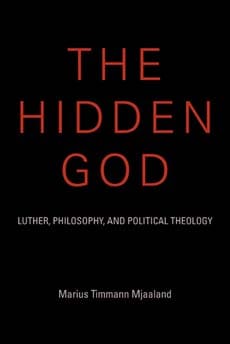
The question of God’s hiddenness is simultaneously the question of God’s presence—not only of where but also of how God shows God’s self. And, this question of presence is a question of not only how God shows God’s self but indeed if God shows God’s self. In Marius Timmann Mjaaland’s The Hidden God: Luther, Philosophy and Political Theology, he offers a careful phenomenological reading of what happens in the event of God’s hiddenness, with special reference to the textuality of Luther’s thought. Beyond his close reading of Luther, Mjaaland also offers a genealogy of the hidden God in modern philosophical and political thought. In so doing, Mjaaland delves into the space where the hidden God transgresses its theological space into the space where the hidden God holds the power to restructure “the world as it appears to ‘us’” (44). This might sound extravagant for some, but for those who read Luther in one hand and the poststructuralists in the other, it sounds right on cue. The artistry of this work, in particular, lies in its ability to go deeply into the conceptual trace of the hidden God in modern political and social thought, beyond the surface of the simple exposition of Luther’s Heidelberg Disputation. This helps show what happens in the spacing of the hidden God, how it affects thought and reorders the world.
In his 1973 article, “To the Unknown God: Luther and Calvin on the Hiddenness of God,” the reformed theologian B. A. Gerrish articulated the two forms of God’s hiddenness in Luther. The first form is explicated in theses 20 and 21 of the Heidelberg Disputation, in which Luther argues that God reveals God’s self in the suffering of the cross rather than the pomp and circumstances of glory. Mjaaland joins many commentators in noting the power of this form of the Deus Absconditus, and the evocative “transvaluation of values” that it puts into motion. But there is a second form of God’s Hiddenness. The second form of God’s Hiddenness is primarily laid out in Luther’s De Servo Arbitrio (“Bondage of the Will”), in Luther’s debate with Erasmus. From The Bondage of the Will, Luther writes, “God does many things that God does not disclose in God’s word; God wills many things that God does not disclose God’s self as willing in God’s word” (Luther, 140). In this second form of God’s hiddenness, God remains hidden beyond God’s revelation, or more precisely, hidden beyond human attempts to comprehend God’s self. Mjaaland correctly points out that many interpreters of God’s hiddenness simply disregard this sense of God’s Hiddenness; Mjaaland quotes Jüngel’s claim that this sense of the Deus Absconditus is “irrelevant” (13–14). Gerrish himself claims that it is an “embarrassment” to many a theologian. An important contribution of The Hidden God addresses this very point—Mjaaland offers an astute philosophical reading of this second form of God’s hiddenness, which bears great fruit for readers of Luther. This second form of God’s hiddenness, that God lies beyond human thought (and thus domestication), is a trace of the deconstruction of the human logos that attempts to know God and know God fully. While Luther’s assertion that God reveals God’s self in weakness challenges the logos of the marketplace, Luther’s claim that God hides beyond God’s revelation challenges the logos of the dominant metaphysics of his time. Mjaaland writes that “the criticism of metaphysics is an effort at redefining the concept of reality, and in that respect it is itself metaphysical” (44). In a detailed reading of these moves within Luther’s own thought, Mjaaland boldly articulates the theological and political significance of the hidden God for today’s world.
Before summarizing the responses from our four distinguished theologians, I want to be explicit about the liberationist possibilities of Mjaaland’s work. This work is valuable in what it offers those of us who are interested in the questions of political and cultural representation. Although some might dismiss “representation” as nothing more than a buzzword, or see it thrown around casually online, the idea of representation is crucial to the ways in which cultural and political narratives shape the ways in which we inhabit and live-into the world. So often the dominant narratives we hear are those that are produced only by those who have the means to do so. And so it becomes vitally important to lift up perspectives or voices of those who inhabit the margins of our society, and to hear—to really hear—those voices that transgress the status quo. Time and time again Mjaaland writes that the hidden God “opens up [discursive] space” that challenges the dominant narratives of self and society. These are the very dominant narratives that condition and silence the lives of “the other,” that deny them representation. It is my hope, then, that The Hidden God might be seen as a resource that opens up space for the other.
***
Dr. Robert Saler commences our symposium with questions about the materiality of Mjaaland’s discourse in the Hidden God. Saler insightfully asks, “To what extent is Mjaaland’s Luther embodied and not simply textual?” By way of answering this question, Saler explores two fundamental issues of Mjaaland’s work. First, Saler asks about the embodied social and political dimensions of God’s hiddenness. As Saler reminds us, Derrida’s poststructuralist analysis often concretely addressed structures of power and justice, especially later in his career. Turning to Mjaaland, then, Saler asks about the embodied dimensions of The Hidden God. Second, Saler addresses Mjaaland’s articulation of the “pre-theological space” in The Hidden God, which raises fundamental questions about the task of theology. On Mjaaland’s framing of theology in the Hidden God, how are we to understand the logos of a God who subverts the category of logos itself?
Mjaaland helpfully shows that Luther’s framing of the hidden God opens up grammatological space into question of metaphysics, and thereby provides a space for self-criticism. Looking at the allure of “fundamentalism” and the scope of its grip of modern day Protestantism, Dr. Martinson asks where this critical space went in the history of Protestant thought. Martinson helpfully writes, “The Lutheran and protestant traditions have in themselves often turned into sheer sectarian fundamentalist traditions.” The question, then, becomes about the material consequences about the space that is opened up by the hiddenness of God. In particular, Martinson wonders about the anthropological dimensions of this critical space. What material difference does différence make?
Dr. Kirsi Stjerna provides a helpful overview of Mjaaland’s The Hidden God. In her essay, Stjerna underlines the political nature of Luther’s theology and reads The Hidden God as a commendation of Luther’s political theology. What might be more helpful in Stjerna’s essay, in my reading, is her own appraisal of the core of The Hidden God. She writes:
Mjaaland leads readers of Luther into the deep waters of metaphysical thought that promises to demolish the confessionally-built dams and inspires truth-seeking that goes beyond the often stifling church language and Luther-slogans. Many of them have become too “comfortable,” which has caused us to become too complacent to understand truly their deeper meaning. (my italics)
I, too, found Mjaaland’s deconstructive analysis to be an important component of his argument. So often, we become “too comfortable” in our communities and churches that we fail to apprehend the transgressive nature of Luther’s articulation of the gospel. Stjerna continues with a recommendation that Mjaaland’s work ought to pay more attention to the contextual dimensions of both Martin Luther and those with whom Mjaaland converses in The Hidden God. Finally, Stjerna suggests that Mjaaland engage with the work of feminist theologians, many of whose articulations and readings of Luther dovetail with Mjaaland’s own work.
Jayne Svenungsson concludes the symposium with the suggestion that The Hidden God or something very much like it is the book Derrida would have written about Luther—a significant endorsement in itself. She believes, however, that The Hidden God represents how the early Derrida would have read Luther, in contrast to the late Derrida. The early Derrida was far more interested in the spatial rather than the temporal. The late Derrida, on the other hand, awaited the justice à venir, the justice that is “to come,” which is registered temporally. A reading of Luther that is more attuned to the temporal dimensions of Derrida’s thought, Svenungsson argues, would have more to say about the question of human subjectivity. Although Mjaaland touches upon this issue, Svenungsson would have liked to see it developed to connect human subjectivity “to a different imaginary register,” away from “the economy of death” and toward “life, hope, and promise.”
Works Cited
Gerrish, B. A. “‘To the Unknown God’: Luther and Calvin on the Hiddenness of God.” Journal of Religion 53.3 (1973) 263–92.
Luther, Martin. Bondage of the Will. Luther’s Works 33. Philadelphia: Fortress, 1972.
12.4.17
Grammar, Violence, Performativity
Grammar, Violence, Performativity
Fundamentalism is not the most fashionable of issues, neither in philosophical theology nor in hermeneutics. And still, fundamentalism is probably one of the essential topics of our times, not only because fundamentalism has revealed its ugly violent face in so many political contexts over the last decades, but also because it seems to be lurking behind all sorts of nihilistic relativisms that we encounter today, in the so-called public sphere. It is therefore worthwhile to underscore, already at the outset, that in Marius Timmann Mjaaland’s book The Hidden God I tend to see a kind of philosophical theological prolegomenon to a much-needed critical theory of fundamentalism, although this important aspect of Mjaaland’s effort is not as explicit, developed and stringent as one could have wished.
In what follows, therefore, I have the ambition to discuss in what way the logic of fundamentalism is tied closely to the critical stance that Mjaaland relates to Martin Luther’s famous discovery of a new way to approach the Bible as scripture. The particular problem that I will delve into concerns the performativity of Luther’s reading strategies, such as these are described by Mjaaland. Let me start with a sketch of my general understanding of Mjaaland’s important book, just to make my brief points as lucid as possible. Needless to say, I do not offer anything like a full summary, only a trajectory that I find important in order to make sense of my further considerations on performativity, fundamentalism and critical resistance.
Destruction and Grammatology
In his book The Hidden God, Mjaaland’s overarching aim is to fill a gap in the scholarship on Luther, namely to give voice to the philosophical side of Luther’s theological texts. This task is developed from the point of view of Luther’s christological idea of destruction of metaphysics, which leads on to a conception of the subject based on scripture, questioning ontological essentialism. These two key concepts—destruction and scripture—pave the way for a substantial dialogue with modern philosophical discourse, especially Heidegger and Derrida, in which destruction, deconstruction and writing come forth as important means to shed new light on the philosophical underpinnings of Luther’s theological discourse. In light of these philosophical resources, Luther’s much-debated distinction between the hidden and the revealed God becomes crucial, and Mjaaland challenges some of the leading modern theological interpretations of Luther (e.g., Barth, Ebeling, Jüngel and Sölle) by arguing that the hidden God should not be escaped as a theologically threatening category, but rather embraced as a “pre-theological” (107) path to a serious understanding of Luther’s controversial thought.
The main focus is set on Luther’s ideas as developed in the Heidelberg Disputation (1518) and in De servo arbitrio (1525), and the substantial point of departure lies in a grammatological understanding of Luther’s interpretative experience—his discovery—of the objective genitive in iustistia Dei (dikaiosyne Theou, in St Paul’s Letter to the Romans 1:17 and 3:21–2), which leads Luther to the conclusion that revelation has been slumbering behind misreadings over the centuries. The discovery concerns human righteousness in its passive aspect, that is, when God’s righteousness is what human being is given by God, hence, not only a righteousness that is God’s, in the subjective sense. Mjaaland argues that this tension through the grammatical ambivalence opens up the space for Luther’s destruction of metaphysics, since it quite radically destabilizes the subjective focus on actively being righteous like God, to a passive receiving of the gift of God’s righteousness, a righteousness coram deo. The anthropological implication is that human being coram mundo is still sinful and utterly dependent on forces outside of her own self.
It is the strict scriptural focus that produces this possibility of both/and in Luther’s thought, and Mjaaland links this to Luther’s intricate discussions about the clarity of scripture, according to which scripture is given the central role for opening up one’s heart to the divine gift (inner clarity), and simultaneously being out of human control in the sense that its external structure and concreteness has to be respected as given. This externality (outer clarity) is put in favor of subjective attempts to understand the text according to dogmatic, moral or other presuppositions. As a whole, the concept of the clarity of scripture thus secures it as true revelation given to the needing and receiving human being.
In relation to Derrida, clarity and difference between the revealed and the hidden God idea is discussed in terms of “signification,” “writing of difference,” “spacing of writing,” or “Arch-writing.” Mjaaland sees a tentative relationship between Luther’s distinction and Derrida’s différance, insofar as the text—and its spaced signs—is the primary source for revelation, never the reading subject or an objectively construed reality that the subject stands in more or less direct contact with through the senses or through reason. The difference between writing and reality always precedes any understanding of reality. Written text embodies this difference in itself and, to simplify, this scriptural approach secures for Luther a fundamentally deconstructive approach to tradition. All this is set up against the dominant hermeneutic understanding of text and tradition in modern Protestant theology. This explains Mjaaland’s recurring skepticism concerning for instance Eberhard Jüngel’s attempt to do away with the hiddenness of God. Mjaaland takes the side of deconstructive thought against hermeneutical theology.
Fundamentalism
One of the many interesting aspects of Mjaaland’s endeavor is that he critically connects his grammatological understanding to the question of subjectivism and fundamentalism in the Protestant tradition and beyond. He does so via a discussion of apocalyptic thought, which for Luther is used as a pattern to unmask the illegitimate and contingent authority of kings and clerics who put their earthly totalitarian systems of thought in front of revelation. For Luther scripture and its clarity thus also become the necessary underpinning for any condemnation and destruction of illegitimate religious and social powers.
Now, there is a sharp difference detected between this political aspect of Luther’s thought and the thought of the revolutionary reformer Thomas Müntzer, whose apocalyptic and spiritualistic perspective was of a different kind. To Müntzer, who indeed also favored the principle of sola scriptura, the interpretation of scripture had always to be mediated by the needs of the present, the situation. The interpretation of this need in the situation was to be made by the revolutionary leadership. Hence, Luther’s critical apocalyptic stance against the self-confident earthly leaders, the anti-Christs, could be turned against the revolutionary elite of his own times. This means that both the pope and the revolutionary radicals could be harshly condemned through apocalyptic comparison.
In Mjaaland’s view the sectarian revolutionary apocalyptic reading of Müntzer forms a pattern that is typical for modernity at large, and the recent fundamentalist violence at the global scene can be seen in precisely this light. There are thus several patterns of reformation at play and in competition in modernity, and Luther’s deus absconditus is generally theorized by Mjaaland as “a distinction between seclusion and revelation” (178–79), which forms a fundamental scar of difference. “The place of such difference is thereby identified as the topos of critical reflection” (179).
But—and this is where I see one interesting lacuna in the argument—the Lutheran and Protestant traditions have in themselves often turned into sheer sectarian fundamentalist traditions, by means of a logic that on the one hand draws substantially precisely on the mentioned difference in God, the place of criticism, and, yet, on the other hand, abandons this (self-)critical space by imposing the content of the discovery as a single premise for interpretation. Hence, the apocalyptic violence of Müntzer’s revolutionary Protestantism is much in line with other forms of Protestantism, initially much closer to the Lutheran stance.
Mjaaland does not deny this in principle, and he touches upon the problem. First in relation to the dominant modern strand of Protestant hermeneutics, where the textual approach of Luther, via the Cartesian subject, has been exchanged for a theory of understanding, according to which the subject has the last word on the meaningfulness of a certain interpretation. And, second, in relation to the general tendency in modern Protestant theology to refer to the Bible as a source for simple and plain truth claims.
However, the internal relationship between Luther’s foundational discovery of a place for radical ambiguity and self-criticism, on the one hand, and the inherent Protestant temptation to abandon this place, on the other, can be theorized further in a way that may problematize the stability of Mjaaland’s distinctions.
Performativity
Despite this preliminary criticism, I am very sympathetic to Mjaaland’s project and I do not exaggerate when I say that the book is among the most interesting and intriguing texts on Luther’s thought that I have ever come across. However, as the suggestion above indicates, there are problems to be discussed further, of which one has to do with some kind of circularity, creating a tangible uncertainty in relation to some of the points that the author makes.
When, for instance in the last part of the book, the theme of political theology is discussed more explicitly, in relation to apocalyptic thought, is strikes me that Mjaaland has great difficulties of being clear whether his project is normative or descriptive. On the one hand, as I have already touched upon, he offers a rather detailed narrative of Müntzer, and he also makes clear that political theological violence trickles down in historical reality independently of the particular view of the Reformation project that is favored. Hence, Luther’s grammatical subtleties do not in any way stand up as a secure bulwark against practical political violence. To claim that would indeed be to misread Mjaaland. On the other hand, however, Mjaaland’s argument as a whole seems to indicate that he prefers and even idealizes Luther’s standpoint, at least close to, and at least as long as it is philosophically decoded through the Derridean perspective of différance. The reason for this seems to be precisely that the Lutheran discovery displaces the subject, opens up a critical space, and thus points in the direction of a humbler and less violent conception or reality.
So, what is the problem of normativity in this? The question of violence is actually only the last question in a chain of other questions, or debatable areas, linking back to the scriptural approach. Let me briefly summarize this chain:
- The question about the relationship between, on the one hand, a grammatical discovery in general, opening up a new space, destructing old readings and regimes of reading, and restructuring the possibilities of readings; and, on the other hand, a substantial theological discovery through the grammatical layer, generating a new theological insight with strong anthropological consequences.
- This question leads to a more general question about performativity of interpretative discoveries. If a discovery is done on the interpretative level, meaning that a series of earlier options becomes obsolete, cannot this be understood in terms of the performativity of the interpretative discovery itself, let’s say in the sense of Thomas Kuhn’s idea of the revolutionary character of scientific discoveries, which henceforth changes the very preconditions for a particular branch of science?
- If that’s the case, should not the actual theological and anthropological consequences of Luther’s discovery be understood less in terms of a general function of grammar and interpretation, and more as a paradigmatic discovery of one possible understanding of human being as radically decentered; an understanding of decisive consequences for many other issues, and with foundational weight for important branches of subsequent theorizing, such as the grammatology of Derrida?
- Does not this mean that the Lutheran discovery first and foremost is a discovery of a new way of understanding human being as radically sinful in her saved state, that is, a new dogma of human being that actually will become a hindrance for self-criticism—at least when it comes in its theological shape, although it also carries with it a philosophical and atheistic residual that may be traced in several subsequent atheist philosophies, especially in the Nietzschean tradition.
- This, finally, can be seen in the practical political violence of historical Protestantism, both in its rationalistic and its irrationalistic versions.
Hence, what I mean by performativity is that a discovery of grammatical kind such as Mjaaland finds in Luther can never appear in the clean sense presupposed by Mjaaland’s “place of difference.” It is Luther’s particular, contingent and theologically substantial discovery of human being in relation to God that performs or creates the conditions for the grammatological reading, which then can be interpreted atheistically as an empty place of radical preponderant difference. The grammatological discovery is thus Mjaaland’s rather than Luther’s.
The brute violence of Protestantism in history is not something alien to Luther’s foundational theological and anthropological discovery, as Mjaaland himself seems to realize when he effectively describes the relationship between Luther’s propagandistic strategies, his cunning rhetoric, and the contemporary public sphere, “with a collapse in the absolute distinction between public and private, and insulting cross-references between various styles, languages, public religions, and authorities” (153).
What I would like to push further, therefore, is the idea that Luther’s discovery, besides its theological distinctions, has fundamental anthropological implications, which will become normative for all other acts of interpretation and deliberation in the Lutheran universe. There is a crude performative moment in this discovery, a creation of a new universe of interpretative possibilities that will indeed underpin violet fundamentalism but—and this is where Mjaaland’s analysis becomes so helpful in order to develop serious anti-fundamentalist and anti-relativist strategies—also open up a potential space of severe criticism of precisely this form of fundamentalism.
What I miss, therefore, is probably only a more careful and serious theoretical elaboration of the internal dialectic between the critical (and self-critical) space that the grammatological (and nihilistic?) reading opens up, and the crude substantial violence that theologically precedes the philosophical need for critique and self-critique. In my view—not for a second denying the urgent need for a critical and self-critical space—there just seems to be no empty, “pre-theological” space beyond or before the violent theo-political performativity, creating the paradigm for five centuries of brutality in the Protestant world.
12.4.17
Is This about Fundamentalism?
Is This about Fundamentalism?
Fundamentalism? What is fundamentalism? And was Luther a fundamentalist?
Martinson’s contribution is subtle and puzzling, he argues on various levels, and I am not quite sure that I can do justice to all of them. Still, I wish I could. This is the most challenging response to The Hidden God I have read so far.
But was Luther a fundamentalist?
I ended up avoiding a serious discussion of the term in my book, after having touched upon it in previous drafts. There are two reasons for that: First of all, the phenomenon currently referred to as fundamentalism or foundationalism is typically modern, even a reaction to modernity. Second, it seems clear to me that almost everyone uses the term pejoratively, but it often lacks a more precise clarification that would make it analytically helpful. The OED defines it as follows: “Strict adherence to doctrines and practices held to be fundamental to Christianity, spec. belief in the inerrancy of Scripture and literal acceptance of the creeds as fundamentals of Protestant Christianity.” Similar definitions adhere to Islamic fundamentalism or fundamentalism in a more generic sense.
According to this definition, it is difficult to situate Luther more precisely. As a Catholic, he was definitely rather unorthodox, even heterodox, when it came to belief. His practice was even more so, breaking with the customs and practices of the church to which he belonged. He obviously enjoyed earthly goods and broke the rules for a pious life of his times. And he notoriously questioned authorities.
On the other hand, he believed that his understanding of the Christian confession was more orthodox than the one professed by his contemporaries, including the pope (whom he addressed as Antichrist) and the leading theologians of the time. He adopts a confessional and polemical style that raises much controversy and becomes the occasion for new confessions.
Hence, was Luther a fundamentalist or a proto-fundamentalist?
Basically no. Not because there are no traits in his thought that may be used by fundamentalists within the Christian tradition—rather on the contrary—but in its polemical form, this label becomes anachronistic when applied on the historical figure Martin Luther. He became an assertor who rejected the literal inerrancy of Scripture (he even considered rejecting parts of it), but insisted on its clarity in questions of salvation.
Luther’s reflection on the distinction between hidden and revealed is another example of anti-fundamentalism: It jeopardizes the direct identification of “goodness,” “being,” or highest reason with “God.” It opens up the vast space of difference, even within these terms “goodness” or “being,” as names for God. The logic of theology is thus drawn into critical reconsideration in terms of this pre-theological difference. Consequently, apocalypse as a script for divine will must also be radically reconsidered.
Mathias Martinson argues that the question of fundamentalism is linked to the grammar and performativity of texts. And this may be a point of disagreement. I see this reflection on grammar and performativity as a critical theory of texts, and not the opposite. But I may be erring here.
Admittedly, what Martinson had hoped to find in The Hidden God was not a definition of fundamentalism or instances thereof, but a theory of the critique of fundamentalism, although “not as explicit, developed and stringent as one could have wished.” As already mentioned, there is no such theory in the book (the word “fundamentalism” is only mentioned twice), but that does not prevent us from discussing a challenging topic.
The ambitious but ambiguous goal of Martinson’s contribution is to discuss “in what way the logic of fundamentalism is tied closely to the critical stance that Mjaaland relates to Martin Luther’s famous discovery of a new way to approach the Bible as scripture.”
The ambiguity lies in the alleged connection between the grammar and performativity of texts on the one hand, and “fundamentalism” as political violence based on confessions and literal interpretation of holy scriptures on the other. It is in connection with my analysis of apocalypticism in Müntzer that Martinson introduces the term, but the crux of his argument is based on the relationship between the grammar of texts such as Romans 1–3 and their performativity.
This gives the occasion to his intricate argument in five steps, first concerning the relationship between Luther’s grammatical discovery and the destruction of old readings, second the “performativity” of new discoveries, third a shift from grammar and interpretation to anthropological insights, fourth, that this insight represents a dogma hindering self-criticism, and fifth, that this dogma allegedly leads to “the practical political violence of historical Protestantism, both in its rationalistic and its irrationalistic versions.”
Actually, I cannot follow any of these inferences from one point to the next. I see neither a logical nor a causal connection between each step, and I disagree with the descriptions of grammar and performativity linked to violence.
Martinson thinks that I may have “idealized” Luther’s position. This was not the intention (on the contrary, my description of Luther is way too critical to most Protestant theologians), but he may of course be right. Anyway, based on a detailed reading of Luther, Müntzer and Catharinus, it became more than obvious to me that Luther is the only scholar who reconsiders and deconstructs the apocalypse in the 1520s. He does not reject apocalyptic texts per se, but he urges the reader to seriously question the logic of apocalypse with the help of reason and of scripture. Whether this point is understood by the later Protestants, is an open question. Possibly they only see the new dogma, and not the explicit critique of dogmatic positions in Luther’s thought.
This is one of the severe difficulties we uncover when we study political theology: The political usage of theological insights or principles, from the sixteenth to the twenty-first century, often runs counter to sound theology. Hence, the authority behind this interpretation ought to be questioned, as Luther continuously does. As a scholar, Luther keeps on questioning false authorities, including his own, and that is perhaps the most significant anti-fundamental strategy of his writings.
However, apocalyptic imagery is not reproduced based on Luther’s or Müntzer’s authority, but because it is dramatic and polemical. It enhances the conflict and demonizes the enemy, as, e.g., the revolutionary texts of Engels demonstrate within a different historical context. Hence, it can easily be instrumentalized, deliberately or not.
Now Martinson asks, and this question is extremely important, whether the alleged “performativity” of scripture, including the justification of sinners expressed in Rom 1:17 and 3:20 as such is an expression of fundamentalism? Is the Lutheran slogan of sola scriptura one of the triggering reasons for a flood of unrestricted violence flowing over Europe in the sixteenth and seventeenth centuries? Is there possibly even a causal relationship between this theory of scripture and religious fundamentalism?
No, I think the causal relationship follows very different paths and trajectories, above all political ones concerning power and identity. But I agree that there is not exactly a solid protection against fundamentalism within this theory of “scripture alone.” Taken in its plain and literal sense, and void of the substantial critique of authorities, it makes the door wide open towards modern fundamentalism, possibly even an unrestricted excess of violence.
Hence, in conclusion I would simply emphasize a crucial point of this principle: It only makes sense within tradition, as a critique of religious authority, and related to the continuous negotiations of political and philosophical reason. Detached from these discourses, the dangers of another triumphalism are obvious. Protestantism is probably neither better nor worse than other traditions in this respect. There is liberal and intellectual Protestantism that represent driving forces of modernity and secularity. Yet the dialectic of modernity produces counterreactions, e.g., in the form of fundamentalism, which is the phenomenon OED actually refers to, beginning in the 1920s. There is a dialectical link here, but it becomes highly problematic when explained by Luther’s theory of scripture and linked to excessive violence.
A significant discovery in theological respects—the justification of sinners—may not be equally helpful in countering fundamentalism. In this sense, Martinson is of course perfectly right. And yet, given the various apocalyptic movements spreading around the world, a theological critique of apocalyptic imaginary could be a fruitful strategy of identifying the inherent logic of apocalypticism (rather than fundamentalism) and its limits.
Indeed, this would not be a total theory in order to solve the problem of fundamentalism once and for all, but a critical inception in times overflowing with dystopic and utopian visions.

12.10.17
What if Luther was wrong?
What if Luther was wrong?
Reflecting on Martinson's reply to Mjaaland, and this sentence "the idea that Luther’s discovery, besides its theological distinctions, has fundamental anthropological implications, which will become normative for all other acts of interpretation and deliberation in the Lutheran universe". That's it, Luther's discovery that had perhaps the most far-reaching consequences for how human being and her knowing and "relating" capabilities are understood. This discussion on the hiddenness of God in its many aspects assumes Luther was right. But, just for fun: was he? Or how much of what he thought he knew we actually don't perhaps quite get because we don't have his late medieval mindset and imagination? I'd imagine Luther would be the first to argue that each generation generates its own ways of seeking for the truth with the Scriptures; he certainly did that. Back to the topic of sin and human limitations: I'd like to add to the mix Luther's ruminations with the Genesis lectures on how human beings bought the devil's lie on what was good to be bad while it actually wasn't. All that "mess" that came to hinder human knowledge of God's ways started by that tree of .... knowledge.
12.11.17
Commentary by Kirsi Stjerna
Commentary by Kirsi Stjerna
Introduction
It would be difficult to write a traditional book review that does sufficient justice to the richness of Marius Timmann Mjaaland’s book The Hidden God: Luther, Philosophy, and Political Theology. The book has so many dimensions and its questions are far-ranging, which attracts the attention of many different disciplines. The contributions or challenges of the book could hardly be detailed in a single conversation. Therefore, this work is ideal for the Syndicate forum and is an important invitation to its readers “to get philosophical” with Luther. In the following, I will articulate some of the observations and questions regarding the book’s basic orientation, trusting that the conversation on the details will take place in the back-and-forth discussion in the forum with the author’s input.1
Overview
Mjaaland leads readers of Luther into the deep waters of metaphysical thought that promises to demolish the confessionally-built dams and inspires truth-seeking that goes beyond the often stifling church language and Luther-slogans. Many of them have become too “comfortable,” which has caused us to become too complacent to understand truly their deeper meaning. The deconstructive mission of Mjaaland’s book unveils the radical offensive nature of Luther’s fundamental points, which were first and foremost philosophical, but were also deeply political. We are all familiar with these expressions: “sola scriptura,” “the hidden God,” “theology of the cross,” “justification by faith,” etc. These are philosophically loaded expressions, just as they are political. The moment that these expression cease to bear that dual energy, they are in danger of becoming dead pretty words—and, may I say, they become quite impossible to teach!
This premise alone is a worthy conversation starter and central for contemporary classrooms where Luther is the dish: bringing together the words “Luther,” “philosophy,” and “political theology.” For some these words hardly jell together (I could name actual persons off the bat, presenting opposing views, but let me digress). I am with the author on his fundamental position. Namely, if Luther was not contributing to questions of philosophy and if his theology did not promise to change the world—if it was not political—then what would be the point of still getting excited about him?
If the words “philosophy” and “political theology” were outside of the parameters of a meaningful discourse on Luther, what would that imply? Is Luther best reserved as a historical figure or as a compendium of systematic doctrines that promise not to break from the sixteenth century? Is Luther best left in the late medieval ages, as a theological voice of reform who indisputably caused an avalanche of many casualties and new formation, while failing as a political theologian (if taking the Peasant’s War as the criteria, as often is the case)?
The stakes are high with the question “to whom does Luther belong?” Here, I will mention only a few of the obvious concerns: (1) The future of Luther scholarship, about which the questions are many: What is considered important and tenable in Luther? Who are Luther scholars’ conversation partners? What methodologies are to be used? And finally, who might have any interest in that in the future of Luther scholarship? (2) The possibility of constructive transformative theological engagement that reforms our world today—that is, a construction of a theology that is life-giving and reality-altering. Luther certainly believed that his theology was the latter—was not that the whole point of the Reformation?
Mjaaland engages a variety of philosophers, most of whom are associated with deconstruction, to demonstrate the political promise of Luther’s central theological arguments that open up to their fullest potential when they are approached philosophically. Mjaaland presents Luther as a truly unique thinker, who nevertheless falls short in his ability to convince his philosophically oriented contemporary counterparts (e.g., Erasmus of Rotterdam). The author suggests tracks of Luther’s influence in the orientation of several continental philosophers since his time (e.g., Heidegger and his followers). To fully converse with Mjaaland and test his arguments, one needs to spend some valuable time with thinkers such as Derrida, Gadamer, and Ebeling. While I am aware, with the author, of the criticism of flying through the centuries and places, looking for those meta-connecting places where one can engage another thinker with the philosophical questions, pushing aside contextual considerations, I ultimately find these encounters constructive for the big picture. This kind of scholarship has worked well with systematicians (whatever that word means today) but causes major “hiccups” for historically oriented scholars. That said, Mjaaland could have dealt more with the historical circumstances that led to Luther’s disassociation with the world of philosophy, or so it seems. This would have probably constituted a more historically oriented chapter.
Evaluation
While Mjaaland’s work focuses on complex theological concepts and ideas, these ideas were products of human beings who operated in particular times and places. Given that theology and philosophy are “human efforts” with language that always has its particularities to consider, the work would have been strengthened if the author had given more attention to the historical circumstances that produced these ideas. Such work would add nuance to the criteria of evaluating a philosopher’s value for the future. For example, because both Althaus and Heidegger are known for their Nazi-affiliation, it is problematic in a post-Holocaust world to simply refer to their “words” as if their politics did not matter—especially so given the intent of the book to connect the philosophical and the political. My words are not meant as criticism here, as I understand the author’s chosen methodology and also personally do believe in the value of time-traveling (even shamelessly so). My point here is that the addition of a historical context may be able to help situate the reader.
Mjaaland could have also engaged feminist scholars’ work, e.g., Jennifer Hockenbery Dragseth, Christine Helmer, Else Marie Wiberg Pedersen, Caryn Riswold, Daphne Hampson, and Sarah Coakley. Especially given the deep ambitions articulated in the book, the deconstructive/reconstructive feminist theological work would have greatly enhanced the discourse. Right now, a big wheel is missing in that regard. Related to this omission, I am puzzled regarding the use of male pronouns in the book. For a book that highlights the significance of language and theological grammar, that carefully scrutinizes every word and “iota” used, what could be the reason for those remnant “man” and “he” sentences? This is not merely a question of grammar. It is about more than “just pronouns.”
Among Luther scholars there appears to be a renewed interest in Luther’s exegetical method. Mjaaland enters this dialogue with his assessment of how Luther—“a scriptural thinker and a grammatologist” (16)—read the Scriptures and for what reason he did so. Without deeply engaging the Scriptures themselves, Mjaaland seeks to explain Luther’s method and its benefits philosophically vis-à-vis his overarching question about the hidden God. Drawing particularly from the beloved Heidelberg Disputation (1518), Luther’s attentiveness to the grammar is presented as the path to God-knowledge that, actually, consists of less knowing and more unknowing—a tension Luther explains from the cross that also serves as a hermeneutical key of sorts.
Luther’s criticism of his generation’s scholastic formulations and assertions about God was a significant act of destruction. A bold move, unpopular, utterly radical! He was onto something deeper there that became lost in the shuffle, in the shadow of the fascination about his criticism of the abusive selling of indulgences and the “economic logic” (27). What was also lost in the aftermath of such tragedies as the Peasants War(s) and Luther pulling back from his potential role as a social reformer was the politically charged and dangerous nature of his Heidelberg Disputation, the reading of which has become somewhat diluted in the time since Luther.
The way to know God for Luther is in the Scriptures, thus the importance of working with the grammar and translation. In order to reach this revelation, we need to approach the Scriptures without knowing or predetermining what we are looking for. If I understand Mjaaland’s thesis correctly, with Luther, we cannot expect to find God or see how God really “looks” like, but rather we can be certain of finding ourselves in a space where God speaks as God wants. It is this encounter that leads to a transformation that can be political. God remains hidden for the finite beings but that hiddenness per se is a discovery and a revelation, of which God is in full control and from which the human observer is passively benefitting.
As long as I’m reading Mjaaland correctly, I share his assessment that for Luther, the hiddenness of God is best understood as a space for a (I’d say holy) discourse with and within the Scriptures, where the reader is not in control but needs to remain open to the seemingly contradictory, opposite meanings. The simple principle of sola Scriptura becomes quite complex, and becomes less a matter of a law or a rule. Instead, it becomes more of a signpost that points to the Word as the voice, the subject, the revealer of what is being revealed, or the writer of what is written. For Luther, scripture is its own interpreter, “being interpreted by itself” (50).
Luther embraces the kind of approach that echoes the radical deconstruction necessities of our time. The conversation points with thinkers like Derrida are obvious. The political consequences of reading the Scriptures with such openness “to be illuminated” and to focus on the grammar as the specific way to understand them originate from these spaces of encounter. One way to explain this event or encounter is philosophical, which is Mjaaland’s chosen language. Another, I might suggest, is the mystical language of negation. As Mjaaland discusses, the Dionysian model is an invitation for the mystics to join the conversation as full-fledged partners with equally trustworthy ways of “knowing.” Mjaaland does not use the word “spiritual” but that word might well be considered in the effort to describe the space that belongs to all, per Luther’s egalitarian grace-grammar-induced inclinations.2
Conclusion
To conclude, I will consider a couple of Mjaaland’s statements where he suggests new directions for the well-rehearsed topics of Luther’s theology. Although they are well-rehearsed, they deserve critical reconsideration. They truly inspire, if we hear Luther for what he really was saying:
First, on reading scripture, Mjaaland writes that “Luther insists on a change of perspective: Reading and understanding a text is not a question of what you understand, but of how the world proceeds in the light of scripture” (14). His question “what if sola scriptura originally initiated a critical, interdisciplinary discussion about the conditions for both philosophy and theology” promises to end the beating of the old horse called “word alone,” so to speak. In other words, it sets new questions of Luther’s originality as a philosopher grammatologist and also stresses the importance of reading scripture in the midst of our own experience, as Luther himself practiced. To this end, it is indeed helpful to remember that “sola scriptura was a slogan with the purpose of liberating [my emphasis] the text from the institutional control of its meaning” (24). We appear to be constantly struggling against different mechanisms which seek to control rather than to liberate the readers of scripture in hearing what the word speaks for us to do. Sounds political—and that tends to make Luther’s associates nervous, just as he himself was nervous about the political implications and dangers of his own theology.
Second, on the question of the deus absconditus, Mjaaland concludes with Luther that “the problem of hiddenness cannot merely be located to the doctrine of God, as was often the case within theological discussions of the issue. The problem should at least be articulated as a more generic one, a problem concerning the origin and place of theory, including philosophical inquiry and the theory of texts” (19). In other words, Luther needs to be liberated from the clutches of the dogmatists. There are plenty of reasons for us to return to Luther for the purposes of “what he was up to,” with the promise of being intellectually stimulated. I agree with Mjaaland: “It would be incorrect to say that Luther rejects metaphysics and metaphysical arguments altogether. On the contrary: He struggles with metaphysics in many respects, and the passages where he struggles most intensively with metaphysical notions are also the ones that are philosophically most interesting” (39).
For Luther, scripture was scandalous and offensive (62), as was the theologizing of Luther. To dilute the scandal of Luther would be a shame and it would be to keep Luther in a closet—and scripture’s meaning hidden to us. For Luther to speak to a modern person—to heed his call to go “beyond” the tradition (35)—we need to liberate Luther in order to meet him under new terms, perhaps the very terms Mjaaland has presented us. For us to do this kind of work, we need to be a little bit like Luther, a little bit mad. Mjaaland, along with Luther, reminds that madness and foolishness are prerequisites for good philosophy (65). Let this be an open invitation, then, for all of us to be foolish and utterly mad in our search for the deeper meanings that ever haunt us.
- Coming to this task of initiating conversation with the book, I want to explain my starting point and intent: I am a Luther scholar whose first love is systematic theology and secondary learned method involves history. I am not a Gadamer or Derrida scholar but, as a feminist scholar, I appreciate the vitality of deconstructive theological scholarship and continue be fascinated by the world of language(s) and word(s). I don’t care for Heidegger or Althaus for their Nazi-affiliation. I teach at a Lutheran seminary and in an interfaith graduate setting. My primary questions with the book have been pedagogical: how can this work assist in the classroom and in the broader world of educating new Luther scholars in asking the most transformative and eye-opening questions? ↩
- In my own classrooms, this is the space where students either connect or not with Luther’s inquiries on a deeper and more personal level, regardless of their denominational grooming. ↩
12.11.17
Luther Reconsidered
Luther Reconsidered
When I read Kirsi Stjerna’s generous and critical reading of The Hidden God, I definitely agree with some of her key points: There are numerous groups and scholars who preserve “their” Luther and tend to reject other versions of this controversial figure. This was also one of the reasons why I generally tried to avoid the traditional controversies along confessional lines. Turning to the philosopher Martin Luther I wished to discuss some key issues of his thought, from a historical and a contemporary point of view. My approach is definitely contemporary, drawing on the textual theory of grammatologist Jacques Derrida and other key figures in continental philosophy, but I also try to situate the texts within their historical context. I believe that this analysis across historical contexts may demonstrate how key points of Luther’s theory of scripture acquire new relevance when they are read philosophically.
Stjerna has obviously her own agenda and her own stakes in this debate, e.g., in rejecting Heidegger for his affiliation with NSDAP and suggesting a critique of traditional male language inherent to Luther’s thought. She is perfectly right that her project is different from the one presented in my book, although the project she outlines is a highly interesting one. In particular Jennifer Hockenbery Dragseth’s contributions in this respect have caught my attention after the book was submitted to the publisher. I am not impressed by anachronistic criticisms of Luther for using male pronouns, etc., but the Heidelberg Disputation (HD) has the potential to destabilize the male/female dichotomy in a more radical sense.
The destabilization of power and suffering discussed in HD similarly applies to the male/female distinction, an insight Sarah Coakley applies to her systematic theology in a convincing way, connected to the path of negative theology in Gregory and Dionysius. Stjerna points at Dionysius as a point of departure for this approach, and there is little doubt that she is onto something crucial here. Even Luther refers to Dionysius as a thinker of negative theology, and his reflections on Deus absconditus all presuppose such an apophatic approach, whether you call it “spiritual” as Stjerna suggests, or “literal” as I prefer, with reference to the grammatological difference it presupposes.
Stjerna underscores the possibility of applying the orthodoxy of Luther against Lutheranism, and this is exactly what I have been looking for by extending the “sola scriptura” to writing in general: taking a step beyond the tradition in order to engage with tradition more critically, possibly even closer to the text. Hence, the purpose of liberating the text from institutional control of its meaning entails a promise of new readings, including those that challenge us to reconsider the meaning of “dogma.” That’s where the offenses of the text are still waiting, and possibly even a rediscovery of the promise connected to new discoveries of the mystery called “grace.”
12.12.17
About that inclusive language
About that inclusive language
A response to Dr Mjaaland's response to my comment about inclusive language and Luther: First of all, it not anachronistic to pay attention to this matter, not only in translating Luther's theology to contemporary readers not (wanting or needing to be) stuck in 16th century structures (language or other), or when deciphering what exactly did Luther say or, dare we say suggest, mean. This is easier to do when looking at this Latin texts where he often uses "homo" rather than "der Mann", unlike many of the English translations unfortunately would suggest. As a person who's native language is more gender neutral (with no "he" and "she" but simply "hän") than let's say German and English, I admit I am quite alert to these translation and meaning issues and can honestly say, that back in Finland, when discussing Luther in Finnish, and favoring his Latin rather than German formulations, I did not "hear" any inherent male language while of course saw the gendered formulates and imagery he used, which made sense in his linguistic context. Also historical-theologically, many of the theological premises and constructions he inherited obviously bear with them a plenty of patriarchal yeast and preferences, but, beyond that, looking at what Luther was trying to say and trying to discern that beyond his 16th century context, I heard quite inclusive theology that we have a responsibility to translate properly. - Of course works focusing on literal translations for different disciplinary purposes are a case of their own. I'm talking about Luther's theology here, and would say, meta-theology. - As Mjaaland's book is forward looking, it is surprising to hear resistance to this. On this matter, one needs to choose the "camp" on stands in.
12.12.17
Response to Stjerna on gender neutrality
Response to Stjerna on gender neutrality
There are two different issues here, which are connected: the question of translations and the question of topics for discussion. It's definitely a significant topic to subject Luther's texts to gender analysis, but I guess I tend to disagree if this is considered a prerequisite for discussing any other topic in Luther. The other question is about gender neutrality. Here, two opposite strategies may be considered: either trying to impose gender neutrality on a gendered text or represent, resp. criticize, gender representations in his thinking. Dr. Stjerna favors the former, based on experiences from reading and writing on Luther in Finnish. Based on different linguistic presuppositions, I guess I would prefer the latter.
12.12.17
About agendas and anti-Semitism
About agendas and anti-Semitism
About my criticism of referring to works of Althaus and Heidegger,
without an explicit criticism of their well-known association with Nazi ideology and politics: this is a worthy topic of conversation beyond Mjaaland's thought-provoking book, and with the stimulus it gives to rescue theology from the constrain of confessionalism
to build a polis that is build on justice, and seeing if Luther's work can fuel that. I believe it does, but only if we name the tainted pieces, in Luther and his readers. There are some explicit places where theologians can stand and confess in their vocation:
for me, I would not call this my "agenda" in a personal sense but as a Lutheran theologian I consider it important not ignore the connections between people's theologies and political stands. Such as Althaus and Heidegger. Also Luther.
12.12.17
Discussing Heidegger – once more
Discussing Heidegger – once more
The question of whether we could possibly read or quote Heidegger without discussing his political involvement with the Nazi regime in the 1930's has again become a huge topic in continental philosophy over the last two years, since the publishing of the Black Notebooks. I have discussed this topic separately, and in further detail, in a book edited by Jayne Svenungsson - cf. the contribution coming up on Monday, December 18. It is a complex issue, but in my view it's a pity if these moral-political issues prevent a constructive discussion of his phenomenology and his existential philosophy. The question "how could he..." remains a critical issue in Luther studies, e.g. his anti-Judaic text from 1543, as well as in the reading of Heidegger. These are huge and serious failures with disastrous consequences. But I think we commit an equally huge failure if this prevents us from discussing other aspects of their thought, without always recurring to these issues as dominant questions of their thinking. These questions have been debated critically and they will be, e.g. in the book published by Mårten Bjørk and Jayne Svenungsson - and by Thomas Kaufmann on Luther and the Jews - but if they are given too much attention, and in all fields of philosophical and theological debate, I'm afraid that these questions are brought out of proportion and become a "watchtower" function for writing about Luther or Heidegger in the first place. I hope we can avoid such a development.
12.16.17
It’s Latin
It’s Latin
Not Finnish but Luther's Latin (!) gives us reasons to re-translate Luther in English in ways that does justice to the imbedded inclusivity of his theology. German is more complicated, as is English, with these gender pronouns that, honestly, make no sense to a non-indo-European Finnish speaking scholar. I don't quite agree with your categorizing me and my methodology, Dr Mjaaland. I supposed we agree that there is definitely space for different approaches when it comes to reading and translating and interpreting Luther; one can make different decisions, as long as one explains "what's up" and depending on the project. There are great many divides between approaches - as is evident in our conversation already. Yes, with certain projects it is called for to translate and interpret Luther as inclusively as his theology gives permission for. I do believe that attempts to interpret Luther for the future, or construct theology for the future, this language issue is not to be belittled. There's this strange animal called misogyny that is embedded in our theological language and needs no defending. In a way, time has come to say "no, thanks". Sort of a #metoo movement in theological circles.
12.16.17
A haunting topic leading to transformation
A haunting topic leading to transformation
I agree, and yet - in light of the future-orientation of your book, Dr Mjaaland, and the inspiration you offer for meta-reconstruction with some important pieces of Christian theology - it is in my opinion vital for the credibility of any Christian theology to deal with this issue that is not limited to Luther's late writings. Dr Kauffmann and I, and my partner Dr Schramm, share this difficult conclusion that the issue of ant-Semitism in Luther - and in Christian theology before and after Luther - has long tanticles. Knowing this brings about a certain responsibility. This topic is never "done", unfortunately. I see we have a shared interest here.



11.27.17 Robert Saler
Embodied Hiddenness and Theologia Crucis
Embodied Hiddenness and Theologia Crucis
“But I Mean Real Jails”
An instructive exchange took place between Jacques Derrida (the philosopher whose work serves as the methodological centerpiece of Marius Timmann Mjaaland’s intriguing book The Hidden God) and the American philosopher Mark C. Taylor (whose work has also been heavily influenced by Derrida) at the conclusion of Taylor’s paper at a conference at Villanova University. Taylor, in his paper, had offered a kind of phenomenological account of the symbolic economies at play in the architecture of Las Vegas. Derrida responded by asking about the applicability of Taylor’s framework to other American institutions—specifically, prisons. The exchange that follows is instructive:
This interchange is so instructive because it shows that, for all of Derrida’s linguistic and grammatological playfulness throughout his canon, he was ultimately quite concerned with the concrete, material structures of justice and injustice that shape embodied experience within given contexts. While Taylor’s points about the parallels between the ephemera of Vegas and the literal bars of prisons might be well-taken, particularly towards the end of this career Derrida became less interested in relegating questions of violence, marginalization, and disempowerment to the realm of pure textuality and instead began aggressively pursuing questions around concrete structures of justice. Despite enduring some mockery from both the left and the right for insisting that justice is the one undeconstructible, in his last writings Derrida persisted in his confidence that such concretely messianic notions as the democracy “to come”2 and a kindness that could encompass issues from animal rights to immigration could be the enduring legacy of deconstruction.
This suggests, among other things, that any Derridean analysis of texts that have had decisive impact upon Western legacies of legitimation, violence, and political maneuvering—and Luther’s writings certainly are such texts, as Mjaaland ably shows—must not lose sight of the “real jails,” of the concrete interaction between textual strategies and the meeting of actual bodies. It is along those lines that I would like to pursue further dialogue with Mjaaland and his text.
Cross Formation
To what extent is Mjaaland’s Luther embodied and not simply textual? There are a number of places within The Hidden God where this question can be brought to bear, but I want to focus specifically on Mjaaland’s discussion of Luther’s theology of the cross. In Mjaaland’s discussion of the Heidelberg Disputation, he writes:
On my reading, Mjaaland is exactly right—within the confines of the sort of textual play of reading and rereading that he finds recommended in Luther—to suggest that Luther wants the life of the Christian reader to be caught up in exactly the kind of narrative doubling that such a reading suggests: the Word of God mediated in the text itself works a physical and visceral effect upon what Luther would call the “old Adam” and its ties to economies of merit, glory, and earned justification (“works righteousness”). As I have sought to argue elsewhere, contrary to the fashionable deployment of theologia crucis by a number of contemporary theologians, the theology of the cross never functions in Luther as a free-floating epistemological principle to be wielded for deconstructive purposes apart from a very specific formation within the Christian life.4
This formation for Luther, however, is embodied precisely because it is tied to concrete, material things: namely church (which for Luther might have been “invisible” in certain historical and contemporary perspective but was in fact never disembodied; his Genesis lectures make clear that is serves as a concrete thin read line of faithful belief throughout history) and sacraments. In Mjaaland’s discussion of Luther’s hermeneutics, for instance, what significance is Luther’s insistence over against Zwingli that the “is” of the “this is my body” signifies real presence that has the same effect of destroying the old Adam and raising the sinner to life via God’s forgiveness as does the preached and proclaimed word? How does the insistence upon the disruptive presence of the actual “is” of Christ’s body relate to the textual strategies that Mjaaland sees at work in that same God’s disruption of metaphysical strategies of assured presence?
For Luther, after all, the sacraments were precisely indexed to the hidden God to the extent that the sacraments are the place where God promises to be present benevolently rather than destructively. God can be found anywhere, thought Luther, but in true Exodus 33 fashion God (on Luther’s account) protects us from the obliterating force of God’s majestic presence by granting material sites where God’s presence can forgive and save rather than destroy. The sacraments, to a certain extent, were Luther’s own theological domestication of the hidden God, but in such a way that preserves the divine wildness outside the strictures of these formative material constraints on piety. This, among other things, was what was at stake in the debates with Zwingli.
This is a body. This is a jail. Text takes Luther only so far, just as it only takes us so far is we are truly concerned about how power and sovereignty operate in our own particular “states of exception.” If bodies are killing and bodies are dying, then what embodiment does the destruction of metaphysical stratagems take, and to what ends?
Pre-Theology?
Now, it may be that that sort of question falls on the wrong side of the disciplinary lines that Mjaaland stakes out when he indicates his desire to engage in pre-theological analysis of Luther. In a revealing passage, he clarifies the stakes of this engagement as follows:
Here, and at other points in the book, Mjaaland is clear that “theology” for him signifies, among other things, the stratagem of either dismissing or domesticating the Deus absconditus in such a way that the radical destructive/deconstructive potential of the idea is lost. Here contemporary theologians such as Eberhard Jüngel and Gerhard Ebeling come in for particular criticism, as well as the thinkers of the twentieth-century “Luther Renaissance” whose various foundations in Kant, Hegel, and Ritschl left them unwilling to engage God’s hiddenness in any conceptually daring way.
As it happens, I have substantial sympathy for Mjaaland’s critiques here, and in raising questions of Luther’s sacramentology and ecclesiology my intent is not to suggest that other contemporary ways of reading Luther (such as emphasizing his “Catholicity,” as a number of modern interpreters have done)6 somehow are necessary as a corrective to the systematic strands from which Mjaaland demurs. But it remains the case that the range of Luther scholarship from theologians proper that The Hidden God surveys is relatively narrow given the size of the field, and so it brings focus to the question: must theology always and everywhere truck in the sort of domestication and quest for certainty based on univocal reading strategies that Mjaaland seeks to undo?
Suppose the answer is yes, and that for Mjaaland (as with Martin Hägglund’s reading of Derrida) the hiddenness of God must keep the grammatology at work in interpreting Luther strictly pre-theological (or perhaps even anti-theological).7 As Paul Hinlicky has pointed out,8 Luther is capacious enough to where we all have to sort out “our Luther” amidst diffuse and in many cases inconsistent lines of thought within his corpus, and Mjaaland has found an interesting Luther for our consideration.
But the question remains: if the framework that keeps the Deus absconditus undomesticated and “destructive” in its full metaphysical potential must needs be pre-theological, then I would like to hear more from Mjaaland about “actual prisons,” that is, actual material structures of formation that cause readers to be formed by texts such as Luther’s to the benefit of our planet rather than its destruction. Mjaaland’s sensitive readings of the Peasant Revolt and his references to terrorism in our own time indicate that his text has an agenda beyond textual playfulness; as with Derrida, perhaps, there is a core of longed-for justice “to come” that haunts Mjaaland’s Luther as well. Can any institution, any formation, any embodied structure produce readers that heal rather than harm, that bend swords rather than wield them? If Heidegger was at all right that “only a God can help,” can a fully wild Deus absconditus help us now?
11.27.17 Marius Timmann Mjaaland
What Is Actually at Stake?
What Is Actually at Stake?
Derrida’s deconstructive approach is often seen as an effort to escape reality or arbitrarily redefine the structures of understanding by suspension, indecision, and play. And there are many texts apparently confirming this impression, emphasizing the undecidability of an aporia, of an ethical situation, or of responsibility. There is no outside-text, Derrida famously asserted (in the form of negation). Still, this concern for real jails, i.e., for real and decisive problems, is never far away from his texts. However, the jail is not outside-text. It draws the individual into a very specific text of crime and punishment, of justice within or without jails. The imprisonment and thus the exclusion from regular society, this outside-text (if there is an outside) is already inside that textual space.
A real jail is definitely something more than words, words, words. It is a constructed reality keeping humans behind bars. A real God would definitely also be something more than words, words, words. And Derrida hints at this in his reflections on the name, when he describes the “narcissistic” belief that you have captured X (a child, a person, God) merely by giving it your name. What if X simply departed from this naming, and liberated itself from your gift:
Derrida describes the problem of naming, of giving name to X, in speech or writing. Even when names define things or living persons, this X would be impossible to capture simply by giving it your name, even by using a traditional name. This corresponds to the linguistic insight of nominalism, and the nominalist insistence that the origin or creator called “God” ought to be sufficiently free, powerful, creative, and autonomous to live alone and radically without you and your name.
An expression of narcissism or not, this was not a merely abstract or speculative insight for philosophers like Scotus or Ockham. On the contrary, it was a reminder that one consequence of earlier scholastic philosophy was the subtle effort to control the name of God, and regulate the world accordingly. However, if the world does not fit in, the real world, with real jails, so neither does “God,” or the name thus given to God. The system of thought has become the product of philosophical and theological phantasms.
Hence, the need for deconstruction. Not in order to produce another system, but in order to identify the secret within the name, that God remains different from the name of God, and that the reminder of this difference points to a more real and more realistic naming of this complex reality, although it provokes difficulties for understanding.
It thus corresponds to a somewhat more realistic, or at least more open and complex, conception of worldly matters, of physical experiences like suffering and passions, and of life and death, e.g., in the form of a cross, a paradox, and a crucified God.
In a similar vein, although very differently (and belonging to a different “affiliation”), with emphasis on scriptural matters, Luther discusses the advantages and disadvantages of applying scripture for understanding and relating to “God.” It is, according to Luther, a realistic God that encounters the reader in scripture, although in the secrecy of death and cross. And yet, he admits, if God is God, he would have to break free from this naming, and thus reserve a huge space for himself, even beyond scripture.
In both respects Luther is writing about a “hidden” God. The first one is a hidden God of revelation, which means a preached and graceful God. God is thus hidden within scripture.
The second hiddenness is referred to as secrecy beyond scripture. An indefinite space opening up beyond the names given in scripture and the explanations or economies thus referred to. Sufficiently free, powerful, and creative.
This distinction between first and second hiddenness is not a merely abstract or metaphysical distinction. On the contrary, the distinction breaks open the complexities and contradictions of human experience and suffering, contradictions that are not solved by reference to scripture. They are left open. Open to humans and open to God. Indecisive. Inconclusive.
And yet, this inconclusiveness is a way of encountering reality as complex, disturbing, and realistic, in the sense that real jails are disturbing and realistic. At least, I read Luther’s critique of Erasmus and scholasticism in this way. It is a harsh critique of the all-too-easy definition of God as simply “good,” according to scripture, while the people suffering (or suffering death) are left on their own.
Luther subscribes to this insight, shared by nominalists and deconstructivists, that the linguistic constructions we produce, and the names we give, are oversimplifications, and often based on wishful thinking.
Hence, when he refers to God beyond scripture, this reflects an effort to cut the crap, and admit that the secret inscribed in the name of God is also a terrifying secret, a secret of divine hiddenness, or as Luther describes it, “a multitude of secrets,” way beyond the abstract definitions of metaphysics.
When I have described this hiddenness as “pre-theological,” it is hardly in order to reject the realism of real jails, or the reference to a God Almighty. It is simply in order to make aware of the open space behind theological rationality. This is a space shared with other meta-disciplines, such as metaphysics, not in the abstract sense, but as a question of reality, of what is and is not.
Such as walls and bars. Such as justice. Such as Godself.
When this space is referred to as hidden, the foundations of theological rationality are shattered by a question concerning the reference point and intentionality of God, as defined by scripture. I think this questioning is necessary, not only in the sixteenth century, but even in the twenty-first.
Looking for real jails means raising questions of what is real and not. Saler mentions the IS of the sacraments, the presence of body and blood. That IS actually a metaphysical question. He also raises questions of justice, crime and punishment; questions of life and death. Saler has given an intriguing contribution to the symposium, and I have tried to give some clarifications. Still, there might be one or two further questions here, open for discussion.
12.10.17 Kirsi Stjerna
Ways of knowing
Ways of knowing
This discussion between Mjaaland and Saler on the "space before rationality" or "pre-theology" made me think of the question about the different ways of knowing. We know how some of the mystics, mentioned in Mjaaland's work, presented from their own unique experience a way of knowing that was not possible to categorize or compete with the more reason-based epistemologies. For Luther, it would appear that his deepest knowing of God - in his existence - had little to do with reason but something else. Also, in light of his anthropology, human reason is fallible and limited, that we know with Luther, but does that then make other ways of knowing more trustworthy? Is this one way to think of the hiddenness of God and theologies' attempts to get a satisfactory glimpse or a grammar to express that experience (!), that humans a looking for knowing with the wrong gear and faulty receptors? The word pre-theological space is intriguing, as long as it does not present a chronology.
12.15.17 Marius Timmann Mjaaland
Two Answers
Two Answers
Thanks to Robert Saler for precise and intriguing questions! The first question appears to be simple, but it's not. The situation in which Luther is writing, in particular in the early 1520's, is characterized by a polemical situation concerning the common Catholic Church, shared by Luther and his adversaries. We cannot speak of different confessions or church communities. Moreover, Luther is not merely concerned with the local church, but with the universal church, organized under the pope. Hence, the question of definitions and appearances becomes crucial. That's the reason why he discusses the hidden church as the true one, and opposed to the apparent church that only focuses on visions and appearances. I refer to the controversy with Catharinus (1521) on "facies", a Latin word used for (apocalyptic) visions and the emphasis on apparent glory - pomp and liturgical clothing - in the church, which turns the true glory into a fake one - and the true blessing into a travesty. Hence, he writes in the controversy with Erasmus:
Hence, the following two responses to Saler's questions:
1) When Luther refers to the Church, he needs this critical difference between the hidden and the apparent in order to distinguish between church and church. It is a question of identifying the true church, its authority and (in the final analysis) the presence or absence of Christ. The reason why he points at its invisibility, is exactly the need for a critical distinction of what the church "is" and how it is recognized - later identified by seven marks, in particular connected to the clarity of the word professed and the distribution of the sacraments. Otherwise, it could easily turn into the opposite. And the difference is identified linguistically between the signifier and the signified.
2) The funny thing is that Luther plays with this relationship between signifier and signified in his Vom Abendmahl Christi. Bekenntnis (1528). The "is" that identifies bread with body and wine with blood is not simply the copula, but an ontological definition of substance (without transsubstantiation). After rejecting the Zwinglian symbolism he discusses the problem of double determination of the bread and accepts the paradox of blood-wine and bread-flesh in order to emphasize the phenomenological realism of the "is". Hence, he moves from an ontology of substance to a phenomenological ontology, identifying the real presence of Christ in blood and wine.
More to the latter question in recent studies by Philipp Stoellger (Passivität aus Passion), Nete Helene Enggaard (Communion as presence, event, and materiality), and in particular Martin Wendte (Die Gabe und das Gestell)